Every day: 25 minutes = 3 retrieve/notice + 5 explicit model + 8 guided practice + 6 independent transfer + 3 exit and record. Context/key cards, A4 coordinate grid, blank model plot and assessment are original. Keep a calculator available for arithmetic access, but ask for the relation and units. Give a large-print/tactile/digital grid or narrated coordinates as needed. If an adult places a point under learner direction, score the learner's decision and note the access route. All contexts are invented; no physical safety or real price conclusion follows. AC9M9A03 is the principal Weeks 1–2 link; AC9M9A05 is a partial Week 2 link; see scope.
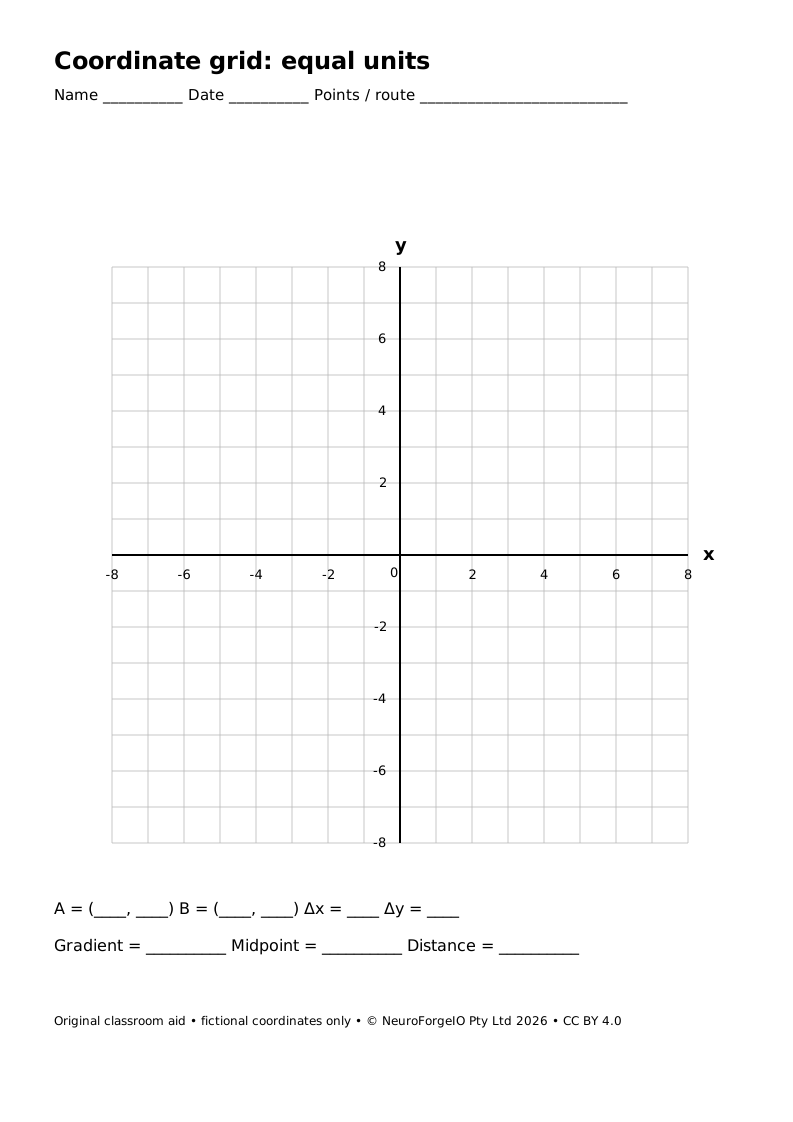
Day 1 — Two points, two signed changes
Goal/materials: recover ordered pairs and calculate horizontal/vertical change; grid, Card 1, two markers. This is a readiness check, not a speed test.
- Notice, 3: Mark A(-4,1) and B(2,4). Ask “Which coordinate tells us across?” Key: x. If x/y are swapped, trace axes labels before proceeding.
- Model, 5: Say “From A to B I move 6 right: 2−(-4)=6. I move 3 up: 4−1=3. These are changes, not the endpoint coordinates.” Mark a right-angle path on the grid.
- Together, 8: Plot Card 2 (1,4)→(5,0); calculate Δx=+4 and Δy=-4. Repeat with points reversed, getting Δx=-4 and Δy=+4. Discuss that a direction change reverses both signs.
- Try, 6: New fictional game route (-3,-2)→(2,1). Learner plots and states Δx, Δy in speech, text, tactile steps or AAC. Key: +5,+3. Teacher records coordinate/negative-number prerequisite separately.
- Check, 3: “From (4,-1) to (1,3), what changed?” Key: x=-3, y=+4. If learner subtracts in mixed order, write end minus start in two columns, then fresh recheck.
Day 2 — Gradient is rise divided by run
Goal/materials: form and interpret gradient when run is nonzero; grid and Cards 1–2.
- Notice, 3: Retrieve Card 1 Δy=3, Δx=6. Ask which describes vertical change per horizontal unit. Key: 3/6.
- Model, 5: “Gradient m=rise/run=3/6=1/2. On this paper grid, moving 2 right rises 1. The axes use equal grid units; I have not measured a real-world slope.” Draw one step triangle.
- Together, 8: Card 2 Δy=-4, Δx=4 ⇒ m=-1. Trace 1 right/1 down. Then reverse point order: (-Δy)/(-Δx)=-1; gradient stays the same for the same line.
- Try, 6: New theatre-map points (-2,0)→(4,3). Key: Δx=6, Δy=3, m=1/2. Learner labels rise/run; calculator can simplify fraction.
- Check, 3: “What is m from (0,5) to (3,-1)?” Key: -6/3=-2. If answer +2, attend to the downward change with a signed arrow, then recheck new points.
Day 3 — Zero and undefined gradients are different
Goal/materials: distinguish horizontal zero gradient from vertical undefined gradient; grid, Cards 3–4.
- Notice, 3: Ask what happens to y on Card 4 as x changes. Key: y remains -2.
- Model, 5: “Card 4 has Δy=0, Δx=8, so m=0/8=0. Card 3 has Δx=0, so a rise/run fraction would divide by zero; its gradient is undefined, not zero.” Use perpendicular paper strips.
- Together, 8: Sort (0,2)→(5,2), (3,-1)→(3,4), (-2,-2)→(2,2). Keys: zero, undefined, +1. Explain before applying a label.
- Try, 6: Learner creates one new horizontal and one new vertical pair inside grid limits, gives reasons and marks them. Accept: any distinct points sharing y or sharing x respectively.
- Check, 3: “Gradient from (-4,3) to (-4,-2)?” Key: undefined, because Δx=0. If called 0, contrast one horizontal and one vertical pair with explicit denominators.
Day 4 — The midpoint averages each coordinate
Goal/materials: locate halfway point even with negative coordinates; grid, Cards 5–6.
- Notice, 3: On a line, what is halfway between -6 and +4? Key: -1. Check equal distance 5 each way.
- Model, 5: Card 5 A(-6,2), B(4,8). “Average x values: (-6+4)/2=-1. Average y: (2+8)/2=5. Midpoint (-1,5).” Plot and check equal horizontal/vertical moves.
- Together, 8: Card 6 (-3,-4),(5,2) ⇒ M(1,-1). Swap point order to show midpoint invariant. Check x displacements 4/4, y 3/3.
- Try, 6: Fresh design segment (-5,-1)→(3,7). Key: M(-1,3). Learner may state/plot and justify equal displacement.
- Check, 3: “Midpoint of (1,5) and (7,-1)?” Key: (4,2). If coordinate pairs are cross-averaged, colour/tactile-code x with x and y with y, then try a new pair.
Day 5 — Straight-line distance is not a route length
Goal/materials: use Pythagoras for coordinate distance; grid, Cards 7–9, calculator/square table available.
- Notice, 3: On Card 7 (0,0)→(6,8), mark horizontal 6 and vertical 8. Ask whether their sum 14 is the straight shortcut. Key: no, 14 is the two-leg path.
- Model, 5: “The right triangle gives d²=6²+8²=36+64=100, so d=10 grid units.” Do not call this a travel time, accessible route or device measurement.
- Together, 8: Card 8 (-2,1)→(1,5): legs 3 and 4, d=5. Card 9 (1,-2)→(7,6): legs 6 and 8, d=10. Check the distance is positive and unchanged if point order swaps.
- Try, 6: Fresh park-plan sketch (-1,-1)→(2,3). Key: Δx=3, Δy=4, d=5 grid units. Learner shows squared legs or a right triangle.
- Check, 3: “Distance between (3,2) and (3,-5)?” Key: 7 units. If learner squares the vertical difference unnecessarily, show direct axis interval and compare the general formula. Assessment Items 1–4 may be collected across Days 4–6.
Day 6 — Choose the right relationship
Goal/materials: select gradient, midpoint or distance from a question; Cards 10–12, grid. Begin with a three-item prerequisite pulse before new model.
- Notice, 3: Point to axes; ask “Which question wants steepness, halfway, straight separation?” Keys: gradient, midpoint, distance. Record any category confusion.
- Model, 5: Card 11 (-6,-4)→(2,2). “For steepness Δy/Δx=6/8=3/4. For straight separation √(8²+6²)=10. Same points, different question and unit.”
- Together, 8: Card 10 (-5,3)→(-1,-3): m=-6/4=-3/2 and M(-3,0). Card 12 (-4,-6)→(4,0): M(0,-3), d=10. Ask why midpoint cannot answer distance.
- Try, 6: Fresh stage layout (-4,0)→(2,8): find midpoint and distance. Keys: (-1,4), √(6²+8²)=10. Mark mathematical prompts separately from graph access.
- Check, 3: “From (0,0) to (4,2), which number is the gradient and which point is the midpoint?” Keys: 1/2; (2,1). If measures conflated, attach units/point notation to the requested output.
Day 7 — A gradient becomes a rate in context
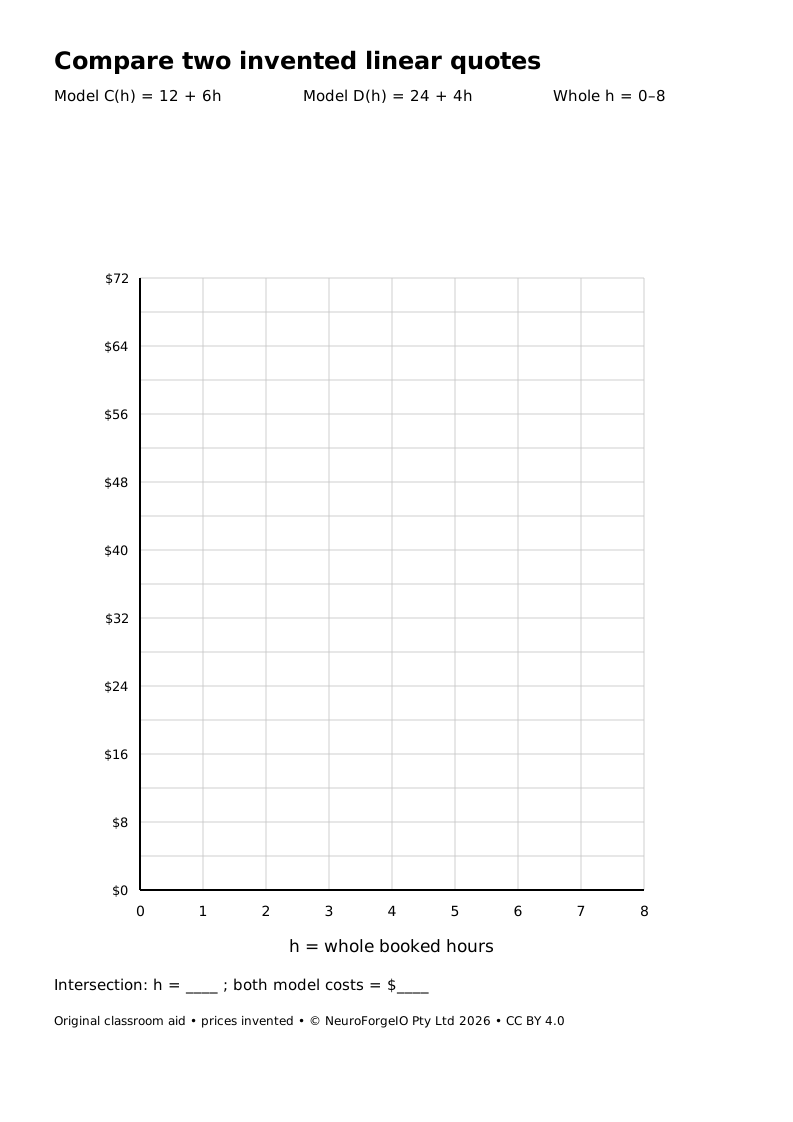
Goal/materials: derive C(h)=12+6h from two invented plot points; blank plot, graph-check card.
- Notice, 3: Show fictional print-studio points (0,12),(4,36) with h in whole booked hours and C in credits/dollars. Ask for vertical change. Key: 24 credits.
- Model, 5: “Rate m=24/4=6 credits per hour; at h=0, cost is 12. Model C(h)=12+6h for 0–8 whole hours. This is a stipulated quote, not a live offer.” Plot points (0,12),(4,36),(8,60).
- Together, 8: Groups derive D(h) from (0,24),(4,40): rate 4, fixed 24. Plot (0,24),(4,40),(8,56). Name what the intercept and gradient mean in this fictional model.
- Try, 6: New bike-locker simulation E(h) through (0,5),(3,20). Key: rate 5 credits/hour, fixed 5, E(h)=5+5h; E(4)=25. Learner states domain if teacher stipulates h=0–6 whole hours.
- Check, 3: “Does a graph point at h=2.5 belong to our print-studio booking rule?” Key: no, booking domain is whole hours; a mathematical line can be drawn between points but a half-hour quote is not provided. If overlooked, re-read domain card.
Day 8 — Compare two lines and a break-even point
Goal/materials: solve/interprete intersection and conditional advantage; C and D model card, plot and calculator.
- Notice, 3: Retrieve C(0)=12 and D(0)=24. Key: C lower at 0 whole hours under stated model.
- Model, 5: “Set 12+6h=24+4h. Subtract 4h and 12: 2h=12 ⇒ h=6. Both cost 48 at h=6.” Check by substituting both rules and matching graph intersection.
- Together, 8: At h=3, C=30, D=36; at h=8, C=60, D=56. Ask which is lower for each and why the steeper C line becomes higher after 6. Avoid ‘better for everyone’.
- Try, 6: Fresh training-room simulator F(h)=8+7h and G(h)=20+4h, h whole 0–7. Key: equal at h=4, both 36; at h=2, F22 vs G28, F lower. Learner checks algebra and context.
- Check, 3: “Which of C or D is lower at h=6?” Key: neither; equal at 48. If learner uses only starting charge, plot/compute h=6 and say ‘depends on h’.
Day 9 — A model has a domain and limits
Goal/materials: evaluate what a linear quote can and cannot justify; C/D card, optional graph and model-audit strip.
- Notice, 3: Ask whether C(10) is a supported price. Key: arithmetic gives 72, but stated domain ends at 8; the pack does not supply a real quote for 10.
- Model, 5: Teacher says “Within 0–8 whole hours, the rule compares stated charges. It omits availability, print quality, taxes and any extra fee. ‘D is always cheaper’ fails at h=3.” Show model → interpretation → check of assumption.
- Together, 8: Consider three claims: “C cheaper at 3” (supported); “D cheaper at 8” (supported); “D prints better quality” (unknown). Learners identify the exact number or missing evidence behind each.
- Try, 6: Fresh concert-prop hire H(t)=18+2t, J(t)=6+5t for t=0–6 whole days. Keys: equal when 18+2t=6+5t ⇒ t=4, cost 26; H lower at day 6 (30 vs 36); J lower at day 2 (16 vs 22). Learner names one omitted condition.
- Check, 3: “If a real supplier adds a delivery fee, what must we do?” Key: revise the cost model using sourced terms; we cannot assume the given graph still applies. If learner answers only ‘choose cheap line’, revisit assumption card.
Day 10 — Unseen transfer and next teaching
Goal/materials: independently choose coordinate tools and critique a new linear model; assessment, grid and plot. Keep assessment figures unseen until this day.
- Notice, 3: Retrieve
Δx, Δy → gradient,coordinate averages → midpoint,Pythagoras → distance, andfixed + rate × input → model. Show symbols, not assessment numbers. - Model, 5: Correct an unscored error: from (0,1) to (2,5), “gradient 4/2=2, not 4; the rise is 4 but the run is 2.” Also name grid units.
- Together, 8: Audit a new unscored line K(h)=9+3h: starting amount 9, rate 3 per hour, K(2)=15; compare its claim “always cheapest” with absent rival data. Use response routes before independent work.
- Try, 6: Learner begins unseen two-week assessment, Items 1–2 or an equivalent scheduled conference. Teacher may scribe only learner-directed steps and notes mathematical prompting separately.
- Check, 3: Ask “Which assumption would you verify before using a classroom model to spend real money?” Accept: real prices/domain/fees or availability; no fictitious quote can justify a purchase. Complete remaining assessment in a separate 10–12-minute check, then select next lesson from rubric, not a single score.
Shared teaching response
If a learner treats Δy as a gradient, show two lines with the same rise but different runs. If the denominator is zero, say “undefined” and trace the vertical line; never make it zero to fit the formula. If distance becomes |Δx|+|Δy|, name that as a two-leg path and contrast straight separation. If a learner produces algebra without context, require a unit, a domain and an assumption. If the concept is secure with a supported response route, remove only the mathematical prompt, not necessary access.
Rights: Original lessons © NeuroForgeIO Pty Ltd 2026, CC BY 4.0. ACARA source and separate rights in README. Educator/local review pending.