The adult reads every information paragraph and interview voice below. A child may respond to a rich idea without being expected to decode it. Learner cards carry only practice; Day 135/140 sources stay teacher-held until the check. All people, places and choices are invented.
Week 27 adult information source A · the display tray
On an invented maker table, Reni placed a smooth paper rectangle beside a ribbed fabric square. The paper rectangle was longer when their near ends met. Both pieces bent when Reni held one edge. A label under the paper said, “Smooth paper; longer in this pair.” A label under the fabric said, “Ribbed fabric; shorter in this pair.” Reni had not tested whether either piece would keep water out. The labels said what this pair showed, not what every paper or fabric piece is like.
Use: Ask which words the adult label adds to a picture of the tray; point out a picture might show relative length but cannot prove touch or waterproofing. “Longer” is bounded to the pair with ends aligned. If a child says the paper is “best” for a roof, mark it as an idea to test, not a seen fact. Do not generalise that all fabrics are ribbed.
Week 27 adult information source B · the paper tube
At a fictional book corner, Lio put a short broad paper tube next to a tall narrow paper tube. A photo-free drawing showed their shapes, but no weights. The captions read, “This one is broad,” and “This one is tall.” Lio asked whether the tall one was heavier. The drawing and captions did not answer that. An adult offered a checked balance to compare the actual tubes later.
Use: This is information about a pictured pair, not proof of mass. “Broad”/“tall” describe different attributes. The later balance is a proposed observation and cannot be reported as already done. Use a dry paper model; no child must bring an object from home.
Week 28 adult source C · a fictional, opt-in interview
Teacher as interviewer: “May I ask a question about these paper label shapes? You can pass.” Teacher as invented respondent Iva: “Yes. For this paper story board, I choose the wide stripe label. Its broad shape is easy for my paper visitor to find in this model.” Interviewer: “So you chose the wide stripe for this model because its shape is easy for your visitor to find. Have I kept your idea?” Iva: “Yes. Please do not say I chose it for every sign.”
Report accurately: Iva chose wide stripe for this model, for a reason she stated. She did not answer for a real person or every sign. A child may ask for repeat or point to a response card. Do not turn “easy for my paper visitor” into “all visitors find it easy.” Use both spoken question and a printed/pointed choice if useful.
Two other fictional response contexts
- Book corner: Invented respondent Sol says, “For this paper book marker, I choose the raised dot card because I can feel its edge.” Report the choice and reason exactly; do not infer Sol's disability or all readers' preferences.
- Maker display: Invented respondent Ari says, “For this model tray, I choose the big square label because I can point to it.” Report big square, not “red,” unless the source names that colour.
These give three domains: maker materials, information display/book marker and paper model labels. They do not claim results about a real class. To use an actual willing adult/peer, first obtain local consent and offer a pass, ask only a neutral object/display question, keep no names or voice/photo recording, and let the respondent correct the report. A fictional script is the complete default route.
Child print ledger and boundaries
Only offer a printed item for independent reading if each link was previously taught to that learner; otherwise adult reads and records oral response separately. Familiar CVC examples: cap, cup, map, mat, red, ten, sit, tap, tin, lid. see uses the earlier selected ee link. Known function words A/a, I, is, on, in, can are reviewed, not introduced here. The ten optional child lines are listed on the learner page. No adult paragraph above is child-decodable by claim, and no colour/texture fact is inferred from spelling alone. A child can compose richer labels via scribing; that is composition, not independent spelling proof.
Exact aid text and tactile equivalent
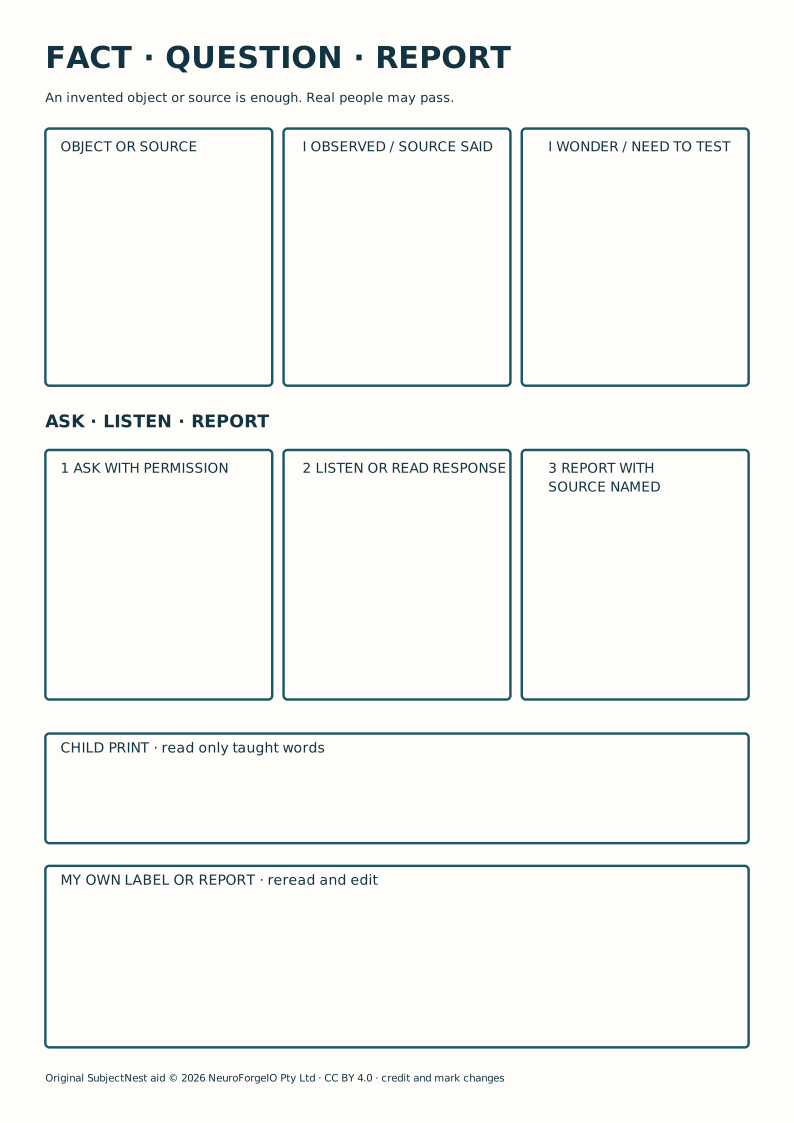
The original A4 portrait fact/question/report mat has three blank top boxes labelled OBJECT OR SOURCE, I OBSERVED / THE SOURCE SAID, and I WONDER / NEED TO TEST. Below are three blank steps labelled ASK WITH PERMISSION, LISTEN OR READ THE RESPONSE, and REPORT WITH THE SOURCE NAMED. Bottom strips read Child print: read only taught words and My own label or report; reread and edit. There is no answer, face, interview name, culture symbol or real location. For a nonvisual route use three large raised trays for fact vs wondering, then three numbered tactile cards for ask/listen/report; adult describes labels and moves pieces as directed. A child may use AAC/sign or direct a scribe. Colour is decorative; position and words carry meaning. Print A4 at actual size. Do not write a held-out check response on the mat before assessment.
Original prose and descriptions © 2026 NeuroForgeIO Pty Ltd, CC BY 4.0. Credit, link and indicate changes.