Adult reads complete original sources A–D. A child chooses one same-target route, including private point, sign, AAC, speech, broad cards, drawing or child-directed adult placement. Every lesson has 3 + 4 + 5 + 7 + 4 + 2 minutes. Save the first independent response before feedback. Adult-read comprehension is not independent decoding; child-selected print, actual listening and actual peer spoken delivery are logged separately. A paper model does not become a real class survey or observation. Keep Days 185/190 fresh checks and the key hidden until the first record.
Week 37 · Day 181 — Ask a question this source can answer
Goal: distinguish a count question supported by A from a purpose/preference question needing other evidence. Proposed codes: AC9EFLY05, AC9EFLA08, AC9EFLY02. Prepare: A and B, large QUESTION / SOURCE cards, Card 181.
- Oral/print · 3 min. Say “six circles” as two spoken words and let the child place one broad token per word. Show six only as adult print; a taught CVC may be used separately.
- Read · 4 min. Read A's adult note and B's four questions in order. Tell the child the tray exists on paper for this lesson.
- Model · 5 min. Put “How many triangle cards?” beside A's triangle row; count two. Put “Which shape is best?” beside NEEDS MORE: the question lacks a purpose, and counts alone cannot choose a best shape.
- Child try · 7 min. Child uses Card 181's library-label, toy-garden or paper-game context to ask one question A can answer and one it cannot, showing the matching row by chosen mode.
- Check · 4 min. Offer “Do all children like circles?” Child explains that card counts are not children's choices; do not conduct a child preference poll.
- Exit · 2 min. Child tells an adult one source detail that would answer their own count question.
Week 37 · Day 182 — Read one symbol as one paper card
Goal: interpret A's three labelled groups using its one-symbol-per-card rule and cite a count. Proposed codes: AC9EFLA07, AC9EFLY05, AC9EFLA08. Prepare: A, twelve broad tokens or spoken linear description, Card 182.
- Oral/print · 3 min. Say and segment spoken mat; optional child print mat only after its links have been taught. Keep this apart from rich labels.
- See/hear · 4 min. Show/read A's labels, six circle symbols, four square symbols and two triangle symbols; say one symbol represents one pretend card.
- Model · 5 min. Point to the circle label, touch/count six symbols one by one, and say “This row shows six circle cards.” Compare the numeral and symbol count; neither colour nor drawn area is the key.
- Child try · 7 min. Child chooses a paper map, pretend shop or game box route on Card 182; counts one other labelled row and cites its label and counted symbols with an accessible response.
- Check · 4 min. Adult deliberately counts a triangle twice. Child checks the one-symbol rule and repairs the count without guessing from row length.
- Exit · 2 min. Child names or selects what each printed symbol stands for; log numeral recognition separately from source understanding.
Week 37 · Day 183 — Say what counts can and cannot tell us
Goal: make a source-bounded comparison and reject a preference inference. Proposed codes: AC9EFLA05, AC9EFLY05, AC9EFLY01. Prepare: A, DATA SAYS / NOT SHOWN cards, Card 183.
- Oral/print · 3 min. Say “more cards” and segment its two spoken words; adult reads the category names.
- Read · 4 min. Reread A's three rows without the adult interpretation note; invite a child to request a reread.
- Model · 5 min. Put “More circle cards than triangle cards” under DATA SAYS and cite six versus two. Put “Children prefer circles” under NOT SHOWN: no child response appears in A.
- Child try · 7 min. From Card 183, child constructs a supported comparison, gives the two source counts and identifies one claim a paper inventory cannot settle.
- Check · 4 min. Offer “Triangles are the worst because there are two.” Child changes it to “The tray has two triangle cards,” keeping quantity separate from value.
- Exit · 2 min. Child says or selects “I know ___ because ___”; accept an adult scribe and keep the child's actual words.
Week 37 · Day 184 — Write a tiny answer with its clue
Goal: create and share-edit a question/source/answer report while stating an unknown. Proposed codes: AC9EFLY06, AC9EFLA09, AC9EFLY07. Prepare: A/B, blank data report mat, first/revised record, Card 184.
- Oral/print · 3 min. Blend a previously taught CVC if suitable; record child-chosen letters, not letters supplied by the adult.
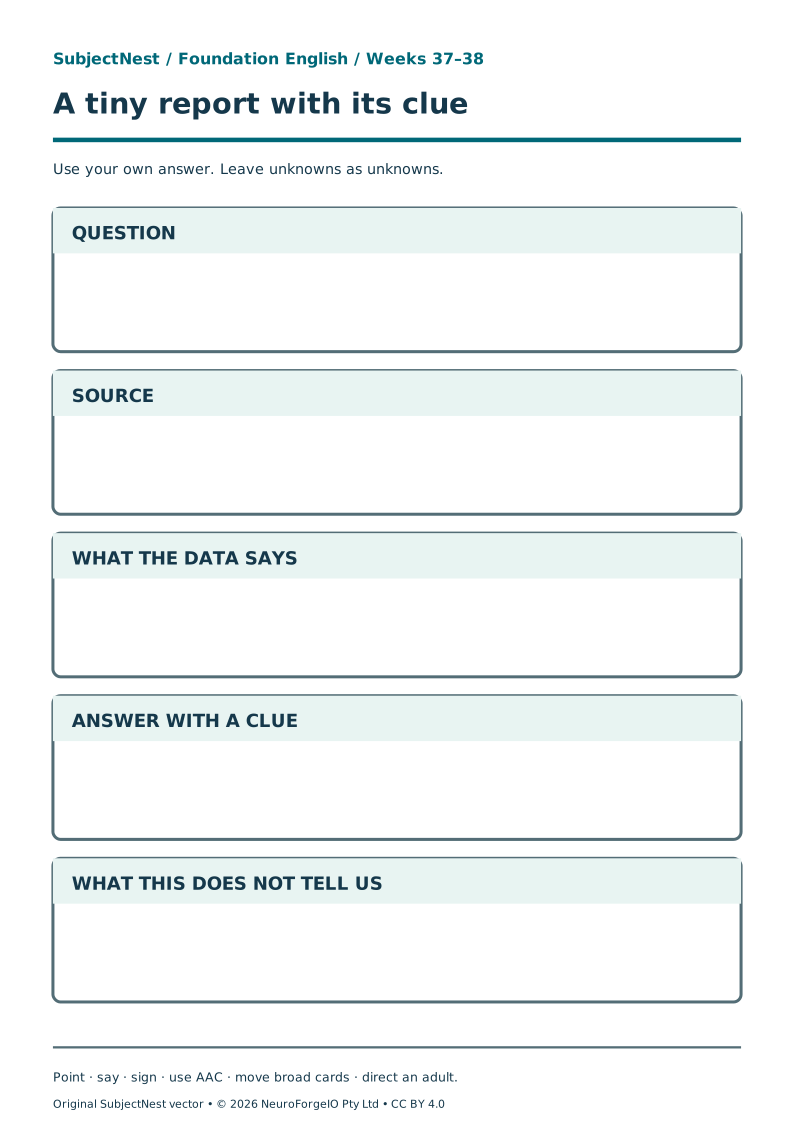
- Model · 4 min. Dictate “How many square cards? Four.” Point to first capital, question mark and full stop; say which row supports the answer.
- Guide · 5 min. Fill QUESTION / SOURCE / WHAT DATA SAYS / ANSWER WITH CLUE / UNKNOWN using B's triangle question. Model that adult-written rich vocabulary is an accommodation, not child spelling evidence.
- Create · 7 min. Child chooses a pretend library index, toy-garden paper label or game-box inventory route; dictates, signs, AAC-selects, draws or writes a new short report from A. Record source and first words exactly.
- Listener/edit · 4 min. Consenting listener repeats the meaning or adult models a listener and labels it MODEL. Child adds or repairs one clue word or says why none is needed. Save first/revised. Peer-spoken code only after actual peer speech.
- Exit · 2 min. Child names one answer A cannot give; Day 185 check source remains unseen.
Week 37 · Day 185 — Fresh question and source check
Goal: ask an answerable question, read counts from a new invented inventory and notice a claim needing different evidence. Proposed codes: AC9EFLA07, AC9EFLY05, AC9EFLY12. Prepare: teacher-held Day 185 check, broad neutral card/linear description; Card 185 only after the first record.
- Welcome · 3 min. Explain that a new pretend paper source will guide tomorrow's teaching, with any chosen private mode.
- Warm retrieval · 4 min. Ask one question about A's triangle row only; do not rehearse the fresh source, categories or number pattern.
- Unseen source · 5 min. Read/describe the fresh held table neutrally once, reread on request and log it; do not point to an answer.
- First independent response · 7 min. Child interprets the new labelled quantities, asks one answerable question and identifies one unsupported preference claim. Save first words, route and adult prompts before feedback.
- Optional print · 4 min. Only after taught-point check, offer held CVC in plain print, one blend then print-hidden sound-to-letter attempt. Otherwise mark NOT ADMINISTERED and use this time to document the child's source evidence or do familiar oral word play, not a second fresh check.
- Close · 2 min. Use separate key to select next practice. Release Card 185 only after the held response.
Week 38 · Day 186 — Is that shown or imagined?
Goal: distinguish visible features of two mock drawings from a real-growth story. Proposed codes: AC9EFLA07, AC9EFLY05, AC9EFLY01. Prepare: C/D, broad oval tokens or linear description, Card 186.
- Oral/print · 3 min. Say “two leaves” as two spoken words; explain that these are outlines in a drawing, not actual leaves.
- See/hear · 4 min. Show/read C's A and B drawings, including MOCK DRAWING and lack of dates. Child may ask for the count again.
- Model · 5 min. Count A's two and B's three oval leaf outlines. Place “B shows one more outline” under SHOWN; place D's first draft about a school plant growing under IMAGINED / NOT SHOWN.
- Child try · 7 min. Child uses Card 186's paper garden sign, picture-book note or art gallery caption route to give one source-supported detail and one detail C cannot prove.
- Check · 4 min. Offer “We felt soft leaves.” Child notes there is no touch or real plant in the source and edits to “We can see oval outlines in a mock drawing.”
- Exit · 2 min. Ask whether a mock drawing is an information source about its own marks; yes, while it is not real plant-growth evidence.
Week 38 · Day 187 — What would we need to observe?
Goal: ask a safe evidence question before claiming real growth, without pretending an investigation happened. Proposed codes: AC9EFLY05, AC9EFLA08, AC9EFLY02. Prepare: C/D and fact/check/edit mat, Card 187.
- Oral/print · 3 min. Orally segment see as one spoken word and its sounds only if the class has taught /ee/; do not require printed see.
- Read · 4 min. Read D's first draft. Ask what source would be needed for “our school plant” and “overnight”.
- Model · 5 min. Pose “Would a safe, dated observation of the same real plant on two occasions show a change we can describe?” Include school permission, a no-touch position and exact dates; observation can remain a future plan.
- Child try · 7 min. Child chooses a paper seed chart, library plant page or school-approved viewing-plan route and asks one answerable observation question, naming what must be recorded. A no-visit paper route is complete.
- Check · 4 min. Offer “The mock drawings show our plant needs water.” Child says C has no real plant, species or needs test, then identifies one record a real claim would require.
- Exit · 2 min. Teacher records “planned only” unless an actual safe observation later occurred; do not infer behaviour from appearance.
Week 38 · Day 188 — Compare drawings without inventing a sequence
Goal: compare C's counts precisely and leave time/order/growth unknown. Proposed codes: AC9EFLA06, AC9EFLA07, AC9EFLY05. Prepare: C, two/three broad oval tokens, Card 188.
- Oral/print · 3 min. Give one broad token for each spoken word in “one more outline”; adult reads outline.
- See/hear · 4 min. Present A and B in a neutral order; say their labels but no “before/after”.
- Model · 5 min. Say “Drawing B has three oval leaf outlines; A has two.” Compare three versus two. Explain that labels A/B name drawings but do not date one plant.
- Child try · 7 min. Child chooses a museum sketch, paper window display or fictional botany notebook route to make a precise two-drawing sentence and an unknown sentence.
- Check · 4 min. Offer “B came after A, so the plant grew.” Child removes the sequence claim; ask what dates and same-plant identity would be needed for an actual change report.
- Exit · 2 min. Child selects the phrase “drawing shows” or “we observed” for C and explains why.
Week 38 · Day 189 — Edit an overclaim into a factual caption
Goal: share-edit a first/revised information sentence so source, detail and uncertainty agree. Proposed codes: AC9EFLA05, AC9EFLA09, AC9EFLY06, AC9EFLY13. Prepare: C/D, blank fact/check/edit mat, first/revised record, Card 189.
- Oral/print · 3 min. Offer an already taught CVC, or spoken phonemes without print. Record actual child-selected letters separately from adult scribing.
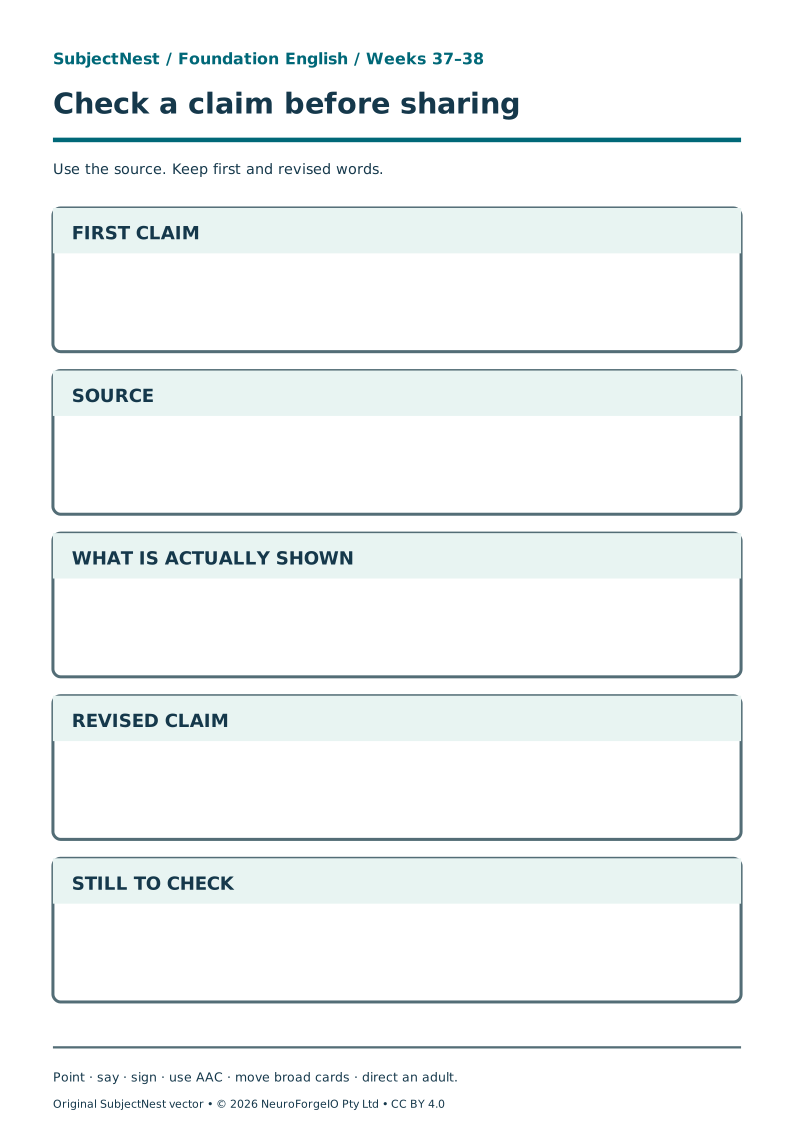
- Model · 4 min. Write D's first draft, cross out “Our school plant” and “overnight”, then write “Drawing B shows three oval leaf outlines.” Identify capital D and full stop; C is the source.
- Guide · 5 min. Fill FIRST CLAIM / SOURCE / ACTUALLY SHOWN / REVISED CLAIM / STILL TO CHECK; leave real growth to check, not declared.
- Create · 7 min. Child chooses a paper garden caption, library display or invented science-picture label; dictates, signs, AAC-selects, draws or writes a first and revised claim. Adult preserves their first words.
- Listener/edit · 4 min. Consenting listener points out a missing source/detail, or teacher models and labels MODEL. Child revises or explains a sufficient sentence. Log actual spoken peer delivery only if it occurred.
- Exit · 2 min. Child gives one real-world question that would need a separate school-approved observation; Day 190 case stays hidden.
Week 38 · Day 190 — Fresh fact-check and revision
Goal: read an unseen pair of mock diagrams, reject an invented motion/time claim and write a source-bounded revision. Proposed codes: AC9EFLA07, AC9EFLY05, AC9EFLY06, AC9EFLY12. Prepare: teacher-held Day 190 check, neutral diagrams/linear description, blank edit mat; Card 190 only afterwards.
- Welcome · 3 min. Explain a new paper picture pair will help plan later teaching; private point, AAC, sign, speech or dictation are options.
- Warm retrieval · 4 min. Use C's A/B leaf-outline difference only; never preview the held object, position or overclaim.
- Unseen source · 5 min. Read the two fresh mock diagrams and first claim exactly and neutrally, with a reread on request.
- First independent response · 7 min. Child names what each diagram actually shows, identifies an unsupported motion/time claim and makes a revised caption with source or uncertainty. Save exact first response/prompt/mode.
- Optional print · 4 min. Held-out CVC blend and print-hidden sound-to-letter selection only after taught-point review. Otherwise mark NOT ADMINISTERED and use this time to record evidence or revisit familiar oral sounds, not the held diagram.
- Close · 2 min. Use the separate key for next step; release Card 190's different practice after the first record.
Boundary: These tasks practise English question, image/text meaning and source-bounded reporting. Correct counts do not establish a full mathematics standard; a drawn plant does not establish scientific observation; no local species/cultural knowledge is asserted. Original SubjectNest scripts © 2026 NeuroForgeIO Pty Ltd, CC BY 4.0.