Each 25-minute session has notice 3 + model 5 + guided build 8 + independent choice 6 + exit 3 minutes. The three original cards for each day offer different domains of life; choose one in class and reserve another for later transfer. A learner can build, draw, select, speak, sign, use AAC, or direct an adult to move pieces. Keep the model and comparison target visible. Record concept prompts separately from access support. These are mathematics lessons, not speed tests.
Day 11 — Five tens and some more
Goal: represent 51–55 as five verified tens and ones, name the numeral and locate it after 50. Prepare: five ten-strips, five ones, labelled mat, chart, Day 11 cards.
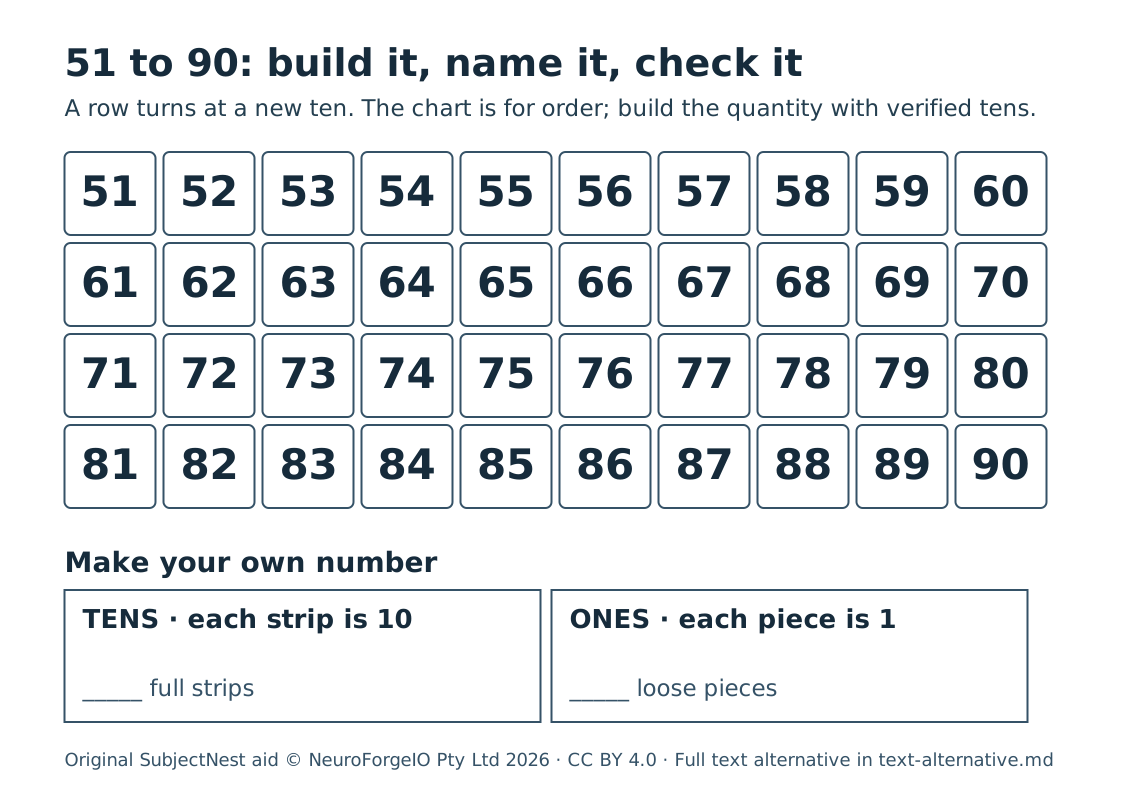
- Notice, 3: Rebuild 50 from Week 2. Add one counter. Ask what changes and what stays the same. Check that each strip really contains ten.
- Model, 5: Build 51. Say, point or display “five tens make fifty; one more makes fifty-one.” Show 50 + 1 and numeral 51, then point to the next chart cell. Contrast 15 with a one-ten/five-ones model.
- Guided, 8: Give A (library: 5 trays of ten book cards and 2 loose) and B (garden: 5 drawn rows of ten seed icons and 4 loose). Pairs model each, say/select the tens and ones, then place 52 and 54 on the chart. Ask whether the library or garden drawing has more icons and why; these are drawn symbols, not real resources to count.
- Independent, 6: Use C (game: 5 packs of ten tokens and 5 loose). Learner chooses counters, marks or digit cards to represent and name 55, then changes it to 53 by removing two loose ones. Give the chart only after the tens/ones claim.
- Exit, 3: Show five tens and three ones; ask for numeral and number one more. Key: 53, 54. If 503 appears, align digit cards above the tens/ones columns and contrast with 5 tens + 0 ones.
Day 12 — The exchange into sixty
Goal: keep the total when 10 loose ones exchange for another ten. Prepare: five verified strips, ten ones, sixth strip, Day 12 cards.
- Notice, 3: Build 58 as five tens and eight ones. Add one; ask what numeral comes next. Key: 59.
- Model, 5: Add a tenth loose one to 59, touch-count the ten loose objects, then replace them with one full ten-strip without changing the total. Show 5 tens + 10 ones = 6 tens + 0 ones = 60. Do not call the zero “no quantity”; it means no loose ones.
- Guided, 8: Learners use A (sports club: five drawn strips of ten tickets and eight loose) and B (maker bench: five racks of ten bolt symbols and nine loose). Move one from A to B's quantity, then one more to 60. Verify 58 < 59 < 60 with quantities and chart order.
- Independent, 6: Use C (music editor: six bars of ten beat marks). Learner shows 60 in two equivalent forms, such as six strips or five strips plus ten loose. Ask what immediately precedes 60.
- Exit, 3: Show five tens and ten ones. Ask for a single numeral and an equivalent exchanged model. Key: 60 and six tens/zero ones. If “510” appears, physically audit and trade the ten ones; recheck with 29 + 1 before moving ahead.
Day 13 — Six tens and some more
Goal: represent 61–65, then compare numbers with equal tens. Prepare: six strips, five ones, mat, Day 13 cards.
- Notice, 3: Start with 60 and add one. Ask for the numeral. Key: 61.
- Model, 5: Build 63; point to six tens, three ones and the digit positions. Say/show 60 + 3 = 63. Write 63 and 36, then build one to show why reversal changes the amount.
- Guided, 8: A (art room: six sheets of ten drawn shapes plus two) and B (library display: six rows of ten title cards plus four) are modelled as 62 and 64. Pair the six tens before comparing two versus four ones. Place both on the chart.
- Independent, 6: C (robotics game: six stacks of ten blocks plus five) becomes a chosen model of 65. Learner makes a second model by trading one ten for ten ones: five tens and fifteen ones. Treat the trade as extension; a correct six-tens model meets today's core goal.
- Exit, 3: Show six tens plus one one and six tens plus four ones. Ask which is greater and what each numeral is. Key: 64 > 61. If a child chooses 61 because of its spoken first word, align the equal tens and compare only loose ones.
Day 14 — Sixty-nine, then seventy
Goal: count and exchange through 70 without losing or inventing objects. Prepare: six strips, ten ones, seventh strip, Day 14 cards.
- Notice, 3: On the chart find 67, 68, 69. Ask what would come next and how a model must change.
- Model, 5: Build 69, add one, exchange ten ones for the seventh strip. Display 69 + 1 = 70 and 7 tens + 0 ones. Audit before/after by counting tens as 10, 20…70.
- Guided, 8: A (postcard exhibition: six rows of ten cards plus seven) and B (trail model: six groups of ten stepping marks plus nine) are 67 and 69. Learners count on from 67 to 70 with three single moves; after each move, name the full total, not just the ones.
- Independent, 6: C (garden design: seven printed strips of ten leaf icons) shows 70. Learner makes an equivalent unexchanged form of six strips plus ten icons and explains why both are 70. Offer large marks or tactile strips.
- Exit, 3: Ask for one more than 69 and one less than 70, with a model. Key: 70 and 69. If the answer is 610, trade ten ones and ask for the number of full tens.
Day 15 — Week 3: order, explain, recheck
Goal: order 51–70 and show both quantity and numeral, using a fresh example. Prepare: Day 15 A/B/C cards, chart, learner Check 1 kept face down until the independent step.
- Notice, 3: Contrast 59 and 61. Ask what happens at the decade boundary; do not rely on the spoken rhyme of “sixty.”
- Model, 5: Build 53 and 63, pair five tens, then notice 63 has one more full ten even though both end in 3. Model an explanation in objects, numerals and words.
- Guided, 8: Use the A/B/C cards (museum 53, classroom plan 61, festival poster 68). Learners build or sketch then order 53, 61, 68. Ask a different child to challenge one adjacency with a chart cell and a model.
- Independent, 6: Give the fresh Check 1 sheet. Read it exactly once or provide the accessible text; do not display the teacher key. Accept a chart for locating, but note whether the tens/ones representation was independent.
- Exit, 3: Collect a representation and one reason for 68 > 61. Key: same six tens, seven more ones. Choose Monday's entry activity from the individual check pattern; a learner needing the exchange at 60 should see it concretely before 71.
Day 16 — Seven tens and some more
Goal: represent 71–75 and compare with the 60s. Prepare: seven strips, five ones, Day 16 cards.
- Notice, 3: Rebuild 70, then place 69 beside it. Ask which has more full tens and which has more loose ones. Compare the total, not the ones digit.
- Model, 5: Build 71 from seven tens and one one; 70 + 1 = 71. Mark 71 on the chart and describe its neighbours 70 and 72.
- Guided, 8: A (bike workshop: seven racks of ten drawn wheel spokes plus two) and B (library shelf plan: seven rows of ten book icons plus four) produce 72 and 74. Learners make both, read the numerals, and explain why 74 is greater.
- Independent, 6: C (craft design: seven packets of ten paper squares plus five) is 75. Learner changes the model to 73 and names the removed amount. Key: remove two ones. Provide digit cards if numeral writing distracts from place value.
- Exit, 3: Display seven tens and three ones. Ask for numeral and a number between 70 and 73. Key: 73; 71 or 72. Rebuild 37 beside 73 if digits reverse.
Day 17 — The exchange into eighty
Goal: maintain quantity across 79 + 1 = 80. Prepare: seven strips, ten ones, eighth strip, Day 17 cards.
- Notice, 3: Give 78 in a concrete model and ask how many more to reach the next full ten. Key: two ones.
- Model, 5: Starting at 79, add one, verify ten ones, exchange to eight full strips. Point to 80 on the chart and write 7 tens + 10 ones = 8 tens + 0 ones.
- Guided, 8: A (theatre seat diagram: seven rows of ten plus seven) and B (drawing archive: seven sleeves of ten plus nine) show 77 and 79. Ask children to model 77→78→79→80 and physically trade at the final move.
- Independent, 6: C (community hall floor-plan drawing: eight blocks of ten place marks) shows 80. Learner makes an equivalent form of seven tens and ten ones and tells a partner, an adult, or a recording sheet what stayed equal.
- Exit, 3: Ask “What is one more than 79? What is one less than 80?” Key: 80; 79. If 710 appears, ask whether 7 and 10 name separate places or pieces to exchange.
Day 18 — Eight tens and some more
Goal: represent 81–85 and order by ones when tens match. Prepare: eight strips, five ones, Day 18 cards.
- Notice, 3: Place 80, 81 and 82 on the chart. Ask what changes by one each time.
- Model, 5: Build 83 as eight tens + three ones; display 80 + 3. Contrast 83 with 38 by modelling 38 using only three strips and eight ones.
- Guided, 8: A (soundboard drawing: eight rows of ten beat boxes plus two) and B (science-fair label design: eight groups of ten blank label icons plus four) are 82 and 84. Count and pair full tens, then compare two and four loose marks.
- Independent, 6: C (market sign illustration: eight groups of ten fruit symbols plus five) is 85. Learner makes 85, then identifies a number greater than 82 and less than 85 from 83 or 84, justifying with ones.
- Exit, 3: Show eight tens and one one. Ask for the numeral and another numeral with the same tens and more ones. Key: 81 and any 82–89 (85 if using only prepared pieces). Recheck one concrete pair if answer relies on visual size of written digits.
Day 19 — Eighty-nine, then ninety
Goal: exchange 89 + 1 and compare totals to 90. Prepare: eight strips, ten ones, ninth strip, Day 19 cards.
- Notice, 3: Ask how 88 differs from 80: same eight tens, eight extra ones. Predict the next two numerals.
- Model, 5: Add one to 89, count ten loose pieces, exchange to the ninth strip. Name 90 as nine tens and zero ones. Check that the amount is the same before and after exchange.
- Guided, 8: A (game-map design: eight lines of ten path dots plus seven) and B (poster collection drawing: eight bundles of ten blank posters plus nine) show 87 and 89. Learners move 87→88→89→90; trade at the end and locate all four on the chart.
- Independent, 6: C (music program graphic: nine rows of ten beat marks) shows 90. Show 90 as nine strips and as eight strips plus ten singles; explain the equivalence without recounting all 90 marks.
- Exit, 3: Ask what numeral eight tens and ten ones become after exchange. Key: 90. If 810 or 18 appears, revisit a familiar 29+1 exchange, then repeat with 89+1.
Day 20 — New contexts, next teaching
Goal: transfer tens/ones, order and decade exchange across 51–90 and choose the next lesson from evidence. Prepare: Day 20 A/B/C cards, fresh Check 2, accessible chart and manipulatives.
- Notice, 3: Present the three invented Day 20 contexts with no numeral labels. Ask which might have a full eight tens; let children justify from structure.
- Model, 5: Use an unrelated example, 64 as six tens and four ones. Show it on the chart and explain why 46 is different; leave the three task-card totals to learners.
- Guided, 8: Learners choose two of A/B/C (game 56, reading-room diagram 78, animal-icon display 86), build and name both, then explain which is greater. Encourage one learner to challenge another with a model or chart position.
- Independent, 6: Give fresh Check 2 without its teacher key. Allow a new context choice or a tactile model. Record accuracy, prompts and representation separately.
- Exit, 3: Ask for the next full ten after 86 and how many more ones are needed. Key: 90, four ones. Use the check pattern to plan Week 5's move toward at least 120; do not treat success to 90 as completion of
AC9M1N01.
Reuse: Original lesson scripts © NeuroForgeIO Pty Ltd 2026, CC BY 4.0. Exact national alignment and review limits are in README.