Five 35-minute Economics and Business, mathematics and English sessions. Partial Year 10 ACARA v9 links: AC9HE10K03, AC9HE10S01, AC9HE10S02, AC9HE10S03, AC9HE10S04, AC9HE10S05; mathematics AC9M10A02, AC9M10A04; English AC9E10LA02, AC9E10LY06. The adult household device-hire brief and all figures are invented. This is consumer-decision reasoning, not financial advice, a real offer, or complete coverage of rights or Year 10 economics. ACARA notes that Years 9–10 Economics and Business access is decided by school authorities or schools; teach this block only after local selection is confirmed. No student is asked for family income, debt, credit, access needs or purchasing plans.
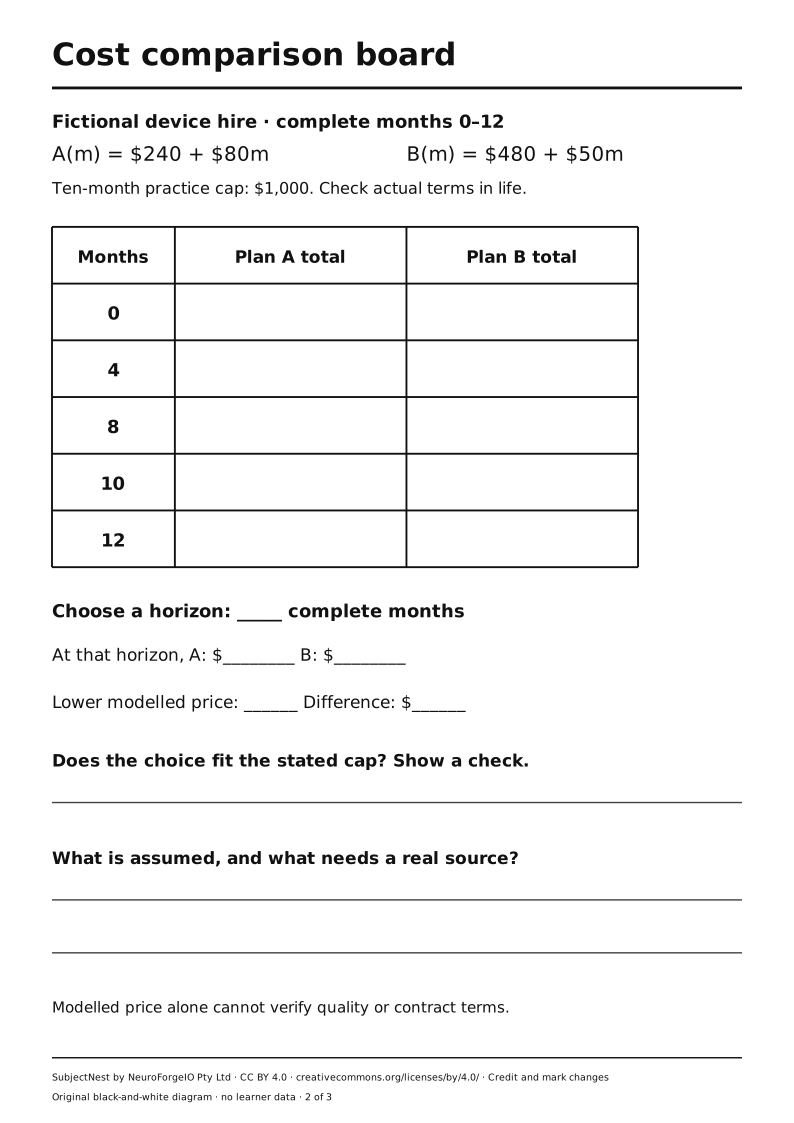
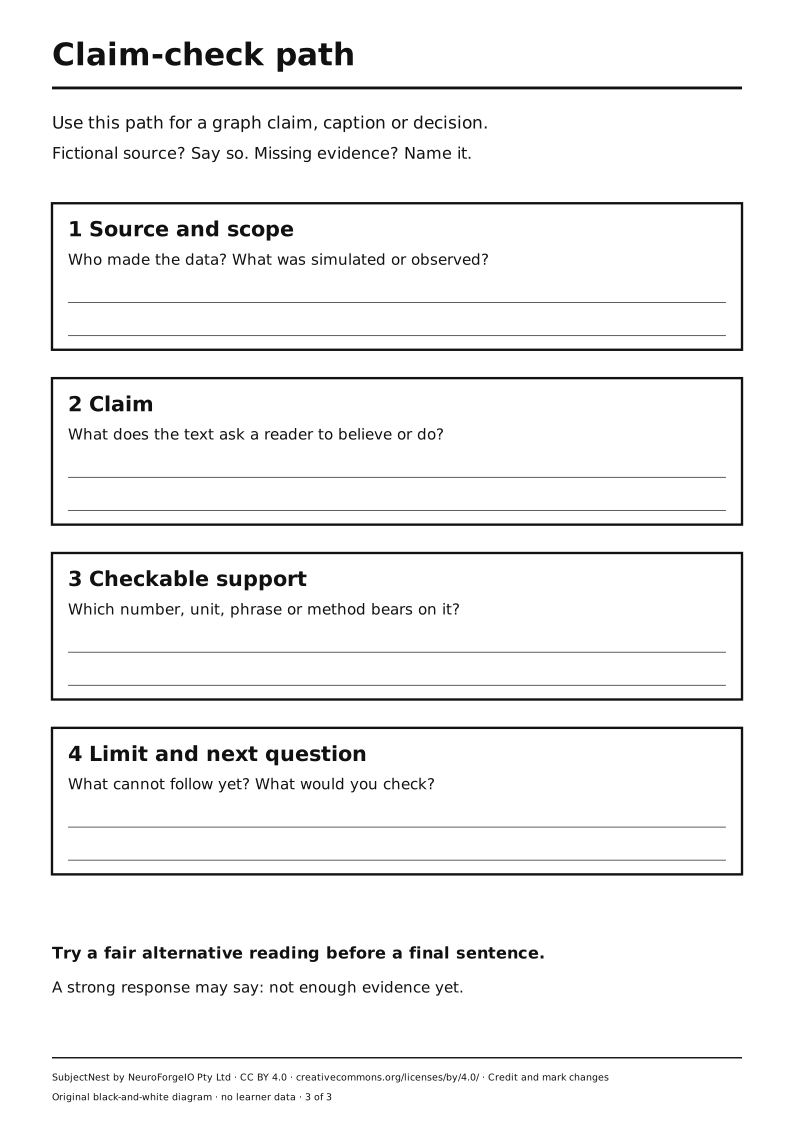
Prepare: two cost models, cost comparison board, claim-check aid, pencil and optional counters. Both fictional plans are assumed to meet minimum access, safety and service conditions only for the exercise; in life those claims and full contract terms must be verified with current authoritative sources and appropriate adult support. No real purchase or student survey follows from this sequence. Plain-text and tactile alternatives are provided.
Day 1 — Name what the decision has to satisfy
Question: Which factors matter besides a single advertised payment? Evidence: criteria list with distinction between given facts and assumptions.
- Invite · 3 min. Say: “An adult fictional household needs a device for study and creative work. We will inspect a model, not anyone's own finances.”
- Read · 5 min. Read both plan rules and the $1,000 ten-month practice cap. Ask which payments happen once and which recur.
- Model · 8 min. Make columns: given invented price rule, assumed minimum, unknown real condition. Place $240/$480 setup in the first, access/safety/service equivalence in the second, actual contract/repair support in the third.
- Set criteria · 10 min. Pairs propose at least three criteria: total at a chosen horizon, ability to pay upfront, verified service/access and exit conditions. Each learner ranks criteria for the fictional decision-maker and explains the ranking; different priorities are possible.
- Source question · 6 min. Ask which factor our sheet actually answers. It calculates modelled price; it does not document real terms or outcomes. Keep “assumed” visible.
- Exit · 3 min. Everyone writes one given fact, one assumption and one question to investigate.
Access: three textured or labelled columns, large print, oral/AAC ranking. Learners may decline to explain personal reasons for their fictional ranking.
Day 2 — Follow the cost through time
Question: Why can two good-faith notes disagree on “cheaper”? Evidence: four- and ten-month comparison with units.
- Retrieve · 3 min. Ask: “What does a horizon mean here?” It is the number of complete months in the comparison.
- Model · 5 min. At four months A=$560, B=$680; A is $120 lower. Separate setup from recurrent total.
- Calculate · 8 min. At ten months A=$1,040, B=$980; B is $60 lower and alone fits the invented $1,000 cap. Check by substitution.
- Compare texts · 10 min. Read D and E. Pairs match each conclusion to its horizon and identify a qualification the author supplies. No one may quote “A is cheaper” or “B is cheaper” without the month count.
- Connect · 6 min. Place equality at month 8, $880, on the board. Ask whether equal price means equal performance. No; performance is assumed/unknown.
- Exit · 3 min. Everyone completes “At __ months, plan __ has lower modelled cost by $; this comparison omits .”
Access: month-value table or tactile lines; calculator after set-up if needed, with equation explanation retained.
Day 3 — Ask a question that could change the choice
Question: What evidence would a responsible decision-maker need next? Evidence: ranked source-check questions with purpose.
- Prompt · 3 min. “Imagine the plan sheet is an advert. What is absent that a reader would need before signing?”
- Model · 5 min. Turn “Is B good?” into “What do the full written terms say about repair support and exit costs during months 1–10?” Explain why a current, attributable primary contract source would matter.
- Question workshop · 8 min. Students write two investigable questions: one about cost/terms, one about access/service. State what answer might reverse a price-only preference.
- Compare source roles · 10 min. Give the three learner source cards: a limited provider summary, an unattributed comment and a limited tryout note. Learners rank usefulness for a specific question, name possible interests/limits and avoid treating any card as verified evidence. The teacher source notes give the scope key.
- Ethical check · 6 min. Ask whether gathering classmates' household finances would help. No, it is unnecessary personal data for this fictional exercise. Keep the question to documents and adult review.
- Exit · 3 min. Everyone submits a question, intended source and why it could change the recommendation.
Access: source labels in text and read aloud; AAC choice with reason; no internet required or real account creation.
Day 4 — Use criteria, not a slogan
Question: Can a proposed response be evaluated against the stated constraints? Evidence: decision board with cost, benefit, risk and unknown.
- Set case · 3 min. “The fictional adult expects ten complete months. The $1,000 cap remains. What does the price model permit?”
- Model · 5 min. B's $980 is within cap by $20; A's $1,040 exceeds cap by $40. This is a model conclusion, conditional on the invented rules.
- Board · 8 min. Students fill cost board: horizon, both totals, cap, comparison, missing conditions. Then add upfront cost as a separate criterion.
- Evaluate · 10 min. In pairs, test two responses: “choose B now” and “provisionally prefer B on price, verify terms/access first.” Identify benefits, costs and uncertainty for each. A learner may prefer no commitment pending evidence.
- Challenge · 6 min. Change expected duration to four months. A becomes price-only lower; ask which sentence in yesterday's conclusion must change. Do not silently change the original case.
- Exit · 3 min. Everyone writes a provisional conclusion and a specific condition that would prompt reconsideration.
Access: numbers as aligned text, counters, large board or dictated response. No public disclosure of actual needs.
Day 5 — Present a conditional recommendation
Question: Can a learner justify a decision while showing what remains unverified? Evidence: individual response and answer to a fair question.
- Frame · 3 min. “You are advising only the fictional case. No actual contract is recommended.”
- Rehearse · 5 min. Learners prepare a 45-second spoken statement, private written paragraph, AAC sequence or equivalent. Include horizon, computed price, criterion and next source check.
- Share · 8 min. In small groups, each learner gives their response. A peer asks one evidence question. Teacher observes 2–3 focus learners; arrange later checks for the rest.
- Revise · 10 min. Learner answers, changes wording or defers the decision, then writes one revision explaining why. Use the claim-check aid.
- Independent check · 6 min. Give the learner Week 2 check. All respond without peer assistance; collect before feedback.
- Close · 3 min. Name the difference between a conditional calculation and a real consumer recommendation. Store no identifiable work outside school policy.
Key prompt: “The invented household expects 10 complete months under $1,000. What can the price model show, and what must be verified before any real choice?” Secure: B(10)=$980 fits by $20; A(10)=$1,040 exceeds by $40; B is lower by $60. These findings assume the invented fees, no exit charge and equal minimum service; full current terms/access/repair support and the person's needs remain unverified. A learner may say defer, provided they state the model result and why missing evidence matters. If they compare four months to ten, return to a common horizon. If they assert real rights or a vendor fact from the fictional sheet, ask for a current authoritative source.
Later independent recheck: New invented X/Y model from maths, ten months, $1,000 cap. X=$1,080 and Y=$1,020; neither fits, despite Y being lower. A sound response may reconsider duration or seek an actually verified alternative, without claiming one exists. Ask which contract/service information would be required; do not direct a purchase.
Teacher record: day | local learner code | exact cost/source/criterion evidence | independent/prompted/not yet observed | access support | next move | later recheck. Keep under school policy; SubjectNest collects no child data.