Teacher copy: includes worked answers. Distribute the learner cards for practice and the separate Day 5 and Day 10 cards at their scheduled fresh checks.
Teaching assumptions only: This is an invented Lantern Yard festival and Paper Loop supplier. The numbers are chosen for learning, not actual Australian pay, tax, benefits, contracts or product prices. No real spending decision should use them. All costs and hours are before unlisted deductions/fees; treat missing information as unknown, not zero. The rate table, budget map and text equivalents repeat these data.
Card 1 — stipulated shift rates
| Model item | Stipulated condition | Computation | Model amount |
|---|---|---|---|
| Base paid hour | $24 per hour | Given | $24.00 |
| Saturday paid hour | 1.25 × base | 1.25 × $24 | $30.00 |
| Extra hour under one hypothetical contract | 1.50 × base, after seven base hours on this one shift | 1.50 × $24 | $36.00 |
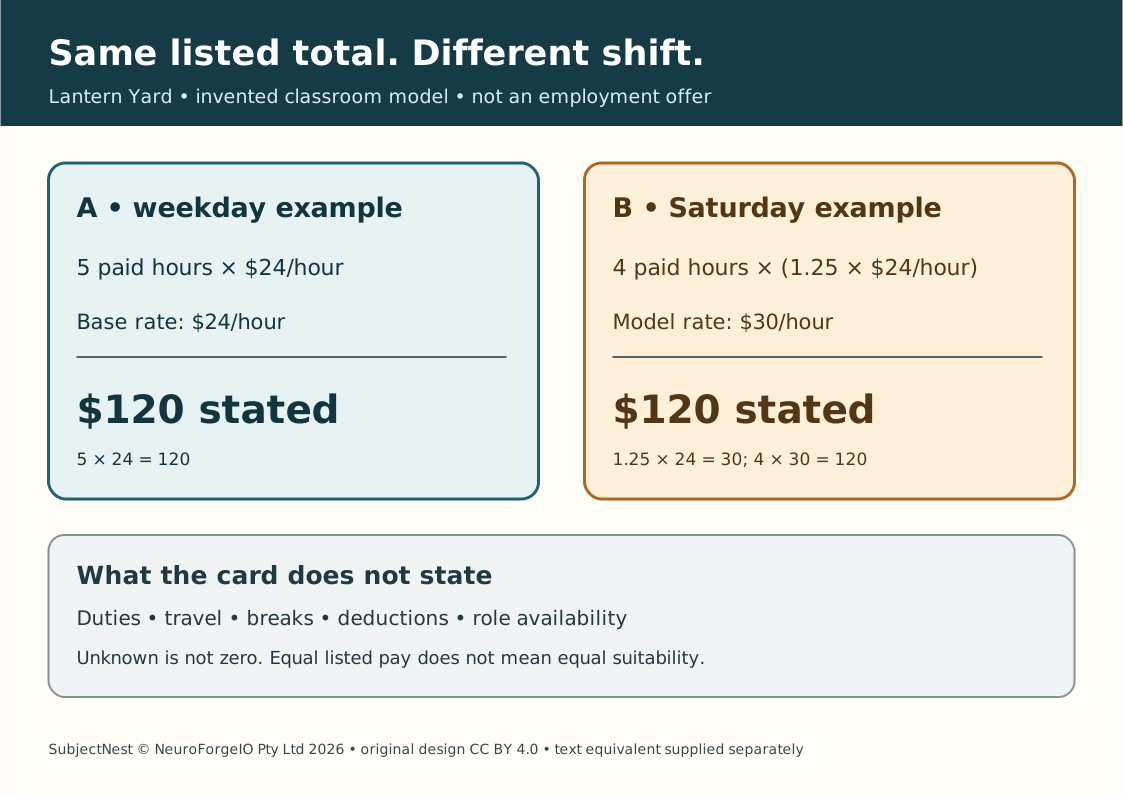
| Weekday shift A | 5 paid base hours | 5 × $24 | $120.00 |
| Saturday shift B | 4 paid Saturday hours | 4 × $30 | $120.00 |
| Extended shift C | 7 base hours + 2 extra hours under the fictional rule | 7 × $24 + 2 × $36 | $240.00 |
The extra-hour multiplier is a made-up contract condition, not a statement about an award or legal entitlement. If a question says a break or allowance is not specified, leave it unknown. For an alternate what-if only, suppose a flat $15 transport allowance is added to shift A: stated total then becomes $135. Do not silently add it to other shifts.
Card 2 — Paper Loop whole packs
| Pack | Fictional whole-pack price | Sheets | Exact unit price |
|---|---|---|---|
| Small | $18.40 | 8 | $2.30/sheet |
| Large | $27.00 | 12 | $2.25/sheet |
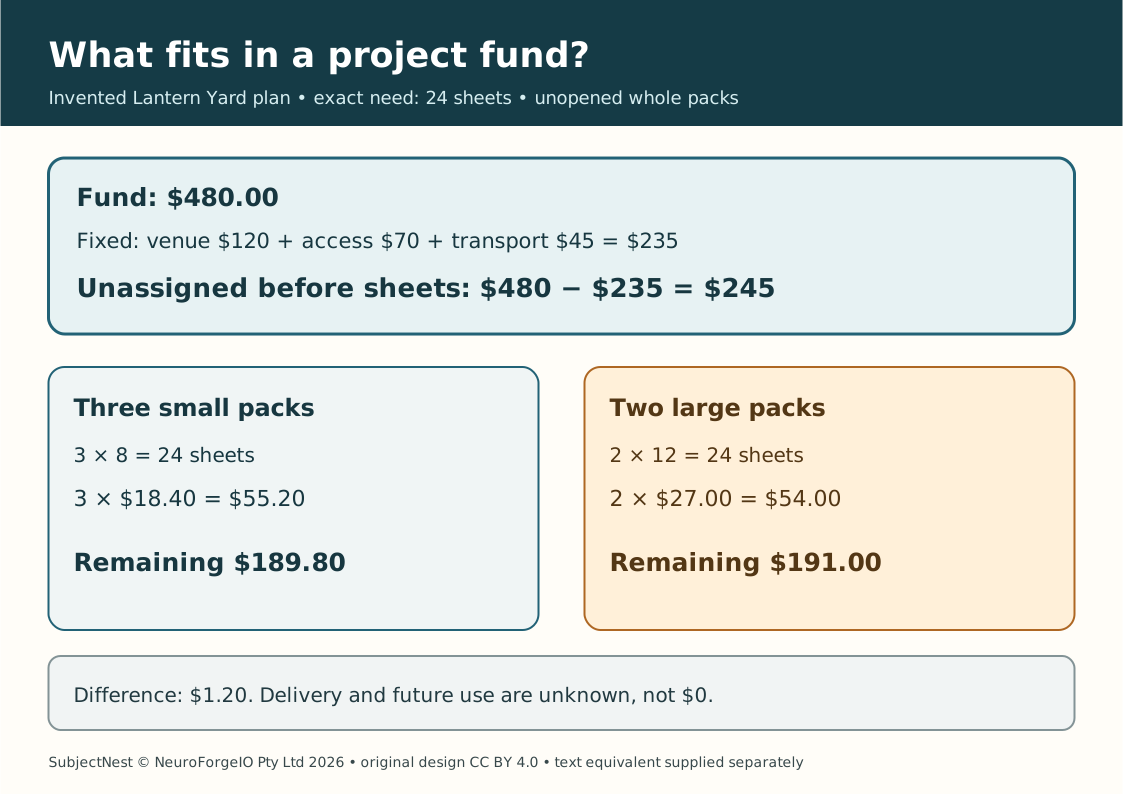
No split packs, no returns of unused sheets. At a need for eight sheets, the small pack costs $18.40 and one large costs $27.00; small wins on total outlay by $8.60 even though large has lower unit price. At twenty-four, three small packs cost $55.20 and two large cost $54.00; large wins by $1.20 before unknown delivery. If the large pack price alone rises 10%, its new price is $29.70 and two cost $59.40, so three small packs at $55.20 cost $4.20 less. Compare whole-pack feasibility before dividing.
Card 3 — a made-up project budget
The imaginary project has a $480 planning fund. Fixed planned amounts are venue $120, access equipment $70 and transport $45: $235 in all. The unassigned balance is $245. The team is considering two large packs for twenty-four sheets ($54), leaving $191 unassigned. In this teaching card the fund and costs are fixed numbers; a real project would need supplier quotes, contingency and approvals. Do not ask learners for their family's budget.
Card 4 — percentage snapshots
- An invented $80 equipment item at 15% off: discount $12, new stated price $68.
- An invented $50 design fee increasing 8%: change $4, new stated fee $54.
- An invented $45 sign at 20% off: discount $9, new stated price $36.
- Change direction matters: a 10% rise on $27 is $29.70; undoing it requires more than a 10% reduction of the new amount. The exact reduction is $2.70 ÷ $29.70 ≈ 9.09%.
Spreadsheet option
Put the numeric base rate 24 in B1, multiplier 1.25 in B2, weekday hours 5 in B3, Saturday hours 4 in B4. Use =B1*B3 and =B1*B2*B4. Confirm both show 120; change B4 to 6 and check the Saturday model becomes 180. Record the formula, not just the displayed answer, and explain which assumption changed. If no spreadsheet is available, use a four-row table and calculator. Never upload learner financial details.
Optional domain switches for practice and recheck
These are fresh fictional contexts, not actual prices or entitlements. Use one after the core task or a week later; keep the answer key out of the student copy. The structure changes with the context rather than assigning a student a fixed “style”.
- Community garden: Six seedling pots cost $15; ten cost $23. Find both unit costs and the lower whole-pack outlay for exactly six pots. No split packs or returns.
- Sports hall: An invented booking rate is $18 per hour for three paid hours. In a what-if, the hourly rate increases 10%. Calculate original and new three-hour totals; do not claim a real venue price.
- Community transport: An invented day pass is $18; individual rides are $4.80 each. Compare stated outlay for four rides and for two rides. Routes and eligibility are deliberately unknown.
Rights: Original data and worked examples © NeuroForgeIO Pty Ltd 2026, SubjectNest, CC BY 4.0; credit, link and indicate changes.