Use the learner cards, release the fresh Day 5 and fresh Day 10 cards only on those days, and use the paired rate and budget aids or text equivalents. Keep the teacher key separate. Each day totals 2 + 4 + 5 + 7 + 4 + 3 = 25 minutes. This samples Unit 1 Topic 1 Consumer arithmetic (GM-U1-T1, source ledger); it is not the whole 14-hour topic. Every number is an invented teaching assumption, not a legal pay rate or financial recommendation.
Day 1 — A rate needs a unit
Success: calculate a stated amount from hours × dollars per paid hour and label units.
- Notice · 2 min. Display
$24 per paid hour; ask whether 5 hours should give $29, $120 or another amount. - Model · 4 min. Teacher writes
5 paid h × $24/paid h = $120; cancel hour units aloud and estimate five twenties ≈ $100. - Guided trial · 5 min. Calculate 3 hours = $72 and 7 hours = $168; ask why adding 24 once is insufficient.
- Independent card · 7 min. Learners calculate 2, 5 and 6 base paid hours, each with expression, units and one reasonableness sentence. Calculator permitted after estimate.
- Check · 4 min. Partner tests whether 6 hours is more than 5 by exactly $24 and corrects a missing unit label.
- Exit · 3 min. Key: five hours $120; six hours $144; the difference is one $24 paid hour. “Paid” matters because breaks are unspecified.
Day 2 — Multiplier versus total
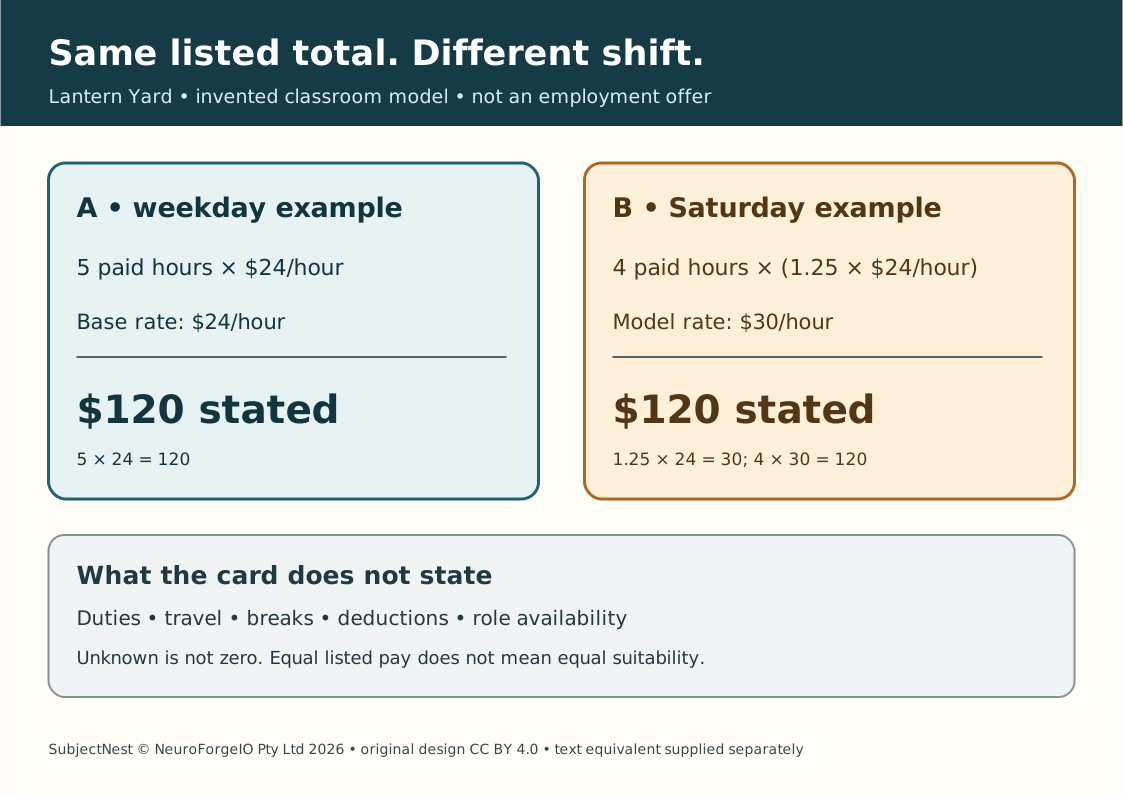
Success: compute a fictional 1.25 multiplier without mistaking it for a $1.25 addition.
- Predict · 2 min. Ask if Saturday model rate at 1.25 times $24 is above or below $24.
- Model · 4 min. Split
1.25=1+0.25: $24 + one quarter of $24 ($6) = $30 per hour. - Guided · 5 min. Calculate four Saturday paid hours = $120; compare five base hours = $120. Label equal totals, unequal hours/rates.
- Independent variation · 7 min. Find Saturday totals for 2 and 6 paid hours; explain which operation applies before multiplying hours.
- Error audit · 4 min. Discuss fabricated
$24+$1.25=$25.25. Students explain why multiplier has no dollar unit and the answer should be $30. - Exit · 3 min. Key: 2 h=$60; 6 h=$180; 1.25×$24/h=$30/h under this fictional card.
Day 3 — An extra-hour rule with a boundary
Success: apply the card's special rule to the specified shift only and avoid generalising it to real work.
- Frame · 2 min. Read aloud “seven base hours, then two extra at 1.50× base” and point to the fictional contract label.
- Model · 4 min. Calculate
$24×1.50=$36per extra paid hour;7×24=168,2×36=72, combined $240. - Guided compare · 5 min. Ask why
9×36=$324is wrong: only the final two of this example use $36. Check 8-hour version = $168+$36=$204. - Independent boundary · 7 min. Learners work a 10-hour what-if under the same stated rule: seven at base plus three extra. They show grouped arithmetic and label it as this model.
- Reasonableness · 4 min. Partner checks adding one extra hour from nine to ten adds $36, not $24; teacher asks which term changes.
- Exit · 3 min. Key: 10-hour model $168+$108=$276. No claim about an actual award or legal entitlement follows.
Day 4 — Percent off is a change, not the final price
Success: distinguish discount amount and new price with a plausible check.
- Estimate · 2 min. For fictional $80 item at 15% off, predict final price between $60 and $80.
- Model · 4 min.
0.15×80=12; new price80−12=$68. Compare0.85×80=68as a check. - Guided · 5 min. For $45 sign at 20% off, one fifth is $9; final $36. Explain that $9 is discount, not bill.
- Independent sort · 7 min. Learners match old price, percent, dollar change and new price for both cards, then invent a fictional $100 item at 5% off and solve.
- Check · 4 min. Partner audits whether new price is below old and above zero; teacher samples equations.
- Exit · 3 min. Key: $80 item $12 discount/$68 new; $45 sign $9 discount/$36 new; $100 item $5/$95.
Day 5 — Independent rate and percentage check A
Success: solve a fresh stipulated contract and explain every unit. Use Day 5 check A.
- Conditions · 2 min. Give a new invented base
$28/h, Saturday1.25×; ask for a rate and two totals. Calculator policy is stated. - Read · 4 min. Learners restate exactly what is known: 3 weekday paid hours; 4 Saturday paid hours; no break/travel terms.
- Plan · 5 min. Individually select multiplication order and estimate before calculating. Teacher does not model this exact problem.
- Solve · 7 min. Keep first work: Saturday rate, each shift total, difference and one unknown for a real comparison.
- Self-check · 4 min. Recompute one route a second way; circle any number that has the wrong unit.
- Exit · 3 min. Submit; key: $35/h, weekday $84, Saturday $140, difference $56. Record prompting and next move, not a QCAA grade.
Day 6 — Unit price is useful, but not always the answer
Success: calculate per-sheet rate and compare whole-pack outlay at a specified need.
- Hook · 2 min. Ask whether “cheaper per sheet” always means “spend less today”. Accept predictions.
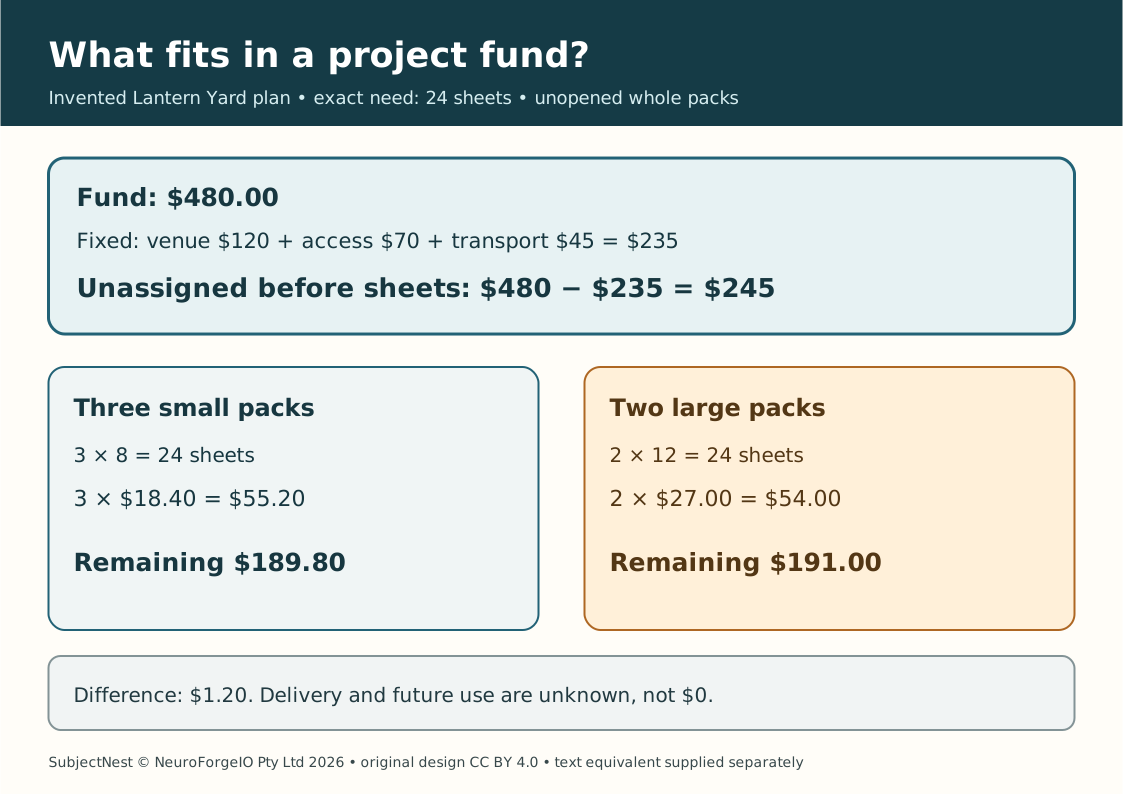
- Model · 4 min. From Paper Loop card: $18.40÷8=$2.30/sheet; $27÷12=$2.25/sheet. Large has lower unit price.
- Guided scenario · 5 min. Need exactly eight; both whole packs cover it. Small outlay $18.40, large $27.00, difference $8.60; unused sheets are not free money.
- Independent compare · 7 min. Learners solve twenty-four needed with whole packs: 3 small versus 2 large. Show pack counts and total, not just unit prices.
- Peer audit · 4 min. Partner checks
24÷8=3,24÷12=2, and whether delivery is known. Name the condition of unopened whole packs. - Exit · 3 min. Key: 24 sheets cost $55.20 small or $54.00 large; large is $1.20 lower in stated model.
Day 7 — A percentage change can flip a comparison
Success: apply a rise to the correct base then redo a whole-pack choice.
- Retrieve · 2 min. Learners state the original two-large total $54 and three-small total $55.20.
- Model · 4 min. Large pack alone rises 10%:
$27×0.10=$2.70; new pack $29.70; two $59.40. - Guided compare · 5 min. Keep small pack unchanged: three $55.20. Difference $4.20; the previously lower total is now higher. Clearly mark what-if.
- Independent check · 7 min. Learners calculate a separate 8% rise on fictional $50 design fee = $54, and explain why they must not add 8 dollars.
- Challenge · 4 min. Partners test whether 10% off $29.70 returns to $27; it gives $26.73. Discuss base changes; calculate $2.70/$29.70≈9.09% if ready.
- Exit · 3 min. Key: after the 10% large-pack-only rise, three small packs are $4.20 lower for 24 sheets, before unknown delivery.
Day 8 — Fixed costs and what remains
Success: build a fictional budget from a total, fixed costs and an unassigned balance.
- Read · 2 min. Display the project fund $480; ask learners to distinguish money available from money already planned.
- Model · 4 min. Add $120+$70+$45=$235; subtract
480−235=$245unassigned. No personal finances are discussed. - Guided add-on · 5 min. If two large packs are selected for $54, remaining $191. If the $480 fund is unchanged, total planned cost is $289.
- Independent what-if · 7 min. Learners choose either three small packs at $55.20 or two large at $54 for 24 sheets; calculate total planned and remaining, and say what cost is still unknown.
- Check · 4 min. Partner verifies
planned + remaining = 480and refuses to set unknown delivery to $0. - Exit · 3 min. Key: with small packs planned $290.20/remaining $189.80; with large $289/remaining $191.
Day 9 — Spreadsheet as a transparent model
Success: enter a formula, change one assumption and explain the resulting difference. No spreadsheet is required if unavailable.
- Predict · 2 min. What would six Saturday hours do to the original four-hour $120 result?
- Model · 4 min. On a spreadsheet or board use Card 1 cells:
B1=24,B2=1.25,B4=4; formula=B1*B2*B4displays 120. Name each cell's unit. - Guided change · 5 min. Change B4 to 6; formula gives $180. Difference $60 equals two more paid hours at $30/h.
- Independent replication · 7 min. Learners make or draw a four-row table with base rate, multiplier, hours, total; test B4=2 and B4=5, record formulas and both outcomes.
- Audit · 4 min. Partner changes one assumption and asks which formula reference updates. Recheck by direct multiplication to avoid trusting a mis-entered formula.
- Exit · 3 min. Key: 2h=$60, 5h=$150. A spreadsheet output is a consequence of entered assumptions, not proof of real pay.
Day 10 — Fresh consumer-arithmetic check B
Success: select a method for a new quantity/price comparison and articulate a missing condition. Use Day 10 check B.
- Set task · 2 min. Present fictional Art Relay packs for a community display. Ask learners to choose whole packs for 30 badges, with no return of extras.
- Read · 4 min. Fresh card: 10 badges/$22; 15 badges/$31.50. No delivery or storage cost supplied. Do not model the answer.
- Plan · 5 min. Learners estimate unit prices, whole-pack counts and possible total before calculator/spreadsheet.
- Solve · 7 min. Independently calculate unit prices and two ways to meet exactly 30, state lower given outlay and its size, then test a 10% rise of the 15-pack price.
- Self-audit · 4 min. Check pack counts and units; distinguish the original comparison from the changed-price what-if.
- Exit · 3 min. Submit first and checked work. Key: three 10-packs $66; two 15-packs $63, lower by $3; after 10% 15-pack rise, two cost $69.30 so 10-packs are $3.30 lower. Delivery remains unknown.
Rights: Original lesson scripts © NeuroForgeIO Pty Ltd 2026, SubjectNest, CC BY 4.0; credit, link and indicate changes.