Each day is 25 minutes: 3 + 5 + 6 + 5 + 4 + 2. The teacher uses Texts A and B; Text C is held for Day 10. Use teacher key for examples, diagnostic readings and next moves. The quick exits are formative and never QCAA marks. Extend with the school's actual texts and full senior timetable.
Day 1 — A door and an audience
Success: Name Text A's proposed change and use two words from the text to explain whom it addresses.
- Notice · 3 min. Display “Open to everyone” beside “the door shuts before everyone is free to arrive”. Ask: What tension does this pair make? Accept a private written thought.
- Model · 5 min. Read Text A's first paragraph aloud or invite independent reading. Underline “trial” and “six weeks”. Say: “This is a bounded proposal, not a demand for permanent opening.”
- Try · 6 min. Learners mark claim, intended decision maker and the people the writer asks that decision maker to imagine. Pair talk is optional; a written annotation works.
- Compare · 5 min. Ask what “public decision” at the end adds to the opening image of the door. Invite two different readings, each tied to wording.
- Transfer · 4 min. Learners complete: “Night Desk asks the board to ___ because ; the phrase ___ positions the board to .” No personal example is needed.
- Exit · 2 min. Collect one precise claim plus audience. If learners write merely “the library”, point back to the board and the published open-letter form tomorrow.
Day 2 — An example is not a count
Success: Distinguish Text A's illustrative people from measured evidence and name one useful pilot measure.
- Notice · 3 min. Show “apprentice”, “parent”, “student” from Text A. Ask: Are these reported interview participants? Why can we not tell?
- Model · 5 min. Label the three as examples chosen to widen the imagined audience. Contrast with Text A's requested future count of use, which has not yet been collected.
- Try · 6 min. Learners mark one appeal to access and one limit the writer states about what six weeks can prove.
- Compare · 5 min. Two groups propose a measure: arrivals, costs, journey home or quiet-space use. Ask who might still be invisible in each measure.
- Transfer · 4 min. Write two sentences: one about the text's persuasive effect and one about evidence the board still needs.
- Exit · 2 min. Ask “Did Text A prove demand?” Expected: no; it proposes a trial and gives illustrative cases. Reteach claim/evidence if the answer is yes.
Day 3 — A reply that partly agrees
Success: Explain Text B's qualified support with a quotation from both letters.
- Notice · 3 min. Display Text B's “right to ask” and “But”. Invite a guess: disagreement, agreement or both?
- Model · 5 min. Read Text B. Trace its path: accept the access problem; add transport and labour; propose conditions for a trial.
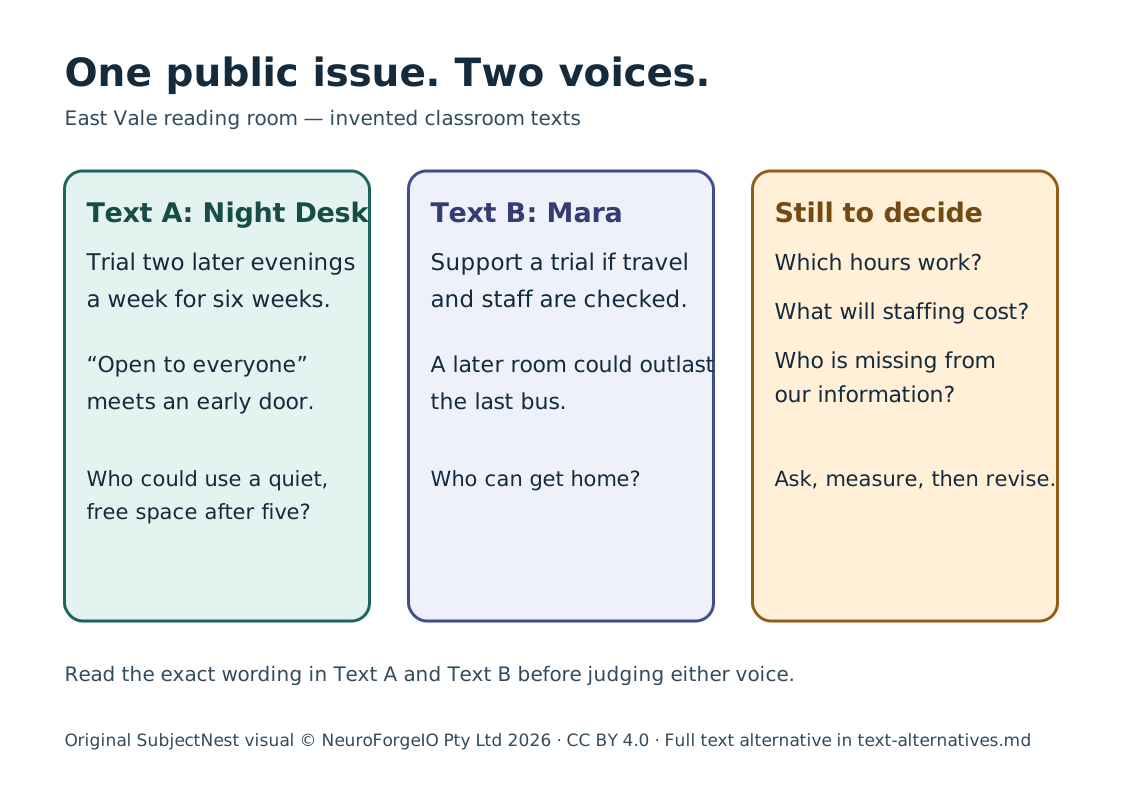
- Try · 6 min. On the two-voice map or plain text equivalent, place one phrase in agree and one in challenge. If writing is slow, point then dictate.
- Compare · 5 min. Ask how the paper board pack audience differs from the online noticeboard audience, and which detail might matter most to each. Avoid assuming all readers have digital access.
- Transfer · 4 min. Complete a two-text sentence with a real connective: “While both , B complicates A's ___ by .”
- Exit · 2 min. Collect one word or phrase that signals qualified support and the condition attached to it. If learners call B wholly opposed, revisit its final paragraph.
Day 4 — Inclusion and omission
Success: Identify a foregrounded perspective and an unanswered question without inventing anyone's experience.
- Notice · 3 min. Place “who arrives” (A) and “who can get home” (B) side by side. Ask what each makes visible.
- Model · 5 min. Say: “An omission is an unanswered issue, not proof the writer intended harm.” Demonstrate with accessible transport: A mentions safe travel but gives no service timetable.
- Try · 6 min. Learners annotate a text's emphasis and a question that a board would need to investigate. Require the question to be answerable, not a guess about a population.
- Compare · 5 min. Sort proposed questions into usable pilot information, unsupported allegation or private disclosure request. Reject private disclosure requests.
- Transfer · 4 min. Draft: “The writer foregrounds ___ through ; this helps , although the decision still needs ___.”
- Exit · 2 min. Collect the question. If it asserts an invented fact, convert it to an inquiry tomorrow.
Day 5 — First independent comparison
Success: Compare how two form/language choices influence the same public issue, with an explicit limit.
- Notice · 3 min. Return Texts A and B with no annotations shown. Give the prompt in student assessment, Check 1.
- Model · 5 min. Model only a structure with an unrelated example: claim, exact words, effect, connection. Do not supply the board-room answer.
- Try · 6 min. Learners write or record a 90–130 word comparison; offer the text and a word bank, but log support used.
- Compare · 5 min. Learners underline one exact phrase from each text and circle the connective joining them. Ask whether the evidence supports each claim.
- Transfer · 4 min. Add one sentence naming what the letters cannot establish about likely attendance or access.
- Exit · 2 min. Save the first version. Use the formative rubric in the teacher key to choose a next move; no QCAA standard is awarded.
Day 6 — Modality changes power
Success: Explain how changing “could” to “will” changes a claim's certainty and audience relationship.
- Notice · 3 min. Display Text A's “could tell us” and the hypothetical edit “will prove”. Which promise is larger?
- Model · 5 min. Show modal verbs as degrees of commitment. “Could” is cautious; “will” claims certainty the pilot cannot give.
- Try · 6 min. Learners locate “might”, “should” and “if” across A and B and annotate how each manages pressure or condition.
- Compare · 5 min. In pairs or solo, rewrite one sentence in stronger and weaker modality; discuss which version is ethical with the available evidence.
- Transfer · 4 min. Write two lines for a fictional board submission: one defensible claim, one evidence condition.
- Exit · 2 min. Ask which is justified now: “a pilot could help us learn” or “later hours will solve access”. Require a reason from the texts.
Day 7 — Shape a spoken argument
Success: Open a 45-second persuasive practice statement for a named public audience, using a concession and reason.
- Notice · 3 min. Read Text B's opening line in two tones, one dismissive and one invitational. Ask which fits the wording and why.
- Model · 5 min. Draft aloud: “Board members, a trial is worth considering. Before we choose the hours, we need a way home for users.” Identify address, position and condition.
- Try · 6 min. Learners choose A's position, B's conditional position or a third defensible position, then draft an opening and one supporting reason. No lived-experience disclosure.
- Compare · 5 min. Offer private rehearsal, typed script, AAC or spoken rehearsal. Peers note whether the audience, claim and condition are audible/readable, rather than judging performance identity.
- Transfer · 4 min. Revise one sentence to be clearer and more respectful to a person who disagrees.
- Exit · 2 min. Collect the opening plus its evidence source. A made-up statistic must be labelled as hypothetical or removed.
Day 8 — Counterargument without a straw person
Success: State another position fairly before answering it with relevant evidence or a research question.
- Notice · 3 min. Display “Volunteers dislike helping” and ask if Text B actually says this. It does not.
- Model · 5 min. Replace the distortion: “B warns that unpaid labour should not carry the trial.” Answer: A also requests paid staffing; remaining cost needs checking.
- Try · 6 min. Learners select a genuine concern from the other letter and paraphrase it in terms that writer might recognise.
- Compare · 5 min. Read only the paraphrase to a peer. The peer finds the text location. If it cannot be found, revise.
- Transfer · 4 min. Add an answer that cites a shared point or proposes an information-gathering step, not a personal attack.
- Exit · 2 min. Hand in a three-line concession, evidence and answer. If the concession is distorted, the next lesson starts with a neutral paraphrase model.
Day 9 — Connect two texts in one argument
Success: Produce a short public-facing argument that uses both texts as a conversation and marks uncertainty.
- Notice · 3 min. Revisit the map. Ask: Where is agreement, where is a live choice, and what information is missing?
- Model · 5 min. Demonstrate a paragraph plan: recommendation; A's access case; B's transport condition; a measured next step. Use no invented demand figure.
- Try · 6 min. Learners choose a pilot option and draft 120–160 words or an equivalent 75-second script. Offer a sentence frame only to those who want it.
- Compare · 5 min. Peer reader marks every claimed number, inferred fact and text reference. If a statistic is not in A/B, label it a proposal for measurement.
- Transfer · 4 min. Revise the final sentence to tell the board what to check after the pilot.
- Exit · 2 min. Ask each learner which one revision improved accuracy. Use the answer to form a Day 10 conference group.
Day 10 — Fresh media text and transfer
Success: Explain how Text C's accurate arithmetic can still support an over-wide public claim, then connect it to A or B.
- Notice · 3 min. Distribute Text C now. Students read independently where this is the chosen construct; record supported reading separately.
- Model · 5 min. Remind learners only of the analysis questions: claim, selection, audience and effect. Do not evaluate Text C for them.
- Try · 6 min. Learners complete Check 2 in student assessment without feedback.
- Compare · 5 min. After collecting first responses, ask students to underline the sampled group and label the headline's broader implied group.
- Transfer · 4 min. Learners add one sentence connecting C's “do not wait” to A's or B's position, with a justified difference.
- Exit · 2 min. Save original and revision separately. Use the teacher key's next moves to decide whether to teach sampling, rhetorical effect or text connection next.
Rights: Original scripts © NeuroForgeIO Pty Ltd 2026, CC BY 4.0.