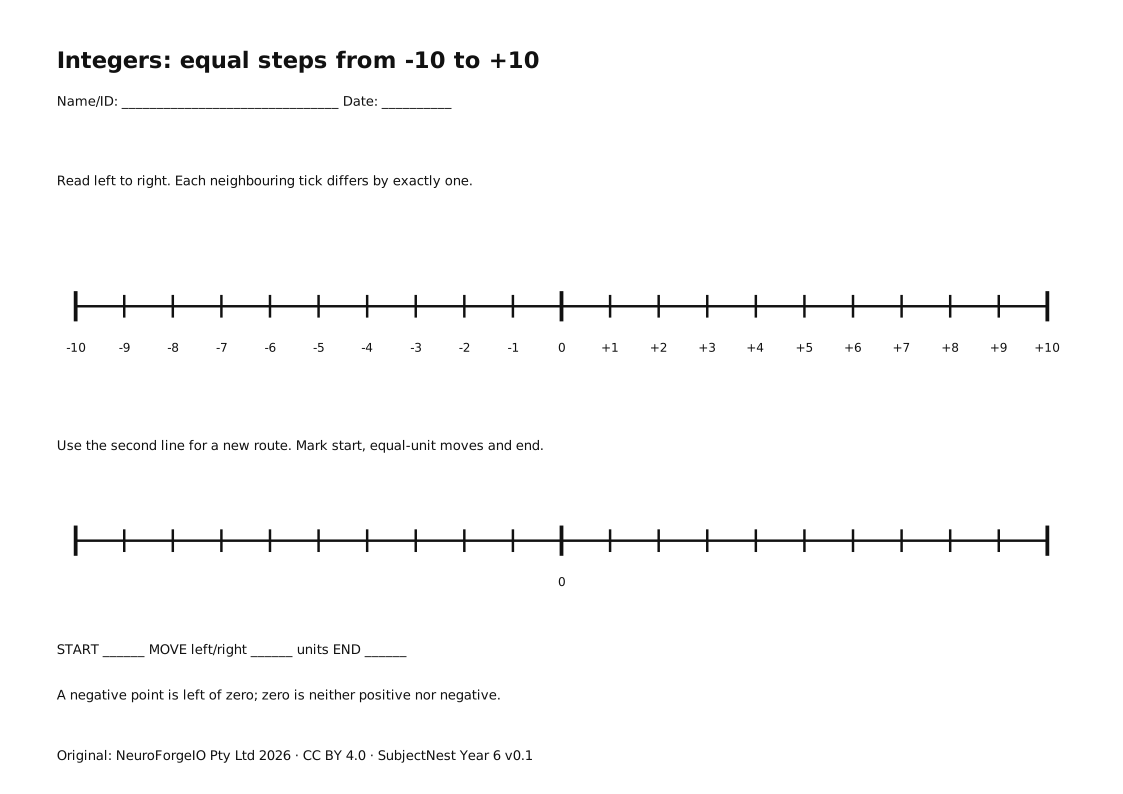
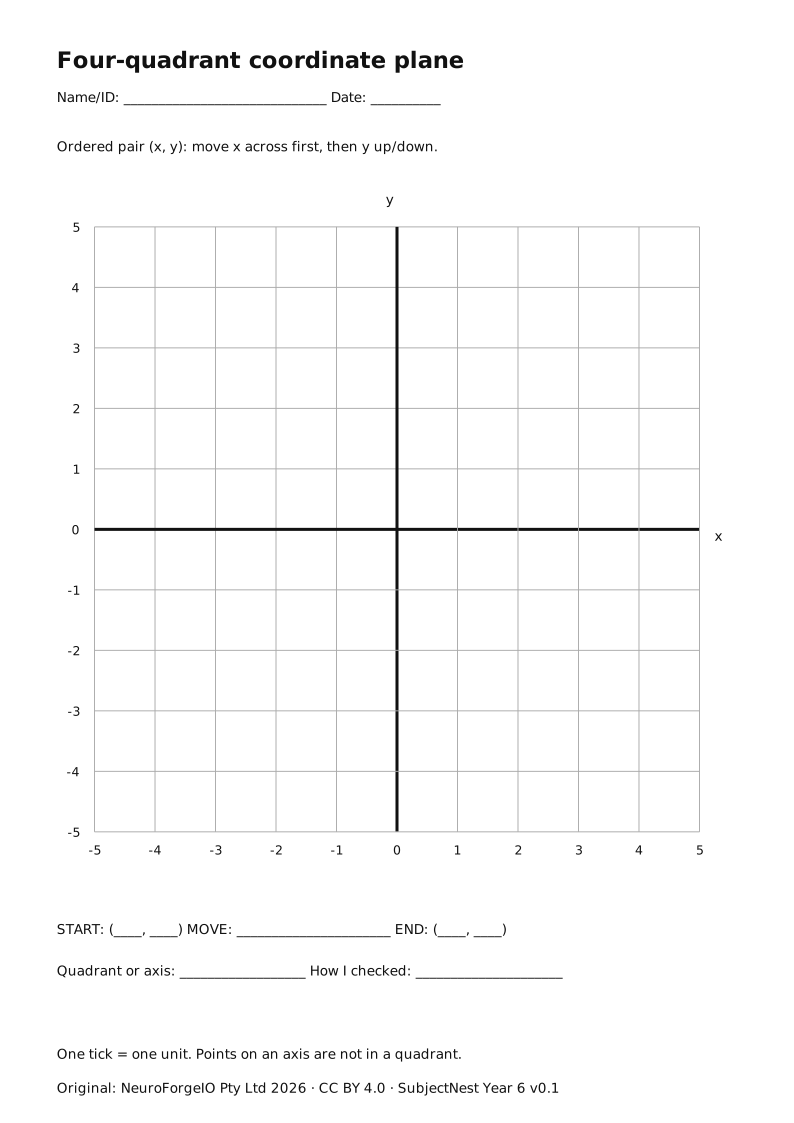
Every day: retrieve/notice 3 minutes + teacher model 5 + guided practice 8 + individual transfer 6 + exit/record 3 = 25 minutes. Use aids, A4 fixed-scale number line, A4 grid and assessment. An equal-spaced line or labelled grid may stay visible; response speed and handwriting are not the target. Access can be large print, raised ticks, tactile counter, keyboard, AAC, sign, pointing or adult movement under learner direction. Record mathematical cues separately. AC9M6N01 supports Days 1–10; AC9M6SP02 also supports Days 6–10, partially (scope and source in README).
Day 1 — Zero is a reference, not a verdict
Goal: identify negative/positive/zero in explicitly referenced situations. Materials: -10 to +10 line, Cards 1–5, tactile markers.
- Notice, 3: Show zero at centre. Ask “What might zero mean?” Accept a chosen reference such as ground floor or game starting balance; there is no universal “bad” side.
- Model, 5: Use fictional lift Card 1. “Ground is 0. Three floors below are -1, -2, -3. I put -3 three equal ticks left on this horizontal line.” Match “below” context to negative label without implying physical up/down is line direction.
- Together, 8: Model Cards 2–5: -5 game points, -2 fictional temperature, -4 sea-level model, +6 rooftop model. For each ask learner to name the reference and sign before plotting. Compare -2 and +6 by positions.
- Try, 6: Learner invents an age-respectful fictional “above/below a named zero” scenario for +4 or -4 and plots it; can select prewritten context and direct adult placement.
- Check, 3: “What integer is three units below the chosen zero? Is zero positive or negative?” Key: -3; neither. If child says -3 always means loss, return to different reference contexts.
Day 2 — Negative integers are ordered on the line
Goal: compare/order negatives by position, not unsigned digit size. Materials: line, Cards 1/2/6.
- Notice, 3: Place -2 and -5; ask which is farther left. Key: -5.
- Model, 5: “-2 is greater than -5 because it lies to the right. The digit 5 alone does not decide the order.” Point from -5 across three equal intervals to -2.
- Together, 8: Learners order -7, -2, 0, +3 with marks. Use story-timeline Card 6: event B (-2) is later on that invented timeline than A (-7). Separate mathematical order from whether story events are good/bad.
- Try, 6: Learner orders -6, -1, -4 least to greatest and explains one adjacent pair. Key: -6 < -4 < -1. A tactile line is available; point selection counts.
- Check, 3: “Which is greater, -3 or -8? Why?” Key: -3, right of -8. If learner compares 8>3, place both on same line and reread from left to right.
Day 3 — Distance from zero and direction are different
Goal: distinguish location (-4/+4) from equal distance to zero. Materials: equal-tick line and paired markers.
- Notice, 3: Put markers -4 and +4. Ask “Are they the same point?” Key: no. “Are they the same number of units from zero?” Key: yes, four.
- Model, 5: Count four intervals left to -4 and four right to +4. Say “distance is four units for both; direction/sign differs.” Avoid introducing formal absolute-value notation unless school scope calls for it.
- Together, 8: Pair -6/+6, -2/+2, 0/0; identify same-distance partners and location. Use fictional temperature board versus rooftop model to show reference and unit matter.
- Try, 6: Give -5; learner names a different integer the same distance from zero and locates it. Key: +5. Extension: -7 pairs +7, not -0.
- Check, 3: “Which has greater value, -4 or +4? Which is farther from zero?” Key: +4 greater; equal distance. If “farther” mistaken for “greater,” isolate both questions with two colours or textures.
Day 4 — Move across zero
Goal: track signed changes on a number line without losing the endpoint. Materials: line, Cards 7–8, move arrows.
- Notice, 3: Start at -1, move one right. Key: 0.
- Model, 5: Card 7 fictional account simulator: start -4, gain 7. Touch seven equal rightward steps: -3,-2,-1,0,+1,+2,+3. “+7 is the change; +3 is the new balance.” No personal financial disclosure or account advice.
- Together, 8: Card 8: start +2, down 5 on scale allowing negatives; plot +1,0,-1,-2,-3. Then start -3 and move +4 → +1. Ask learners to name starting point, direction, steps, endpoint.
- Try, 6: Learner plots start -2 then +5 and start +3 then -6. Keys: +3 and -3. Choose a move rather than recite rule; adult can move marker under child direction.
- Check, 3: “Start -5, move right 8. End?” Key: +3. If child answers +8, distinguish change from endpoint with a two-column record.
Day 5 — Represent and explain an integer situation
Goal: select a suitable reference and justify integer order. Materials: cards, line, assessment Items 1–4 as appropriate.
- Notice, 3: Ask “Could +2 and -2 be compared without knowing whether they use the same unit/reference?” Key: numbers can be ordered mathematically, but a real-world comparison needs common meaning and units.
- Model, 5: Fictional theatre lighting scale with 0 as neutral: -3 lower setting, +2 higher setting. Place both, then state only what the model supports. Do not imply a real theatre's settings.
- Together, 8: Match Cards 1–5 to labelled positions. Learners check an intentionally wrong -4 marker at +4 and explain sign/direction.
- Try, 6: Child writes/dictates a two-sentence explanation comparing -7 and -1 in the same invented game scale. Key: -1 greater because right of -7, six units apart. Alternate tactile markers acceptable.
- Check, 3: Present -6, 0, +4, -2; order least to greatest. Key: -6,-2,0,+4. If order fragile, reteach one-to-one tick moves before coordinate work; allow age-respectful context.
Day 6 — Axes, origin and x-first convention
Goal: plot (x,y) with x horizontal then y vertical; locate axes. Materials: labelled grid, counters, optional raised axes.
- Notice, 3: Find crossing of axes. Key: origin (0,0). Ask whether (0,0) lies in any quadrant. Key: no, on both axes.
- Model, 5: Plot (3,2): from origin 3 right along x, then 2 up parallel to y. Say ordered pair aloud “x three, y two.” Plot (0,3) on y-axis; x=0 means no horizontal move.
- Together, 8: Plot (1,4), (4,1), (0,-2), (-3,0). Contrast (1,4) and (4,1) to show order matters. Let child trace axes physically or with cursor.
- Try, 6: Learner plots (2,3), then reads a teacher mark at (-1,0). Keys: first Quadrant I; second on x-axis. Record if adult only provided motor placement.
- Check, 3: “What point is 4 left and 0 up/down?” Key: (-4,0), x-axis. If (0,-4), repeat x-first route.
Day 7 — Signs locate Quadrants I and II
Goal: identify positive y with positive/negative x. Materials: grid, Robot Cards 9–10.
- Notice, 3: Plot (3,2) from yesterday. Key: right/up, Quadrant I.
- Model, 5: Plot (-4,1): x=-4 means left, y=+1 means up. “Left/up is Quadrant II; it is not a point with y negative.” Point to quadrant label after position.
- Together, 8: Children plot (2,4), (-2,4), (4,2), (-4,2), compare each mirrored pair. Ask which coordinate changes when crossing the y-axis while staying at same height. Key: x sign.
- Try, 6: Give two points (1,3) and (-1,3); child places both and explains difference. Key: same y=3, x on opposite sides, Quadrants I/II.
- Check, 3: “Which quadrant contains (-3,5) on this extended grid?” Key: II, if grid includes +5. If learner calls it III from negative sign alone, separate x/y signs.
Day 8 — Signs locate Quadrants III and IV
Goal: plot negative y with negative/positive x and name axis exceptions. Materials: grid, Cards 11–12.
- Notice, 3: Recall a positive-y point. “What changes if y becomes negative?” Key: point moves below x-axis if x fixed.
- Model, 5: Plot (-2,-3): 2 left, 3 down → Quadrant III. Plot (4,-2): right/down → Quadrant IV. Stress (x,y) and labels, not memorised clockwise chants.
- Together, 8: Learners plot (-1,-4), (1,-4), (0,-4), (-4,0); ask which lie on an axis. Keys: (0,-4) y-axis; (-4,0) x-axis. Both others in III/IV.
- Try, 6: Learner chooses a point in Quadrant IV within -5..+5 and gives its coordinates. Accept: any x>0,y<0, e.g. (3,-1); teacher checks actual plotted point.
- Check, 3: “Where is (-5,-1)? And is (0,-1) in a quadrant?” Key: III; no, on y-axis. If both called III, trace x=0 axis boundary.
Day 9 — Moves change x and y separately
Goal: describe coordinate changes across quadrants. Materials: grid and reserved Cards 13–14 (unseal now), move arrows.
- Notice, 3: From (1,1), move left 2. Key: (-1,1); only x changes.
- Model, 5: Show one analogous unscored route: (-2,2) right 3/down 4 → (1,-2). Record x:-2+3=1, y:2-4=-2. Plot endpoint and name Quadrant IV.
- Together, 8: Unseal Card 13: (-3,2) right5/down3 → (2,-1), Quadrant IV. Learners narrate x and y separately. Try Card 14: (2,-4) left4/up6 → (-2,2), Quadrant II; audit by reverse move.
- Try, 6: New route from (4,-1) left 6/up 2. Key: (-2,1), Quadrant II. Learner plots start/end, uses text/tactile equivalent if needed.
- Check, 3: “From (-1,-3), move right 2, up 5. End?” Key: (1,2), Quadrant I. If signs flip incorrectly, update x and y in separate columns.
Day 10 — Transfer, boundaries and next lesson
Goal: independently locate, move and explain points including an axis endpoint. Materials: still-sealed Cards 15–16, assessment, grid.
- Notice, 3: Sort point cards (3,0), (0,-3), (-2,2), (2,-2) as axis or quadrant. Keys: first x-axis, second y-axis, third II, fourth IV.
- Model, 5: Teacher checks a wrong route from (1,-1) up 2 claimed (1,-3). “Up increases y from -1 to +1; x stays 1.” Model error check with labelled axes, not transfer cards.
- Together, 8: Plot (3,-2) and (-3,2), explain what a half-turn about origin would do if school scope allows; core check is coordinates and opposite signs. Do not score transformation knowledge here.
- Try, 6: Learner selects unseen Card 15 or 16, plots start and follows moves. Keys: Card15 (-1,-2) right3/up2 → (2,0) on x-axis; Card16 (0,4) left2/down6 → (-2,-2), Quadrant III. Record card/support, do not reveal key first.
- Check, 3: Independently give (0,4) and ask move down 5 then right 3. Key: (3,-1), Quadrant IV. Use the full formative check plus daily records for next teaching; one correct route is not Year 6 mastery.
Shared misconception response
If -8 is treated as larger than -3, move equal-spaced markers to compare position. If a child swaps (x,y), say “x across first”, trace one coordinate at a time and contrast (1,4)/(4,1). If a child assigns an axis point to a quadrant, mark the boundary physically. After each model give a new analogous problem and note whether the explanation was independent. Negative contexts are mathematical references, not assumptions about a learner's finances, mood or ability.
Original lessons © NeuroForgeIO Pty Ltd 2026, CC BY 4.0. National source and ACARA's separate rights in README. Educator review pending.