Use the original reading set, clean learner choices, optional extra and home routes, A4/text/tactile aids and private assessment/key. These are compact daily English sessions, not a complete English timetable. Keep the two fresh check passages out of instruction until Days 15 and 20. Every learner gives a short exit response; rotate two or three focus learners for exact evidence notes. Start with a child's independent attempt where possible. An adult read gives access to meaning but is listening-supported comprehension, not proof of independent print reading. AAC, dictation and another language for thinking are welcome; record the supplied support and assess the intended English construct without treating a delivery mode as a fixed learning style. No unreviewed translation, personal disclosure, public recording or speed-of-handwriting requirement.
Week 3 · Day 11 — Agreement is not identification
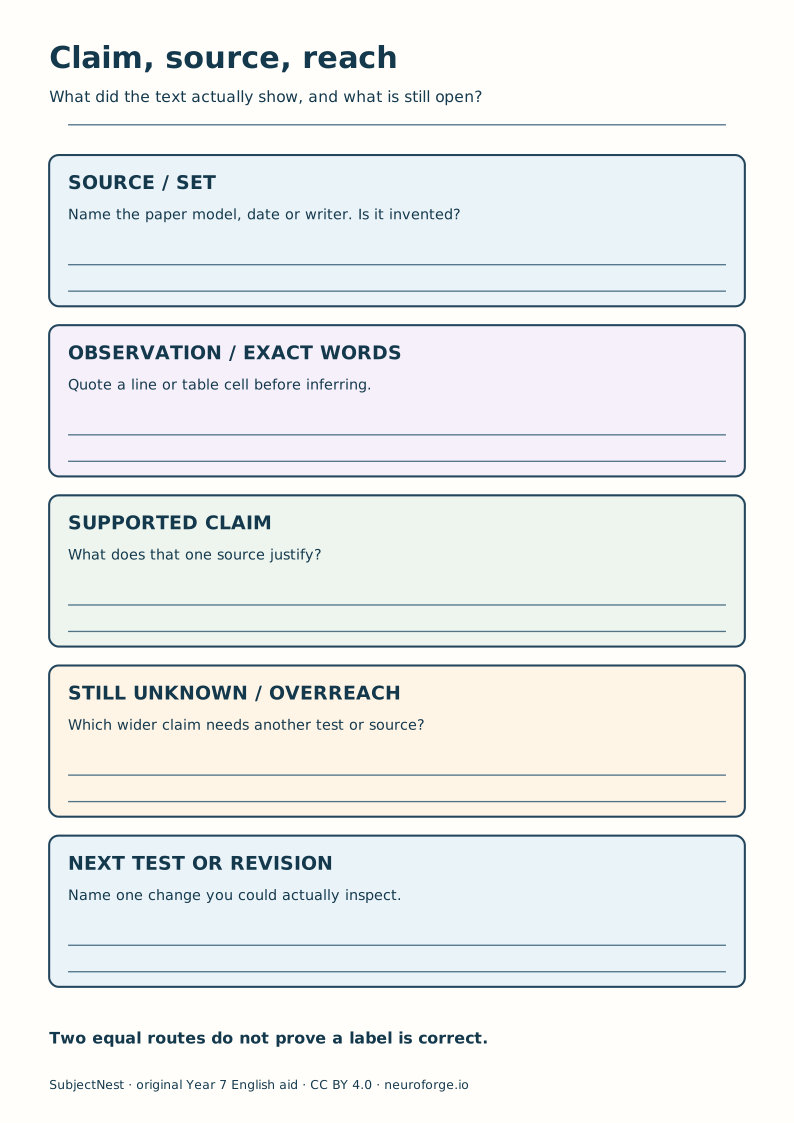
Codes: AC9E7LA02, AC9E7LY05. Goal: distinguish a repeatable reading of a model route from a justified terminal label. Prepare: Text A, blank claim–reach mat, REAL/MODEL labels.
- Recall · 2 min. Ask: “Last week, what did changing any jagged section fix?” Accept “two people could follow the same first question.” Add: “What might still be wrong?” Do not resolve it yet.
- Read · 5 min. Students read Text A silently or hear an exact adult reading. Stop after Dev asks “So it is J?” and let them predict Mira's answer before continuing. Confirm that card 8 is a paper model outside the original six.
- Model · 5 min. Put “both reached J” in the source observation box and “card 8 is J” in the claim box. Ask whether the first makes the second certain. Say: “They repeated a route; they did not verify the identity.” Mark the missing eighth terminal as a limit.
- Try · 7 min. Offer the three learner routes. Each must cite one exact line/table cell, state a claim the log supports, and identify one claim it cannot settle. Prompt only with “Where in the log?” rather than supplying a conclusion.
- Compare · 4 min. Invite two different wordings. Test each against the same card. When a student says “the key failed,” ask whether the route failed or the scope failed; both are discussable with evidence.
- Exit · 2 min. Everyone completes: “The two passes show , but they do not show .” Mark source, reach and access route; use staff next moves.
Week 3 · Day 12 — Make a paragraph carry the limit
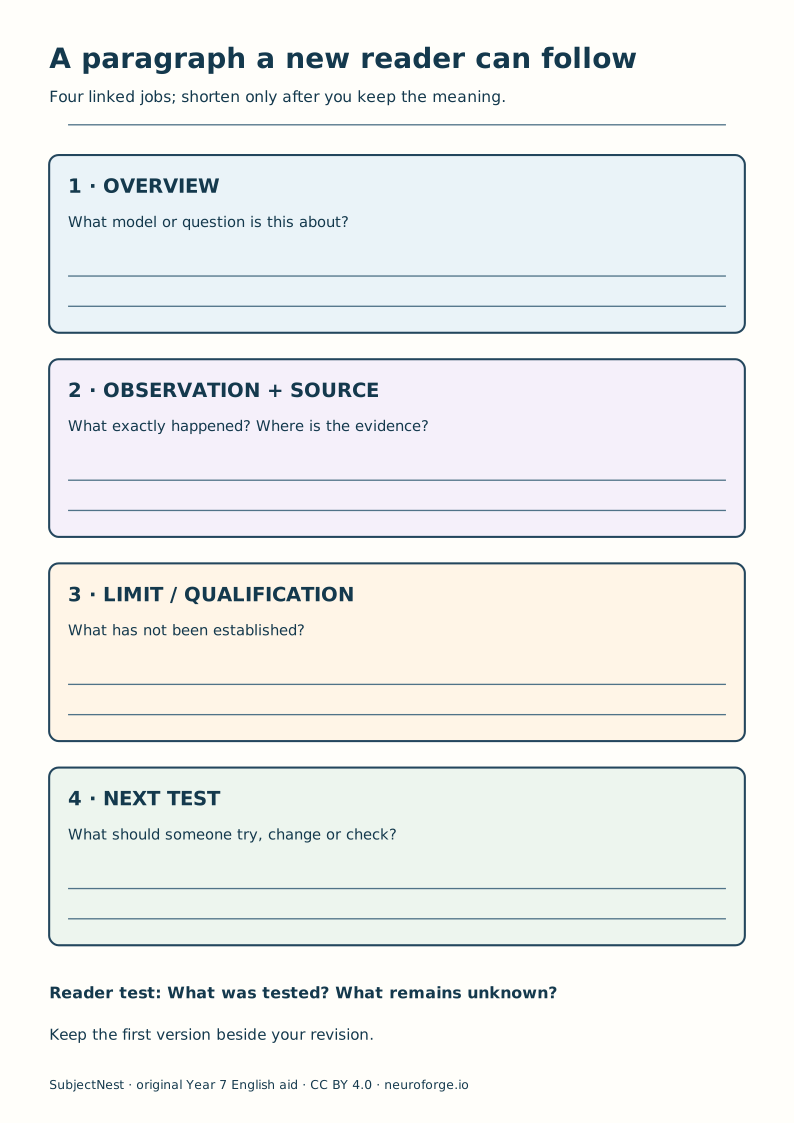
Codes: AC9E7LA03, AC9E7LA04, AC9E7LY03. Goal: compare captions by purpose and trace how overview, evidence, limit and next question guide a visitor. Prepare: Text B, two blank paragraph-path aids.
- Reader first · 2 min. “A visitor has thirty seconds at the display. What must they know before seeing the label J?” Accept source/scope ideas.
- Read · 5 min. Read both captions. Students mark words that promise certainty and words that limit a claim. Let learners use underlining, tactile tags or a two-column typed list; colour is optional.
- Model · 5 min. Outline Draft Two: overview of model test → observed agreement → what it does not establish → next test. Think aloud about their agreement referring back to the two passes. Show how the sentence link prevents a reader from mistaking “two” for every tester.
- Rebuild · 7 min. Choose one of the learner routes. Reorder four idea cards into a caption for a younger visitor, keeping the evidence and limitation. A short caption is valid if it does not silently drop scope.
- Test · 4 min. A partner or teacher plays the visitor: “What was tested?” and “What is still unknown?” If the caption cannot answer both, the author revises the linking sentence.
- Exit · 2 min. Name one phrase that guides the reader and say exactly what it connects. Record a source-backed explanation, not a feature label alone.
Week 3 · Day 13 — Which feedback can you use?
Codes: AC9E7LA02, AC9E7LY02, AC9E7LY05. Goal: evaluate three fictional responses by relevance and evidential reach. Prepare: Text C, claim–reach mat, optional discussion roles.
- Set a problem · 2 min. “Three readers respond to the same draft. Does confidence make a note useful?” Ask for a testable reason.
- Read · 5 min. Students read or hear Ren, Sol and the editor. Identify who reports a test, who reports an impression, and who gives audience advice. Do not rank people by status.
- Model · 5 min. Quote Ren's first-person test. Explain that it supports a viewing-rule revision for one reader, not a scientific label for card 8. Put source, usable advice and limit in separate fields.
- Discuss · 7 min. In pair or private teacher discussion, each learner chooses two notes, names one useful contribution of each, and challenges one claim that outruns its source. Use “I heard your point; the text says…” rather than dismissing a person.
- Decide · 4 min. Students select one edit for a public model caption: viewing rule, scope line or term definition. Require a because-statement tied to a note and the display audience. Where discussion occurred, ask the listener whether naming the note before an opinion made the spoken explanation easier to follow; evaluate that feature of the explanation, never a peer’s accent or voice.
- Exit · 2 min. “I would use ___ for , but I would not use it to claim .” Record the independent source boundary before any discussion repair.
Week 3 · Day 14 — One sentence, three jobs
Codes: AC9E7LA05, AC9E7LA06, AC9E7LA09, AC9E7LY06. Goal: edit a short explanation so sentence structure, tense and punctuation clarify cause, result and a defined term. Prepare: Texts A–C, paragraph-path aid, strips: “the first question was clearer / both readers took the same route / the label remained unverified”.
- Hear the gap · 2 min. Read three strips as disconnected sentences. Ask which relationship a visitor cannot yet hear.
- Model · 5 min. Write: “Because the first question was clearer, both readers took the same route; however, the label remained unverified.” Explain the dependent cause, main result and qualification. Past tense stays with the recorded test. If a semicolon is new locally, use two sentences with However instead.
- Punctuate · 5 min. Add: “Terminal label: the name printed at the end of a route.” Show why the colon introduces a definition. Then make an optional bracketed scope: “The two passes (both with card 8) reached J.” Brackets contain a useful aside, not the sole evidence.
- Compose · 7 min. Choose a learner route; write, dictate or assemble a three-sentence explanation for the fictional display editor. Include an evidence-bearing complex sentence, a limit and a defined technical term. Keep observed past events in past tense; future tests may use future or modal language.
- Edit aloud · 4 min. Read the text without hand gestures. Ask: “Does therefore really follow? Does the colon define or list? Did the tense switch change the claim?” The author repairs one specific issue.
- Exit · 2 min. Submit a before/after sentence and explain what the revision made clearer. This is revision evidence, not a punctuation memory quiz.
Week 3 · Day 15 — Fresh explanation check
Codes: AC9E7LA02, AC9E7LA04, AC9E7LY03, AC9E7LY06. Goal: independently analyse a new model-key explanation, then make a source-bound revision. Prepare: sealed Check A and private staff key; do not rehearse its wording.
- Frame · 2 min. “This is new material. Show what the source says, what it cannot settle and how you would explain it to another reader.” State permitted access supports without hinting at an answer.
- Read · 5 min. Give the fresh text once. Quiet reading or exact adult reading is permitted and recorded separately. Do not pre-label the overclaim for learners.
- First response · 5 min. Students identify one observation and one claim needing qualification. Note the first independent attempt before any teacher prompt.
- Create · 7 min. Students revise the original caption into a three- or four-sentence explanation with an overview, evidence, limit and next test. Speech, AAC, keyboard, writing or directed arrangement may convey the same explanation; note who supplied words.
- Self-check · 4 min. Invite students to point to the exact source phrase behind their evidence sentence and mark a phrase that keeps the claim within scope. A later edit remains visible beside the first response.
- Collect · 2 min. Save locally under school policy. Use the private rubric for a next teaching move; one short check is not an achievement-standard decision.
Week 4 · Day 16 — When a word changes its job
Codes: AC9E7LA08, AC9E7LY04, AC9E7LY05. Goal: infer factor and power in technical versus everyday contexts, then explain how an example and counterexample organise a mathematical explanation. Prepare: Text D, number-and-meaning aid. Calculator is a check tool, not a reading substitute.
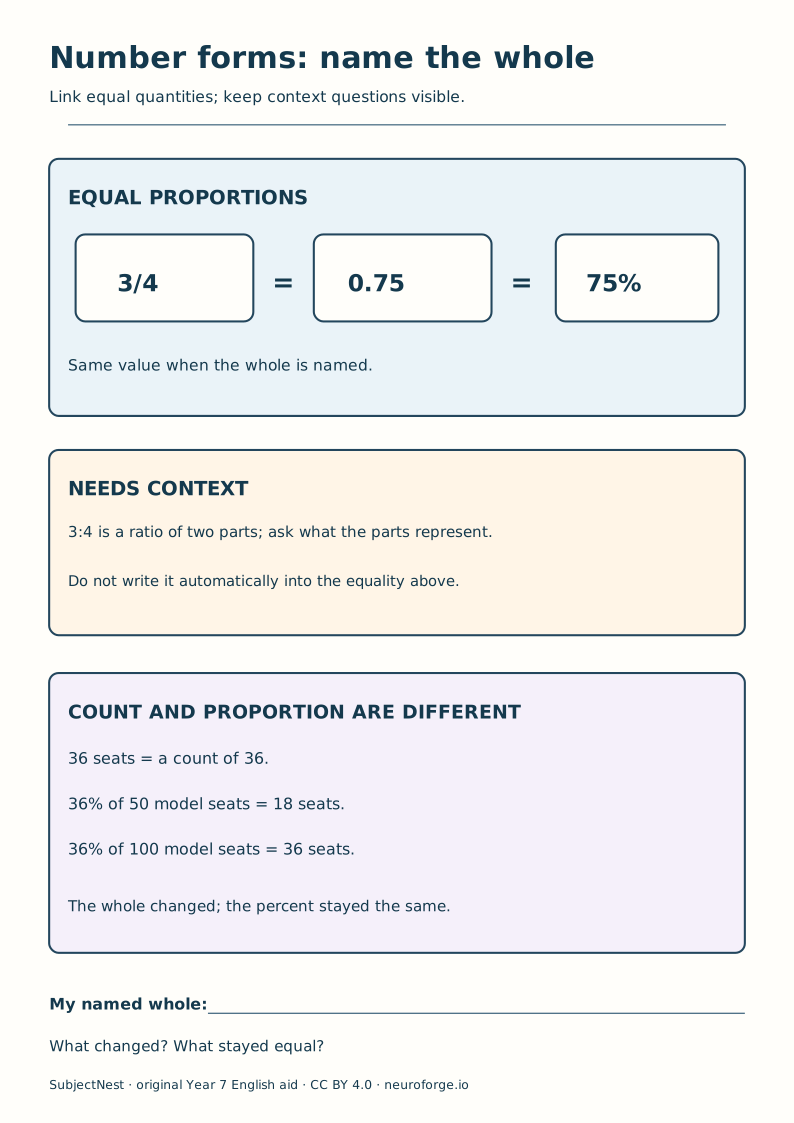
- Contrast · 2 min. Say “Travel time was a factor” and “4 is a factor of 36.” Ask what changed besides topic.
- Read · 5 min. Students read the first two paragraphs of Text D, then the 36% paragraph. Read aloud exactly where access requires. Pause at
36%and ask whether the sign changes the quantity. - Model · 5 min. Locate the technical definition beside factor. Point to
4 × 9 = 36as its check. Then show the ordinary influence sense. Trace cause/effect in the paragraph: if the whole is 50 model seats, 36% gives 18, so “36 seats” would mislead. - Use · 7 min. Choose one of three learner routes: contextual word pair, number representation, or a caption repair. Require a technical meaning, an everyday meaning, and a quoted or computed context clue.
- Probe · 4 min. “Why does
36% of 100happen to give 36 while36% of 50gives 18?” Say the whole aloud. Keep this as explaining the text's reasoning, not a claim that students have mastered the mathematics strand. - Exit · 2 min. Complete: “Here power/factor means ___ because ; in another context it could mean .” Note any arithmetic prompt separately.
Week 4 · Day 17 — A word can hold two meanings in a story
Codes: AC9E7LE03, AC9E7LE05, AC9E7LE06, AC9E7LY05. Goal: explain a literal technical use of base and its second literary meaning in a new vignette, using character, setting and event evidence. Prepare: Text E, optional Text F, two-column literal/layered note.
- Invite · 2 min. “A word on a sign can name a part. Can the same word do more in a story?” Accept tentative predictions.
- Read · 5 min. Read the vignette quietly or aloud. Pause after Luca says “It's obvious when you're here.” Ask what a visitor not beside Luca might need.
- Model · 5 min. Quote “Base: the wide paper support touching the table.” Identify literal meaning. Compare the last two sentences: base becomes a beginning for a better question. Name the doorway, crowded arrows and leaning model as setting/details shaping the problem.
- Interpret · 7 min. Three learner routes allow annotation, a small scene map or oral/AAC close reading. Each gives two readings of base, one character change, and a specific phrase. A different supported reading can stand.
- Compare · 4 min. Read Text F's last two lines if useful. Ask whether the margin is literal paper space, a metaphor for a possible alternative, or both. Students can disagree by pointing to words, with no obligation to reveal personal experience.
- Exit · 2 min. “The word base first means ; by the end it also suggests , supported by ___.” Do not score exact emotional reaction.
Week 4 · Day 18 — Build a reader's route through an explanation
Codes: AC9E7LA03, AC9E7LA04, AC9E7LA08, AC9E7LY06. Goal: create an accessible, mathematically accurate explanation of one representation pair and a boundary case for a younger reader. Prepare: Text D; blank number-and-meaning aid; check 3/4 = 0.75 = 75% and 36% of 50 = 18 locally.
- Audience · 2 min. “A Year 5 reader sees
36and36%. What should the first sentence tell them?” Do not say “they are the same”. - Compare · 5 min. Revisit Text D's overview, definition, worked example and exception. On the aid, show how labelled arrows connect equal values but keep
3:4outside the equality. A non-visual reader gets the full ordered text version. - Model · 5 min. Draft: “The percent sign changes a count into a proportion of a named whole.” Follow with one model whole and a checked result. Explain that
36% of 100 seatsgiving 36 seats is a special case, not permission to erase%. - Create · 7 min. Students choose one learner route: precise two-column explanation, accessible diagram-plus-captions or short audio/AAC script with transcript. Require overview, worked example, and an “only if/depends on” limit. No learner must publish work or reveal their own number skills publicly.
- Peer test · 4 min. Partner or teacher follows the explanation and asks, “What is the whole?” and “Which forms are equal?” Author fixes one ambiguity and keeps the earlier wording to show revision.
- Exit · 2 min. Say/write one line preventing a misleading equality. Record clarity of English explanation and source use separately from mathematical skill.
Week 4 · Day 19 — Keep the younger reader in the room
Codes: AC9E7LA04, AC9E7LY02, AC9E7LY06. Goal: test and revise an explanation for a specific audience without overstating evidence. Prepare: Text D and the student's Day 18 draft; optional invented contexts: 50 model seats, 100 paper squares, 20 numbered cards.
- Set a test · 2 min. “A reader should be able to answer without the author standing beside the page.” Agree on two questions: “What is the whole?” and “What is being compared?”
- Demonstrate · 5 min. Read a purposely weak line: “It is 36, so 36% is 36.” Ask which context is missing. Repair: “If the whole has 100 seats, 36% names 36 seats.” Keep the condition attached to the result.
- Plan feedback · 5 min. Partners choose roles: reader and listener/author; a private teacher route is equally valid. The reader points to a confusing word or missing label, not a person's ability. Authors note the exact question.
- Try/revise · 7 min. Use a learner route to test yesterday's explanation with a peer/teacher or an imagined reader using the two fixed questions. Revise an opening, caption or connective. Explain why the revision helps this audience.
- Conference · 4 min. Sample two revisions. Check whether a new shortcut creates an overclaim:
3:4is not automatically3/4of the whole;36and36%need a whole and units. Praise evidence-bound wording, not display polish. - Exit · 2 min. “My reader asked ; I changed ___ because .” Record actual reader test versus simulated self-check; both aid planning but are different evidence.
Week 4 · Day 20 — Fresh reading, explanation and language check
Codes: AC9E7LA08, AC9E7LE06, AC9E7LY03, AC9E7LY06. Goal: analyse a new number explanation and a short figurative line, then write for a younger reader with exact scope. Prepare: sealed Check B and private key; do not preview its source in prior lessons.
- Frame · 2 min. Explain that the source is new and that source marks, a technical term and a deliberate language choice all matter. State the allowed access route; no hints to conclusions.
- Read · 5 min. Present the fresh pair of passages exactly. Record independent print reading or exact oral access, without interpreting terms first.
- Analyse · 5 min. Learners identify one accurate equality, one misleading sentence and the context clue for a technical word. Capture first independent response.
- Explain · 7 min. Students write, dictate or direct a three- to four-sentence explanation for a Year 5 reader, including a correct comparison and a limit. They also interpret the separate figurative line with a phrase from it.
- Check · 4 min. Students verify their equality, point to the named whole and distinguish literal from figurative claim. They may edit, but keep the first attempt visible for diagnosis.
- Collect · 2 min. Store responses under school policy. Score only observed analysis/composition in the staff key, plan next instruction, and avoid making a whole-Year-7 judgement from this sample.
Original resource rights: © NeuroForgeIO Pty Ltd 2026, SubjectNest, CC BY 4.0. Credit, source, licence and changes. ACARA wording remains in the separate crosswalk under its own terms.