This is an author simulation, not a classroom pilot, independent educator review, child usability result, QCAA approval or evidence of learning impact. It was completed on 30 September 2026 against the frozen fictional pack. An actual school must review device access, safety, local policies and observed child responses.
Teacher lens · can I run the sequence tomorrow?
- Open Day 11, print the four-entry source and three-way mat, and gather four broad safe physical tokens already available in class. The script gives six timed actions totalling 25 minutes, the exact source P T P B, a likely inner-square counting confusion, the correction prompt and an evidence field. Its learner card offers move/mark, say/AAC and tactile/adult-directed ways to do the same representation task. The teacher still has to check whether a real token is accessible and safe for this group; paper drawings alone would leave the object form unshown.
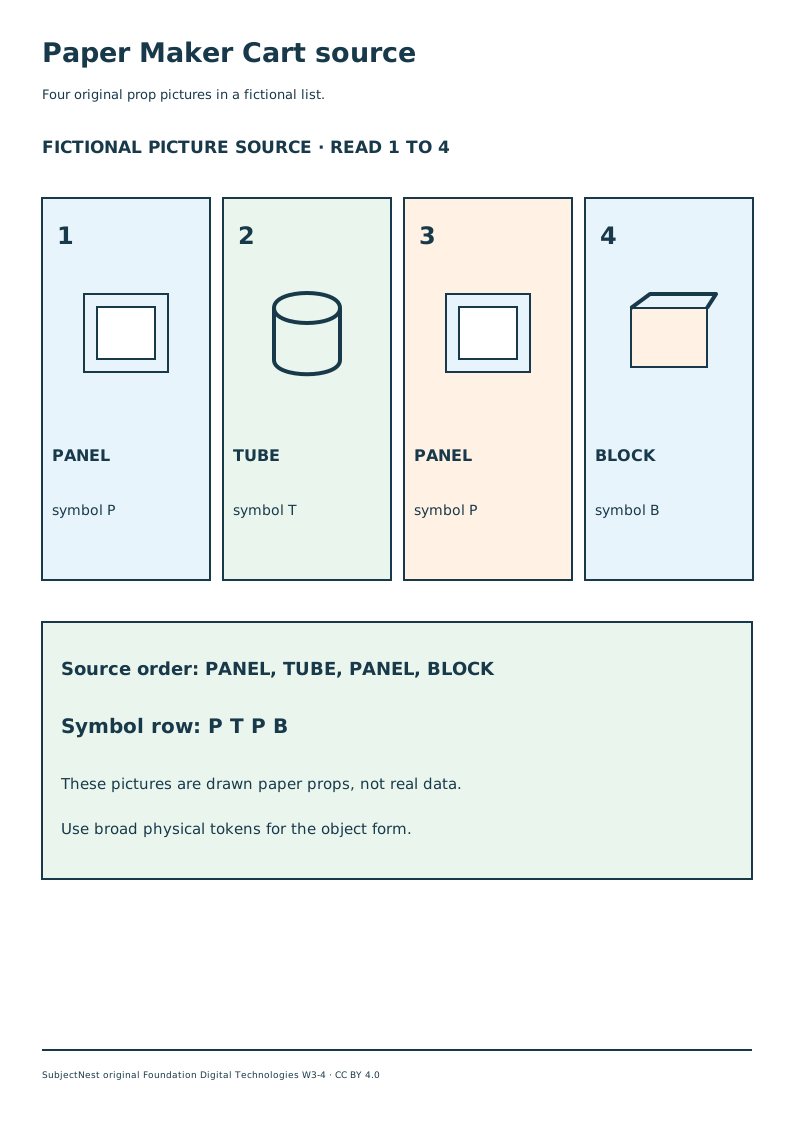
- At Day 13, put source above puppet copy. I compared all four positions: P=P, T=T, P≠B, B=B. The first and only error is position 3; replace puppet B with P. The teacher's four-minute check records the child's own source-linked reason and adult cues, rather than just a copied correct row.
- For Day 16, the hardware/software drawing depicts a real screen outline, keyboard keys and software window. It supports vocabulary only. The device gate prevents marking K01 from that drawing, a screenshot, an adult demonstration, or paper work. Without an approved observed child-controlled device action, the record is NOT OBSERVED.
- Before Days 15 and 20, I located the child-facing public checks without a direct teacher-key link. The worked key is separately labelled public by URL. Collect first responses before opening it; create a new local parallel case if prior access matters. The checks do not become secure exams by being held out of earlier lessons.
Teacher friction found and addressed: a printed source picture must not be called a physical object. The lesson, mat, text alternative and key all state that four real broad tokens are needed for that mode. A teacher will also need to preselect accessible large tokens; no family purchase is needed.
Learner/supporter lens · do the steps make sense?
- I followed the paper source as four entries, not the nested shapes inside a PANEL: PANEL, TUBE, PANEL, BLOCK. The original SVG depicts nested-square panel, cylinder tube, panel and sloped-top block, not text-only coloured labels. Pointing across the four picture fields supports order; the linear/tactile alternatives name each drawn form and its position.
- I desk-solved fresh Check A from its unseen source: ARCH, TILE, ARCH, RING → A T A R; ARCH repeats at 1 and 3; puppet A T R R needs position 3 changed R→A. MY NAME · EMPTY is the possible personal category; the plain prop icon is neutral. Fresh Check B: WEDGE, DISC, WEDGE, SLOT → W D W S; WEDGE repeats at 1 and 3; puppet W D S S needs position 3 changed S→W. MY FACE PHOTO · EMPTY is the possible personal category. No real name or photo is supplied. Both align with the separate public teacher-targeted worked key.
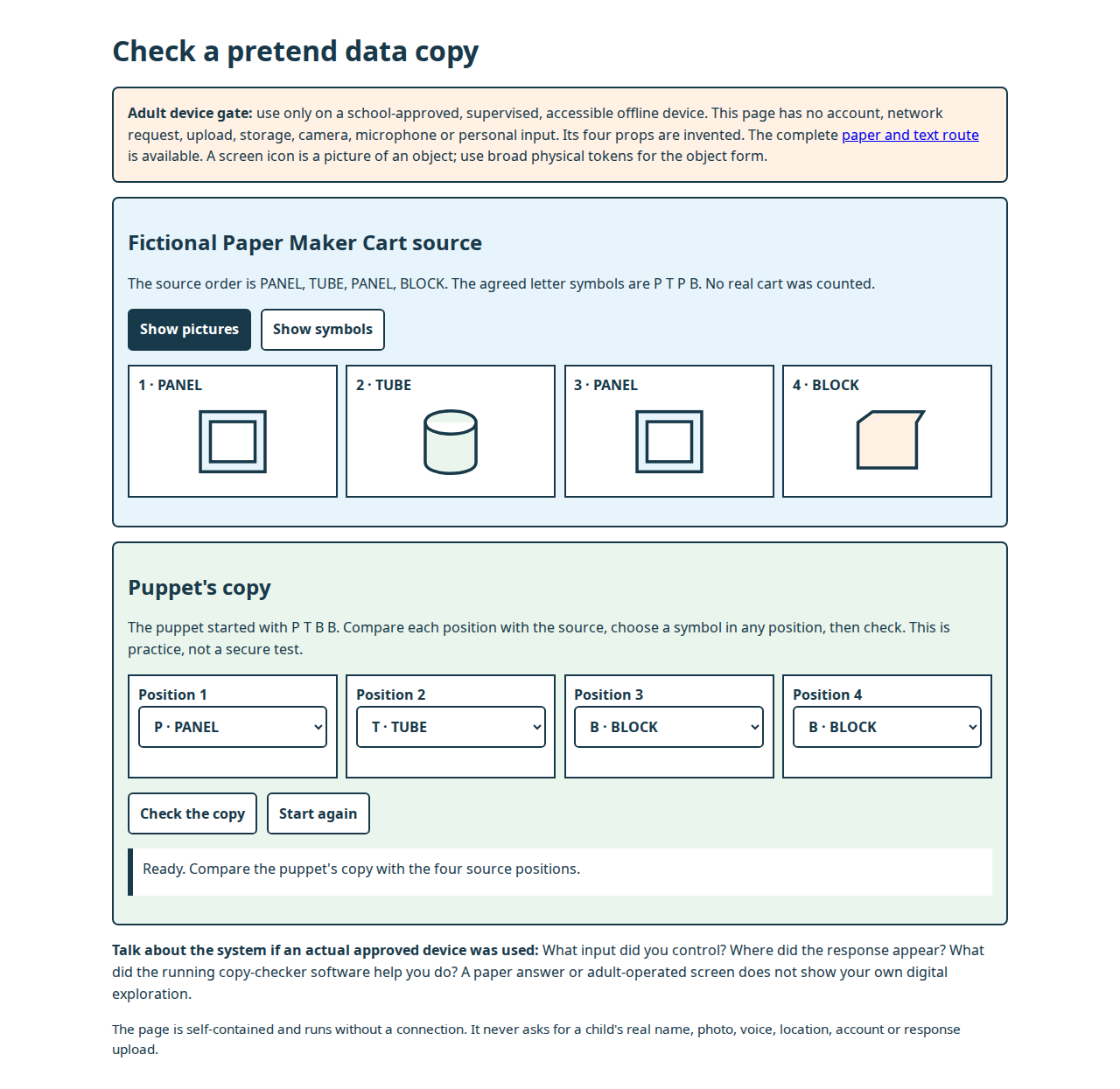
- I ran the offline checker in Chrome with its network set offline and the browser pointed at the local HTML file. Initial CHECK reported Different at position 3; selecting P at position 3 and CHECK reported All four positions match; Enter on the focused Show symbols button switched the view and
aria-pressed; RESET restored P T B B and the picture view. There were no page-script errors or network requests beyond opening the local file. At a 390 px viewport there was no horizontal overflow and all four buttons measured 48 px high. An automated axe-core pass returned 0 violations, 36 passes, 0 incomplete. The browser capture was visually inspected at 1280 px; the source cards contain distinct drawn icons, not labels alone. This is desktop author testing, not proof that a child or a particular assistive device can use it. - The full paper route reproduces source, object-token, picture, symbol, mismatch, feedback and restart steps. It reaches representation/correction practice without a screen. It cannot supply evidence of actual digital-system use.
Reviewer/funder lens · what can this pack safely claim?
The crosswalk pins exactly three ACARA Version 9 Foundation Digital Technologies rows. The QCAA Prep page and alignment document place them in Queensland Prep; the QCAA PDF's printed AC9TDI2K02 typo is explicitly reconciled to ACARA workbook AC9TDIFK02. The source/rights ledger separates official source rights from new CC BY 4.0 text/vector assets and Apache-2.0 code. All scenarios, pictograms and responses are invented. This is an optional ten-day partial sequence, not full learning-area allocation or demonstrated effectiveness. Actual K01 evidence is conditional; K02 and P01 are sampled only.
The eight PDF pages were rasterised and visually inspected in a contact sheet at child-scale overview, including both fresh pictorial sources, three-way mat, drawn system and blank category page. Both check sheets were then inspected at 1100 px; each neutral icon is now actually drawn next to its label. Each PDF was also checked as one-page A4 with selectable text, while recognising that PDF reading order and tagging are not certified. pdffonts found embedded DejaVu subsets, recorded in the rights ledger. The original SVG and full text/tactile alternatives are the accessible parallel route. A second generator run left all 16 SVG/PDF hashes unchanged. The verifier checks exact official rows, daily time/routes, public-key boundary, shape geometry, A4/source text, local links, offline static behaviour and every file hash; it does not measure real comprehension, accessibility with every assistive setup, privacy of a school device or classroom benefit.
Next real-world validation: one educator should trial the instructions and timing with approved materials, an accessibility lead should test actual configured input/screen reader use, and child first-response evidence should remain in the school's private system. Any result should be documented as observed, with support and context, before a stronger claim is made.