Version: v0.1 draft, 29 September 2026. Status: educator, accessibility and local-syllabus review pending. Audience: Foundation / Queensland Prep, after the Weeks 9–10 review. Use: ten 25-minute lessons, original context cards and plain-text aids, a low-ink A4 mat with PNG preview, and a two-week assessment and next-step guide.
| Day | Main idea | Curriculum practice |
|---|---|---|
| 51 | Ten loose objects, one count and numeral 10 | AC9MFN01 |
| 52 | Ten as two fives or one full frame | AC9MFN01, AC9MFN04 |
| 53 | Translate objects into ten marks | AC9MFN01 |
| 54 | Make different disjoint parts of ten | AC9MFN04 |
| 55 | Build and test a reusable ten-frame | AC9MFN01, AC9MFN04 |
| 56 | Equal sharing of six indivisible objects | AC9MFN06 |
| 57 | Share eight, then seven, between two mats | AC9MFN06 |
| 58 | Make equal groups from nine objects | AC9MFN06 |
| 59 | Compare grouping ten in pairs with sharing ten to two mats | AC9MFN06 |
| 60 | Fresh sharing/grouping transfer and close observation | AC9MFN06; review AC9MFN01/04 |
Prepare the room and the next teaching step
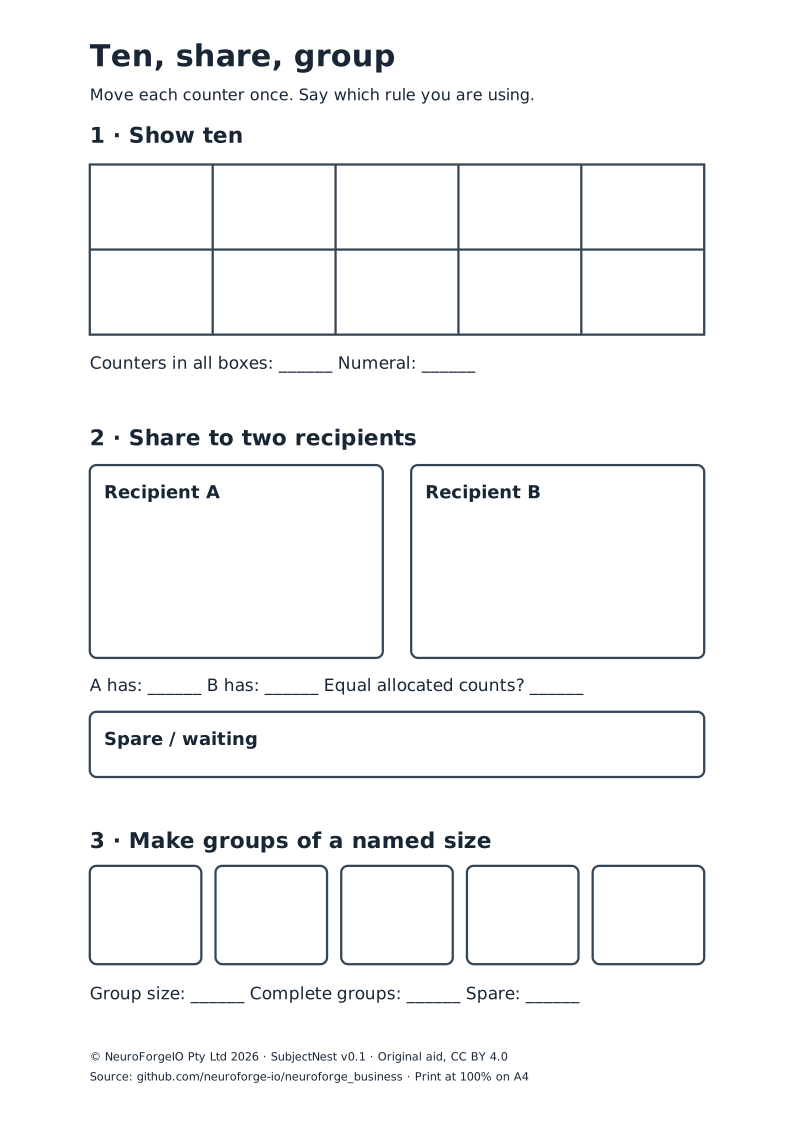
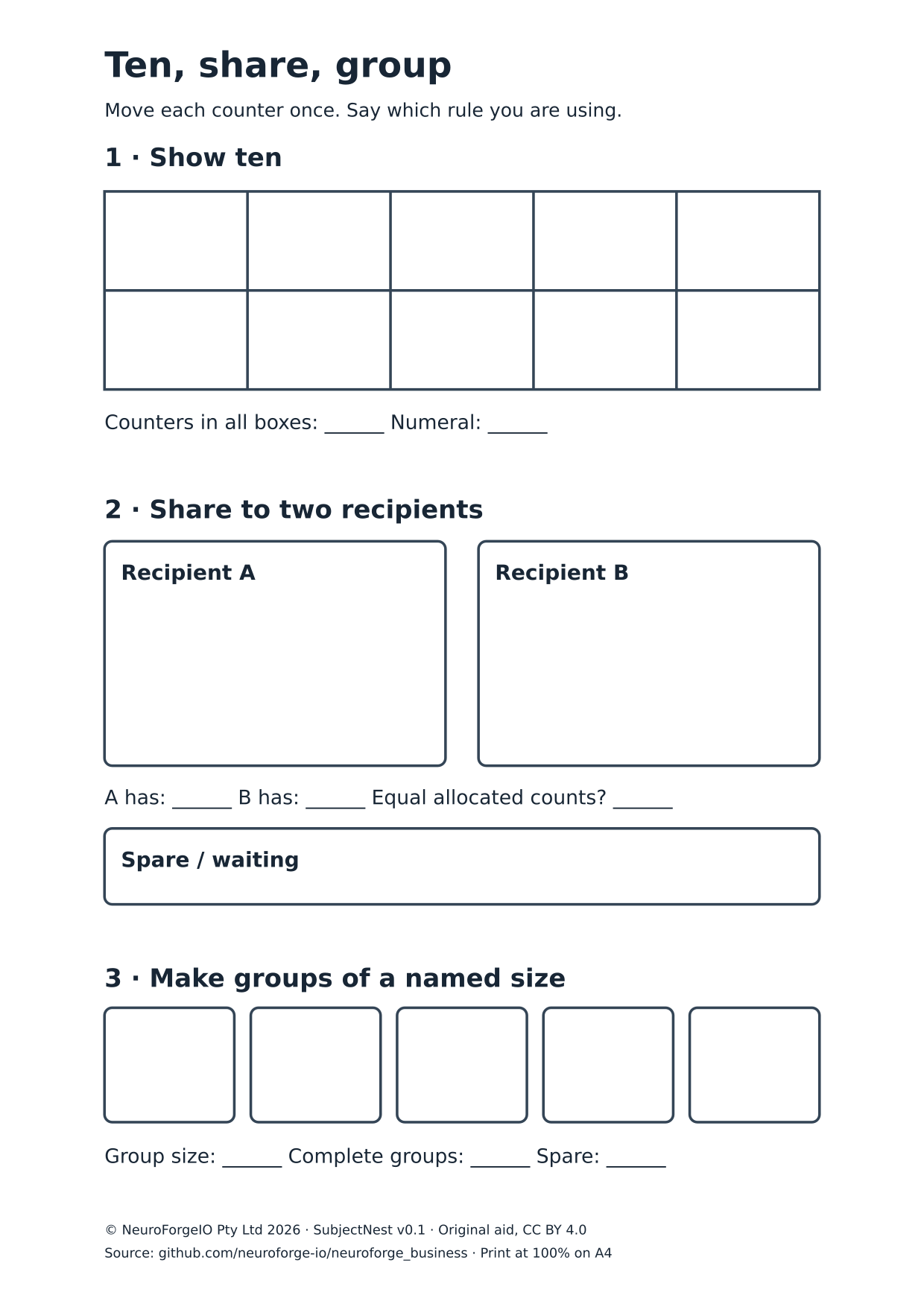
Each pair needs 20 large reusable counters or safe equivalent, two labelled recipient mats, a blank grouping zone, numeral cards 0–20, a pencil and reusable card. Use the A4 mat or draw its simple regions on paper. For each sharing task, counters are indivisible: a spare counter stays to one side. The children can describe another real-world rule, but do not change the mathematical rule halfway through a check. Avoid edible items and assumptions about a child's home, money or possessions. Story settings are imaginary and can be replaced locally.
Days 51–55 connect ten loose objects, a structured frame, two fives, marks, the numeral and part-whole. It is the same ten objects when partitioned; part labels do not introduce extra objects. Days 56–60 distinguish sharing among a given number of recipients from making groups of a given size. “Fair” in these lessons means equal numbers under the stated rule, not a judgement about a child or about fairness in every real situation. A spare indivisible item can remain unallocated without making the equal shares unequal.
Offer large or tactile counters, raised boundaries, uncluttered mats, spoken/printed directions, sign, AAC, a quiet route, and adult placement directed by the learner. Ten fingers are one optional representation; no child's hands are needed to prove ten. A virtual counter or frame can be an optional second format after hands-on work when it is accessible. Record the format and prompt used. Never assign a child a fixed “learning style”; vary the route for the task and learner. Retain work privately under school policy; no photographs are required. Use the assessment guide to plan a small group tomorrow, not to produce a report grade from one score.
Curriculum, evidence and rights
The codes below are Foundation Mathematics content descriptions in Australian Curriculum Version 9.0 downloads. Wording was checked against ACARA's official workbook retrieved 29 September 2026 (SHA-256 db446882d2c00cf7c085a03e250e2442fda6c44011fc114680c46c1dc7a822c3) and the local normalized snapshot data/frameworks/acara-v9.json.
- AC9MFN01: “name, represent and order numbers including zero to at least 20, using physical and virtual materials and numerals.”
- AC9MFN04: “partition and combine collections up to 10 using part-part-whole relationships and subitising to recognise and name the parts.”
- AC9MFN06: “represent practical situations that involve equal sharing and grouping with physical and virtual materials and use counting or subitising strategies.”
The ten-focused work is partial practice within AC9MFN01's wider zero to at least twenty scope. This pack alone does not show the full achievement standard, all physical and virtual formats or transfer across contexts. Check the locally adopted syllabus and the earlier portfolio before classroom use. AERO early numeracy informs deliberate use of objects, representations and mathematical talk; AERO progress monitoring informs brief observations and a later fresh recheck. The lessons and rubric are original drafts, not independently classroom validated.
ACARA rights: The three descriptions above are reproduced without modification. © Australian Curriculum, Assessment and Reporting Authority (ACARA) 2010 to present, unless otherwise indicated. This material was downloaded from the Australian Curriculum website (accessed 29 September 2026) and was not modified. The curriculum material is licensed under CC BY 4.0; see ACARA copyright and terms for exclusions. ACARA does not endorse, sponsor or approve SubjectNest. No ACARA logo, third-party photograph, worksheet, song or story is included.
Original material licence: © NeuroForgeIO Pty Ltd 2026. Original lessons, scripts, cards, print aids, vector art and assessment in this folder are CC BY 4.0, including commercial reuse with attribution. Suggested credit: “NeuroForgeIO Pty Ltd, SubjectNest: Ten ways to see; fair ways to share — Foundation mathematics, Weeks 11–12, v0.1 (2026), source, CC BY 4.0”; indicate changes. This licence does not relicense ACARA or third-party material. A translation needs an exact locale and qualified human review before use.