Use the 25-minute scripts with clean three-choice cards. Keep teacher-held new sets covered until Days 145 and 150. All loose paper tiles are large (at least 40 mm), supervised and accounted for; replace them with drawn marks, large blocks, screen-reader labelled virtual counters or child-directed adult movement when needed. No edible counters, coins, sharp fasteners, body measurements, personal purchases or home resources are required.
Week 29 practice sets · each has a unit that repeats
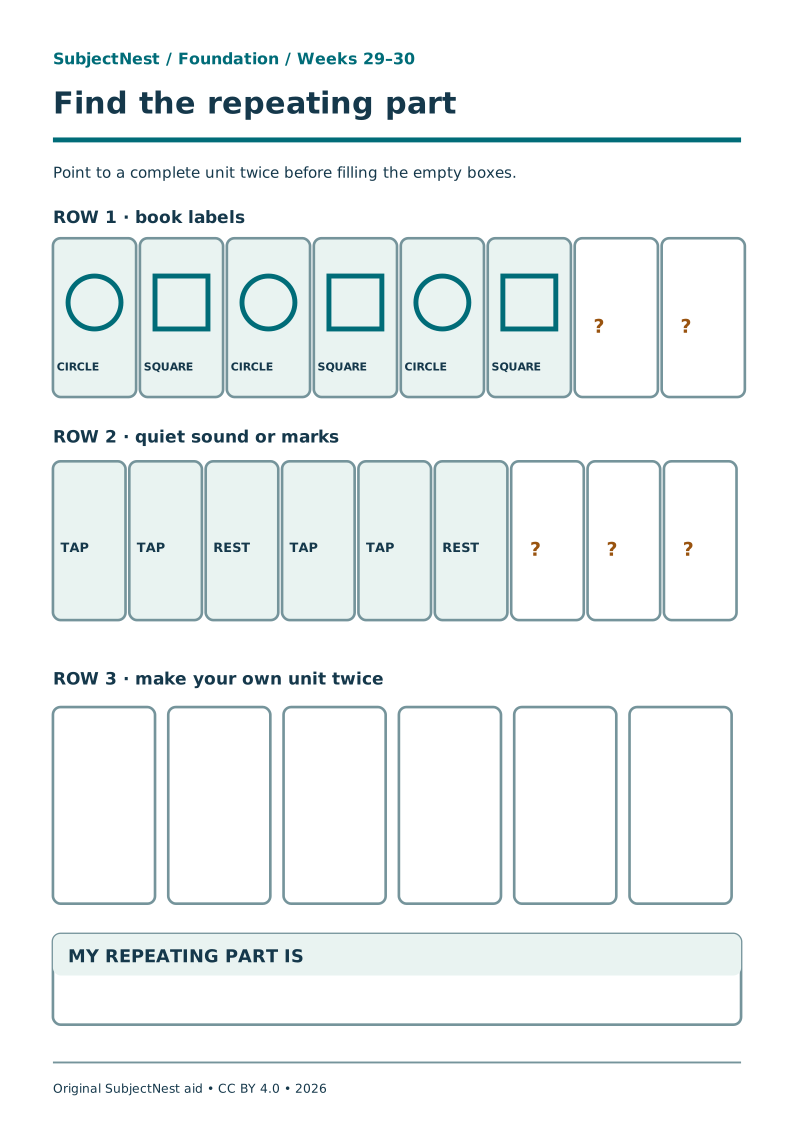
- P1, book-shelf labels: large CIRCLE, SQUARE, CIRCLE, SQUARE, CIRCLE, SQUARE, then two empty boxes. The repeating unit is circle–square. Exact first two missing symbols: circle, square.
- P2, quiet percussion/marks: TAP, TAP, REST, TAP, TAP, REST, then three empty boxes. A tap may be an agreed visual flash, broad mat touch, tactile token or spoken “tap”; a rest is an empty beat. The repeating unit has three positions, not “tap” alone. Exact next three: tap, tap, rest.
- P3, maker flags: DOT, BAR, TRIANGLE, DOT, BAR, TRIANGLE, then three empty boxes. Exact next three: dot, bar, triangle. Shape/word labels distinguish symbols without colour.
- P4, an error to repair: CIRCLE, SQUARE, CIRCLE, CIRCLE, CIRCLE, SQUARE. If intended rule is circle–square, the fourth card is wrong. A child may instead describe a longer invented unit only if they can show two full repeats; one guess after a single partial cycle is not evidence of repetition.
- P5, child's own: choose two or three distinct, accessible large symbols/actions; build and name a complete unit at least twice, with a next position. Record the child-controlled unit before peer feedback.
Print the A4 pattern strip or PDF. It shows P1, P2 and blank pattern boxes. Exact text alternative: Row 1 CIRCLE / SQUARE / CIRCLE / SQUARE / CIRCLE / SQUARE / empty / empty. Row 2 TAP / TAP / REST / TAP / TAP / REST / empty / empty / empty. Row 3 has six blank boxes; child fills at least two full cycles of a chosen unit. Tactile route: use circle and four-cornered square cards; a thick horizontal bar means REST. Read the labels in order; do not announce the unit before the child tries. A 2–3-cell paper unit frame can be slid along a row by a child or a directed adult.
Week 30 practice sets · count each object once
Teacher setup: Lay all objects in view, shuffle their positions before some trials, and let the child touch/point/count in any systematic order. Use identical large tiles when comparing quantities; colour or tile size is irrelevant. Do not confuse a row's visual length with quantity. Never preprint the answer beside the set a child is asked to count.
- C1, paper sign stand: 13 identical large square tiles; arrange as 10 in a tray and 3 beside it, then scatter the same tiles. Both arrangements are thirteen. Optional 0–20 numeral cards are shown after child counting.
- C2, maker display: 15 identical tiles; show a row of 10 and a row of 5. Count once, move the last five into a ring, then count/check again. Fifteen remain.
- C3, two proposed card stands: A gets 12 identical large tiles, B gets 16. Match one-to-one or count each with a tracked path; B has four more tiles. This does not show B is physically stronger.
- C4, reset and compare: A gets 10 tiles, B gets 18. Space A far apart and crowd B together. The spacing changes appearance, not quantity; B has eight more. At a child's point, stop at “B has more” rather than requiring the difference.
- C5, no spare: one model uses all 20 broad tiles; the supply mat is then empty, showing zero left. The maths question is to name/represent 20 used and zero left; this is not scored as a subtraction algorithm.
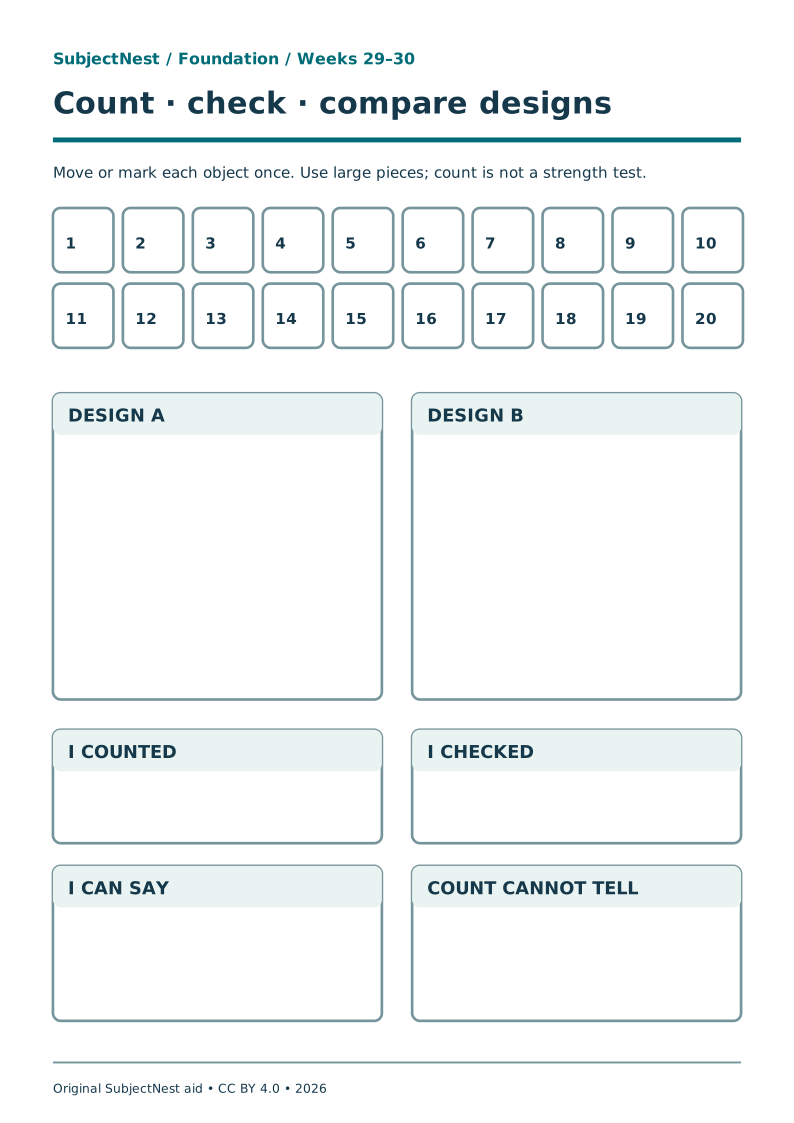
The A4 count/check mat or PDF has 20 indexed places in two rows of ten, a blank Design A and Design B region, and fields I COUNTED / I CHECKED / I CAN SAY / I CANNOT TELL FROM COUNT. Exact nonvisual route: offer a ten-pocket tactile tray twice, then let the child place one tile in each slot and name the count. For comparing two groups, keep separate tactile trays and move exactly one tile from each into matched pairs, retaining any unpaired extras. Child may direct adult placement. The last field prevents “more pieces” from being reported as “stronger design”.
Misconception and response prompts
| First observation | Teacher response next day |
|---|---|
| Child copies visible marks but cannot name the repeating unit | Frame one full unit; slide that same frame over two cycles; offer a different two-symbol row and fade the frame. |
| Child fills “next” by choosing a favoured colour or icon | Remove colour, ask for the repeated order, and make the child show two complete units before predicting. |
| Child recounts one tile twice or skips a tile | Put each counted tile in an indexed mat place or move it to a “counted” tray; start again with a fresh arrangement. |
| Child says spread-out row has more | Pair tiles one-to-one, then separate spacing while keeping every pair. Ask whether a tile appeared/disappeared. |
| Child calls the more-piece design “better” | Ask which quality the count established (only number of pieces), then name a real safe test for strength or stability. |
All pattern sets, numeral tasks and vector aids are newly authored for SubjectNest. ACARA wording is included only by reference in the source crosswalk. Original SubjectNest materials © 2026 NeuroForgeIO Pty Ltd, CC BY 4.0. Credit, link and indicate changes.