Each day: 25 minutes = 3 retrieve/notice + 5 explicit model + 7 guided analysis + 7 learner application + 3 exit/record. Use original fictional source cards, A4 visual post and unseen transfer assessment. Source A contains an unsupported generalisation about young people. Set an evidence-and-respect discussion norm; no child is asked to represent a category, disclose personal use or defend the claim. Provide source text/read-aloud/screen reader, visual description, large print, AAC/sign, keyboard and scribe routes as needed; record independent reading apart from reasoning. The alignment note identifies partial Year 9 codes.
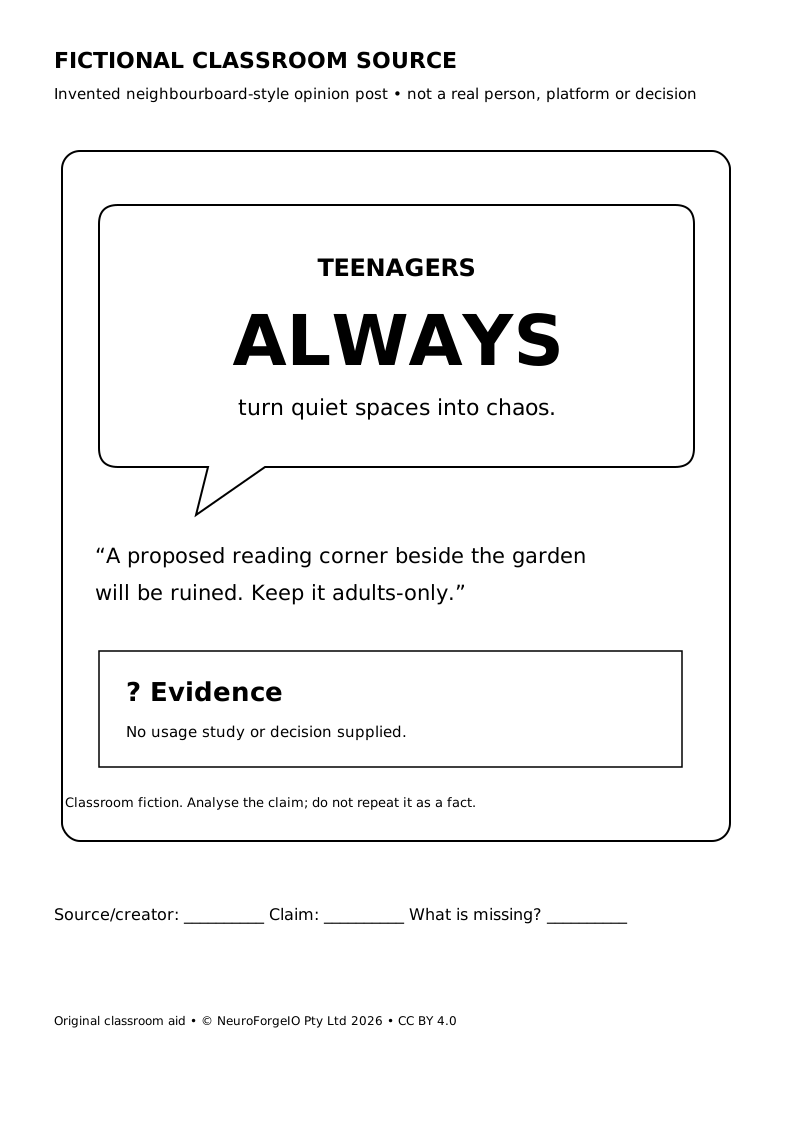
Day 1 — Origin, purpose and exact claim
Goal/materials: identify who speaks, what the post asks readers to believe and what is unverified; Card A, source strip.
- Notice, 3: Display only Card A's large headline. Ask “What is the word
alwaysdoing?” Key: makes a universal claim, not evidence. - Model, 5: Teacher says “The source label tells me this is an invented mock post, written for persuasion. I will quote its exact claim as an object of analysis, not endorse it. It predicts a corner will be ruined without supplying a usage study.”
- Guide, 7: Together mark creator/type, intended audience (readers of mock community board), purpose (influence support), exact claim and missing evidence. Separate Card A from a real news report or council decision.
- Try, 7: Learner fills four source-strip fields and rewrites the claim with attribution: “The fictional account claims …”. A partner checks quoted wording; adult can transcribe learner words exactly.
- Check, 3: “Does Card A establish what all teenagers do?” Key: no; no basis for universal claim. Next: if yes, point to missing-evidence line and practise
source claimsversuswe know.
Day 2 — Evaluation can be direct or implied
Goal/materials: notice direct evaluation and indirect positioning; Cards A/B, highlight strips.
- Notice, 3: Compare “chaos” with Card B's “possible features”. Which directly judges? Key: chaos.
- Model, 5: “
Ruinedgives a negative verdict.Alwaysovergeneralises. Card B's calm list can also position a reader favourably toward a plan even without saying ‘good’; we still ask what it omits.” Do not treat neutral tone as automatic truth. - Guide, 7: Sort five snippets:
chaos,adults-only,possible shade,will be ruined,no final decision. Key: direct negative evaluation first/fourth, exclusion proposal second, descriptive/uncertain third/fifth. Accept well-reasoned overlap in effect. - Try, 7: Learner annotates two exact words and explains their likely effect on a reader without repeating the stereotype as a fact. Offer word bank: predicts, excludes, qualifies, proposes.
- Check, 3: “Can a calm tone still leave important questions out?” Key: yes; Card B lacks use, cost and access audit. Next: compare source content columns, not tone alone.
Day 3 — Symbols and size shape meaning
Goal/materials: analyse visual choices using text alternative; SVG post, Card A description.
- Notice, 3: Ask what is largest and what is smallest in the designed post. Key:
ALWAYS/headline large; fiction/no-evidence detail small. - Model, 5: “A speech bubble marks a voiced assertion. The empty evidence box asks a question. Size can make a claim memorable; it cannot verify it.” Read the complete text/layout aloud for everyone.
- Guide, 7: Learners compare visual with equal-size plain text. Identify what changes (attention and emphasis) and what stays (unsupported claim, proposal status). Do not make colour recognition necessary.
- Try, 7: Student describes an alternative fair layout in words, tactile blocks or sketch: equal prominence for source label, evidence question and claim. Explain one expected effect; grade analysis, not drawing.
- Check, 3: “Does a question-mark icon prove a study was done?” Key: no; this original graphic signals missing evidence. Next: attach a source-status label to each visual element.
Day 4 — Whose perspective is represented?
Goal/materials: compare attributed fictional perspectives without treating one speaker as a group; Cards A–C.
- Notice, 3: Name whose view Card A asserts. Key: account author's claimed view, not a view of all adults or residents.
- Model, 5: “Ari says might use and asks for opening times; Lee values a calm path and asks for a site plan. They could both ask useful questions. Neither speaks for all young or adult people.”
- Guide, 7: Pair exact phrases with speaker and degree of certainty (
alwaysversusmight/would). Discuss missing voices as missing information, not invent testimonies. - Try, 7: Learner makes a 2-column evidence table: what each fictional voice actually states and what cannot be inferred. Example limit: Ari's preference does not prove all teenagers need a reading corner.
- Check, 3: “Can Card C alone settle the proposal?” Key: no, it supplies individual preferences/questions. Next: request usage and design evidence without polling classmates as representatives.
Day 5 — Compare sources before concluding
Goal/materials: evaluate support, limits and possible effect on attitudes; Cards A–C, comparison strip.
- Notice, 3: Retrieve source types: mock post, proposal note, attributed fictional voices. Key: each has a different purpose and limit.
- Model, 5: “Card A says exclude all teenagers. Card B instead proposes use by different ages, but has no study. Card C asks about practical conditions. I can conclude the universal exclusion claim is unsupported; I cannot conclude the proposal is approved or perfect.”
- Guide, 7: Class fills
claim / actual source detail / unknownfor three statements:all young people make noise,a step-free route is proposed,the site is approved. Keys: unsupported, stated concept only, not supplied. - Try, 7: Learner gives a 3-sentence spoken/written comparison with two source labels and one uncertainty. An AAC sequence or typed table is valid; note content cues.
- Check, 3: “What is the difference between a stated step-free route and a verified accessible site?” Key: one is a proposal; the other needs design and lived-use/access review. Next: rewrite a too-certain sentence with
proposes.
Day 6 — Nominalisation can hide an actor
Goal/materials: unpack abstract labels and restore who did what; Cards A/B, sentence cards.
- Notice, 3: Show “The disruption was inevitable.” Ask “Who did what, and according to whom?” Key: neither is specified;
disruptionis an abstract label,inevitableunsupported. - Model, 5: “Turning an action into a noun can condense ideas:
people complained→complaints. It can also hide agency:the exclusion of teenagersleaves out who proposes it.” This is a language choice, not proof of bad intent. - Guide, 7: Unpack
the decision,the concern,the exclusioninto subject + action + source. Example: “The fictional poster's author proposes excluding teenagers.” Compare effects of vague versus attributed form. - Try, 7: Learner revises two statements: “The concern was shared” and “The proposal was rejected.” Accept: “Card A's author expresses a concern; the packet gives no evidence others share it”; “No source states the proposal was rejected.”
- Check, 3: “Why might
the concernbe misleading without a source?” Key: it can imply a shared concern when only one fictional post states it. Next: name speaker and evidence in fresh sentence.
Day 7 — Paragraph order can make a claim seem settled
Goal/materials: plan an analytical response whose sequence keeps claim, evidence and limit clear; Cards A–C, response frame.
- Notice, 3: Compare two outlines:
claim → conclusion → evidenceversusclaim → source detail → limit → provisional conclusion. Ask which helps a reader audit reasoning. Key: second. - Model, 5: Teacher writes: “The mock post presents an exclusion claim through
always. The proposal note instead lists possible shared-use features, yet supplies no usage study. The voices ask about opening times and path design. I would request that evidence before a real decision.” Identify each function. - Guide, 7: Students reorder four sentence strips and justify a connective (
however,because,before) rather than adding a decorative transition. Discuss how a conclusion-first version can hide uncertainty. - Try, 7: Learner makes own four-part plan with one exact Card A phrase, a Card B detail, a Card C question and a limit. Response can be bullets/AAC before paragraph writing.
- Check, 3: “Where does your plan say what remains unknown?” Key: explicit limit/evidence request. Next: add a sentence before conclusion if absent.
Day 8 — Test a scientific-looking sentence
Goal/materials: carry source reasoning into a labelled invented science caption; Card D and science model.
- Notice, 3: Read Card D's first sentence. Key: invented model assigns 100 J input and 60 J useful light output.
- Model, 5: “The second sentence says no energy goes elsewhere. That does not follow: 40 J remains to be accounted for as other transfers in the model. I will not claim we measured a real lamp.” Distinguish model data from observation.
- Guide, 7: Pairs underline numerical statement, unsupported inference and missing 40 J. Use the original energy-flow diagram/text as a second source, with source status named.
- Try, 7: Learner revises the caption fairly in two sentences, naming input, useful output and other transfer. Sample key: “Our fictional model has 100 J input and 60 J useful light; it assigns 40 J to other transfers. A measured lamp would need sourced data.”
- Check, 3: “Does the model show a real device's efficiency?” Key: no, the values are invented. Next: put
modelbeside each number before inference.
Day 9 — Draft and edit a fair analytical response
Goal/materials: turn the plan into a short source-based paragraph for a community-reader audience; Cards A–C, frame.
- Notice, 3: Retrieve difference between “The post says…” and “All teenagers…”. Key: first attributes; second repeats a false universal as fact.
- Model, 5: Compose four sentences from Day 7 plan, explicitly naming sources and one uncertainty. Read aloud once to check the reader can tell proposal from decision.
- Guide, 7: Class checks a flawed draft: “The council approved an accessible garden because everyone wants it.” Correction: no real council or approval, no completed access audit or universal preference in packet. Retain a qualified proposal claim.
- Try, 7: Learner drafts/records 4–5 linked sentences with source labels and revises one sentence for accuracy or effect. Adult transcription must preserve learner wording; no public posting or named peer examples.
- Check, 3: Learner points to exact source wording, attributed view and open question in own response. Next: if one absent, use the three-column comparison strip for a targeted revision.
Day 10 — New source transfer, not a rehearsed answer
Goal/materials: analyse unseen fictional Card E in the assessment and select next teaching.
- Notice, 3: Recall source routine
origin → purpose → perspective → support → omission → cautious response; no Card E content shown yet. - Model, 5: Correct an unscored Card A sentence: “A concept note is not an approval notice.” Name how
proposedchanges certainty. - Guide, 7: Reveal Card E and read through independently or with documented read-aloud access. Ask only “What two source types are supplied?” Key: mock advocacy post and draft planning note. Do not model scored interpretation.
- Try, 7: Learner begins independent assessment Items 1–3; adult supplies access support, not claim/evidence choices. Finish the full check in a separate 10–15-minute block or conference.
- Check, 3: Ask “What claim needs an external check before a real decision?” Key: any claim of universal benefit or actual use. Use rubric and prior writing/reading evidence to decide next instruction, not a single total.
Common response and boundaries
If a learner equates strong words with true facts, return to exact source/status and missing evidence. If they call a fictional voice “fake” because it is subjective, distinguish attributed preference from universal inference. If they copy a hostile claim as an unattributed assertion, require the mock post claims… and discuss its lack of support. If discussion targets a classmate or identity group, redirect to language/evidence and follow school wellbeing processes. Secure analysis via read-aloud is valid reasoning evidence, while independent decoding/reading needs its own check. This pack never asks students to represent their age, culture, disability or family.
Rights: Original lessons © NeuroForgeIO Pty Ltd 2026, CC BY 4.0. ACARA source/rights in README. Educator/EAL/D review pending.