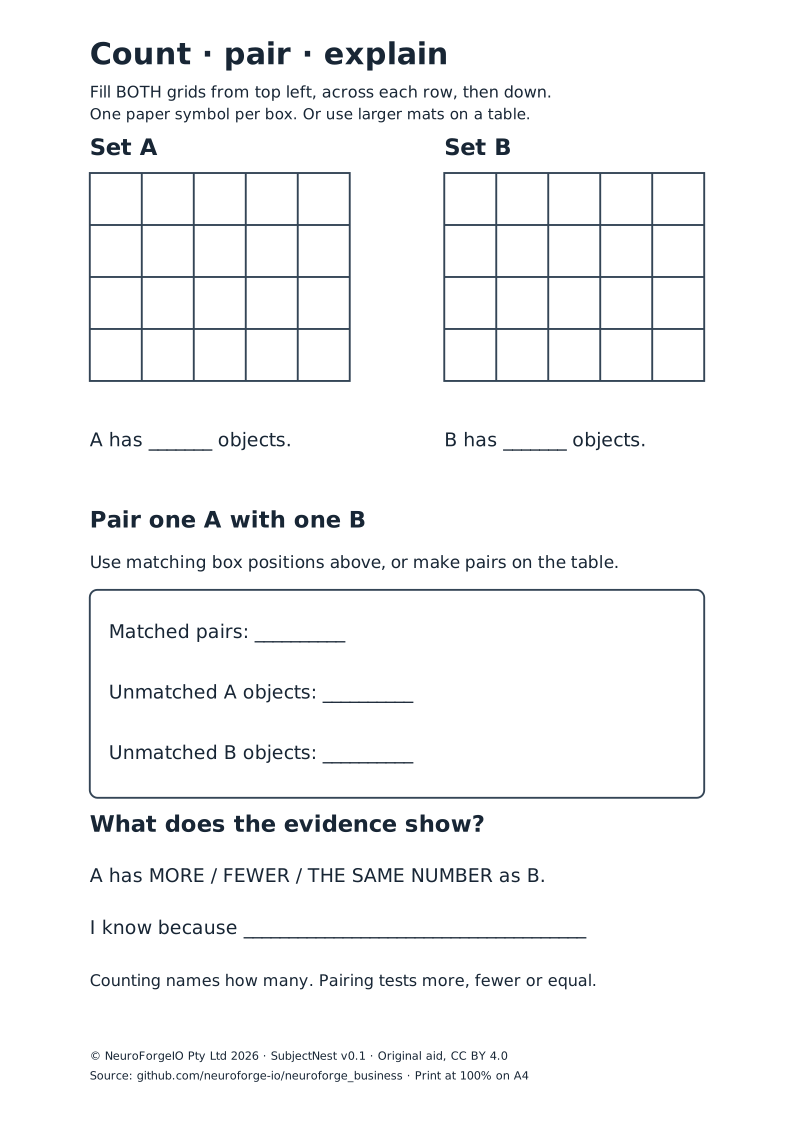
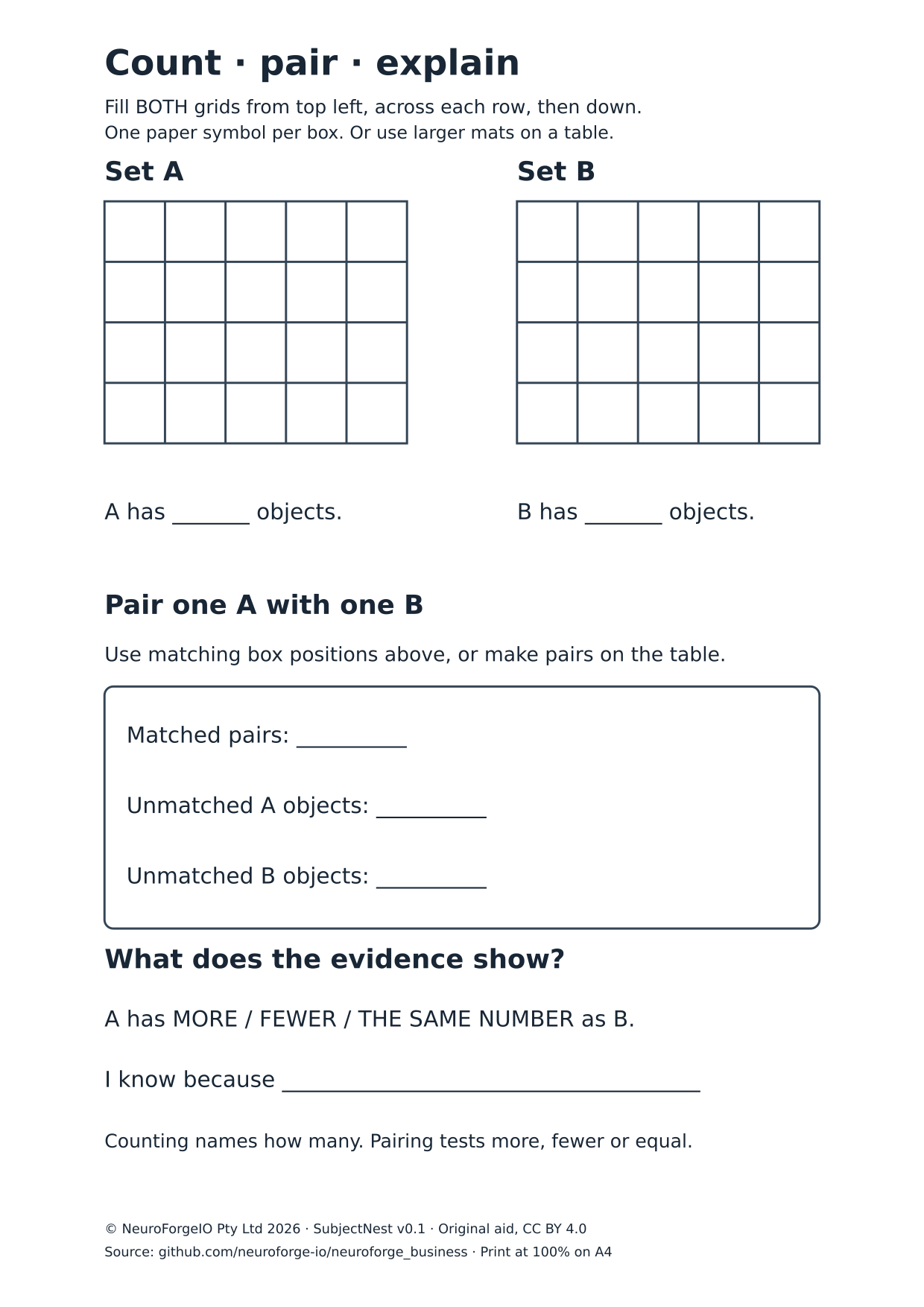
Version: v0.1 draft, 29 September 2026. Status: educator, accessibility and local-syllabus review pending. Audience: Foundation / Queensland Prep, after Weeks 11–12. Use: ten 25-minute lessons, 24 original context cards and plain-text aids, an A4 comparison page with PNG preview, and a formative assessment.
| Day | Main question | Principal code |
|---|---|---|
| 61 | How many in each set? | AC9MFN03 |
| 62 | Can every object find one partner? | AC9MFN03 |
| 63 | Which set has unpaired objects? | AC9MFN03 |
| 64 | Does spreading change how many? | AC9MFN03 |
| 65 | What if one set is empty, equal or twenty? | AC9MFN01, AC9MFN03 |
| 66 | Which paper leaf set has more? | AC9MFN03 |
| 67 | Can size and spacing mislead us? | AC9MFN03 |
| 68 | Can different pictures have equal counts? | AC9MFN03 |
| 69 | Which strategy gives evidence? | AC9MFN01, AC9MFN03 |
| 70 | Which fresh comparison can I show? | AC9MFN01, AC9MFN03 |
The mathematics and the context
The first week uses physical sets up to and including 20. Count by moving each object once; the last number names the collection. For a direct comparison, align one object in A with one in B; a leftover shows which set has more. Pairing can show more, fewer or equal without naming the total. Counting both sets gives the quantities and a second check. Do not infer “more” from the length of a scattered row or the size of printed pictures. Keep the counted objects within labelled boundaries so one object cannot be counted twice.
The second week uses fictional paper drawings and cutouts of leaves, seeds and other living-thing imagery. These are authored exercise materials, not observations of actual local plants or animals. Count the printed symbols only. A child does not need to know an organism's name, habitat, life stage or whether an image is scientifically realistic to succeed in mathematics. If a class also observes real local living things, that is a separate, locally safe and dated science activity; do not attach our printed totals to it. Do not collect real seeds, unknown plants, live animals or child photos for this pack.
Each pair needs up to 20 large counters of type A and 20 of type B (or two distinguishable safe textures), two labelled trays/mats, and the low-ink page or equivalent table layout. Prepare only the counts named in the day's teacher card. A virtual counter view is an optional accessible transfer after physical work; evidence here is partial relative to AC9MFN01's wider physical/virtual scope. For sensory or motor access, provide raised boundaries, grippable pieces, enlarged cards, spoken/plain-text prompts, sign, AAC, a quiet route, or adult moves precisely directed by the child. Record the access route and any mathematical hint. No fixed “learning style” label or speed target is used. Keep child work private under school rules.
Source, scope and reuse
Foundation Mathematics codes below were checked against Australian Curriculum Version 9.0 downloads, official workbook retrieved 29 September 2026 (SHA-256 db446882d2c00cf7c085a03e250e2442fda6c44011fc114680c46c1dc7a822c3) and local normalized snapshot data/frameworks/acara-v9.json.
- AC9MFN01: “name, represent and order numbers including zero to at least 20, using physical and virtual materials and numerals.”
- AC9MFN03: “quantify and compare collections to at least 20 using counting and explain or demonstrate reasoning.”
These ten lessons contribute to those descriptions. A single fortnight, format or checklist cannot establish the whole achievement standard; use several samples and the locally adopted syllabus. AERO early numeracy supports planned counting, correspondence, comparison and mathematical talk. AERO monitoring progress informs observing, teaching and rechecking. This pack has not been classroom validated.
ACARA rights: The two descriptions are reproduced without modification. © Australian Curriculum, Assessment and Reporting Authority (ACARA) 2010 to present, unless otherwise indicated. This curriculum material was downloaded from the Australian Curriculum website (accessed 29 September 2026) and was not modified. It is licensed under CC BY 4.0, subject to ACARA's terms and exclusions. ACARA does not endorse, sponsor or approve SubjectNest. No ACARA logo, third-party art, worksheet, photograph or work sample is included.
Original material licence: © NeuroForgeIO Pty Ltd 2026. Original lessons, scripts, context cards, print/visual aids and assessment in this folder are CC BY 4.0, including commercial reuse with attribution. Suggested credit: “NeuroForgeIO Pty Ltd, SubjectNest: Count, pair, explain — Foundation mathematics, Weeks 13–14, v0.1 (2026), source, CC BY 4.0”; indicate changes. This does not relicense ACARA or other parties' material. No translation is reviewed; an exact locale and qualified human review are needed before use.