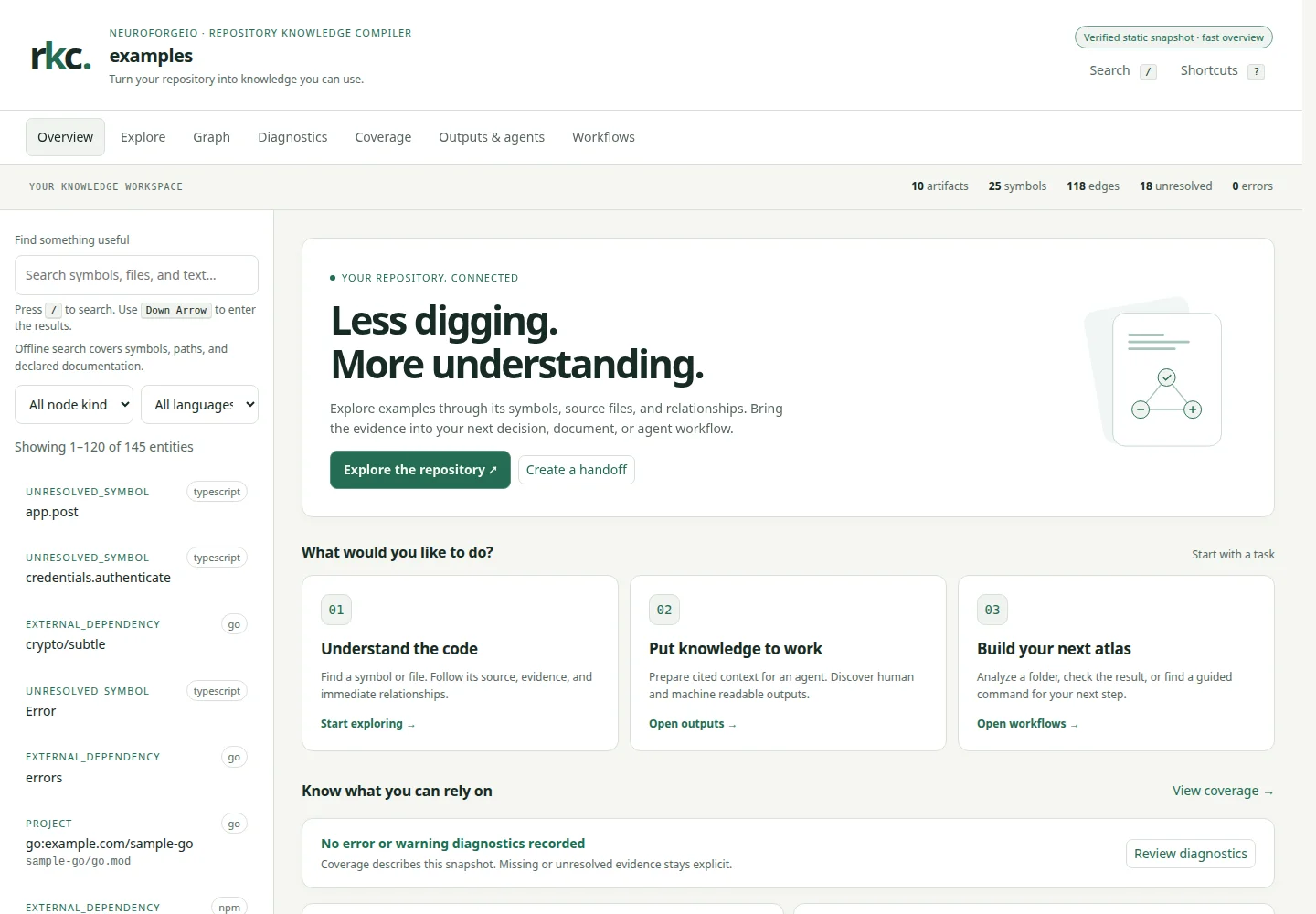
Explore in your browser
Search files and symbols, follow their connections and open the original file.
Free software · Runs locally · RKC
New codebase? A folder of documents you can’t make sense of? RKC makes a searchable map on your own computer, so you can find what matters and open the file it came from.
Optional setup and training: A$110/hour including GST, billed for actual minutes. We agree a maximum in writing. What setup includes →
Start with your own source
Choose your system, install the portable release, then open the local workbench.
RKC 0.4.1 portable downloads are available, including tracked local workspaces. See the release receipts for tested platforms. Manual downloads and release notes
Before you install
Requires user-systemd and delegated cgroup v2 controllers for compilation. Installer: curl, unzip and sha256sum or shasum. Check the installation guide →
curl -fsSL https://github.com/neuroforge-io/RKC/releases/download/v0.4.1/install-release.sh | sh -s -- --version v0.4.1export PATH="$HOME/.local/bin:$PATH"
rkc guiBefore you install
macOS 12+. Installer: curl, unzip and shasum or sha256sum. Intel and Apple silicon builds. Check the installation guide →
curl -fsSL https://github.com/neuroforge-io/RKC/releases/download/v0.4.1/install-release.sh | sh -s -- --version v0.4.1export PATH="$HOME/.local/bin:$PATH"
rkc guiBefore you install
Windows 10+ and PowerShell 5.1+. The portable installer adds RKC to your user PATH and current session. Check the installation guide →
& ([scriptblock]::Create((irm https://github.com/neuroforge-io/RKC/releases/download/v0.4.1/install-release.ps1))) -Version v0.4.1rkc guiIn the workbench
Portable downloads need no Go, Python or model. Folder compilation stays local; GitHub acquisition connects to GitHub.
Need a hand getting it working?
RKC is free. Tell us what you want to find and what computer you use. We’ll try a relevant example before agreeing the setup, training and maximum fee.
Make sense of what you find
See which files were indexed and which references need a closer look. Open a result to check the original source before using it in your work.
Public repositories need no account connection. For private repositories, connect with a personal access token held only for your local server session.
Work with the results
The same source records are available in the workbench, to agents and to your own code.
Search files and symbols, follow their connections and open the original file.
Retrieve cited records through MCP or HTTP for another tool to inspect. RKC supplies the records; your agent writes the answer.
Run scans from the CLI, export JSON records or use the typed Go client in your own application.
Open source · Apache 2.0
Add an analyzer, build an integration, report a rough edge or use RKC in a project of your own.
Original RKC code is available under Apache 2.0. Source material and third-party components keep their own licences.
RKC is an independent open-source project from NeuroForge. ERAIS is a separate proprietary system.