Foundation / Queensland Prep · Visual Arts · Term 2 Weeks 17–18 · Days 81–90 · v0.1.0-draft
Make a broad raised cardboard master, try a dry crayon rubbing, and arrange pieces into your own picture. Choose a quiet desk display, an original postcard for a willing recipient, or a private work to keep. A learner may handle approved materials, direct an adult exactly, or make an unmade plan through words, sign, AAC or pointing. Each route preserves the child's art decisions; record who physically made each stage.
This is a new process after Weeks 15–16 paper construction: the raised master, marks that actually appear on rubbing paper, and a collage assembled from those papers are three different things. The crayon makes marks on the top paper; it is not ink transferred from the cardboard. Our source drawings are illustrations of possible setups, not photographs or results of a rubbing test. No result is promised.
Start as a teacher
- Read materials and preparation, then ten 25-minute scripts. Prepare broad clean card, pre-fixed relief forms and a successful adult trial before offering rubbing. If the materials fail or the process is unsuitable, use the complete drawn-paper/planning route and record it honestly.
- Offer the thirty response routes and ten optional home bridges. Keep the child in control of shape, position, selection, arrangement and intended meaning. Display, handling, cutting, touch and sharing are optional.
- Use twenty worked swaps for practice. Preserve the first fresh response on Days 85/90 before any worked check-day example. Checks Y/Z and the separate teacher key support a next step; they do not award a term grade.
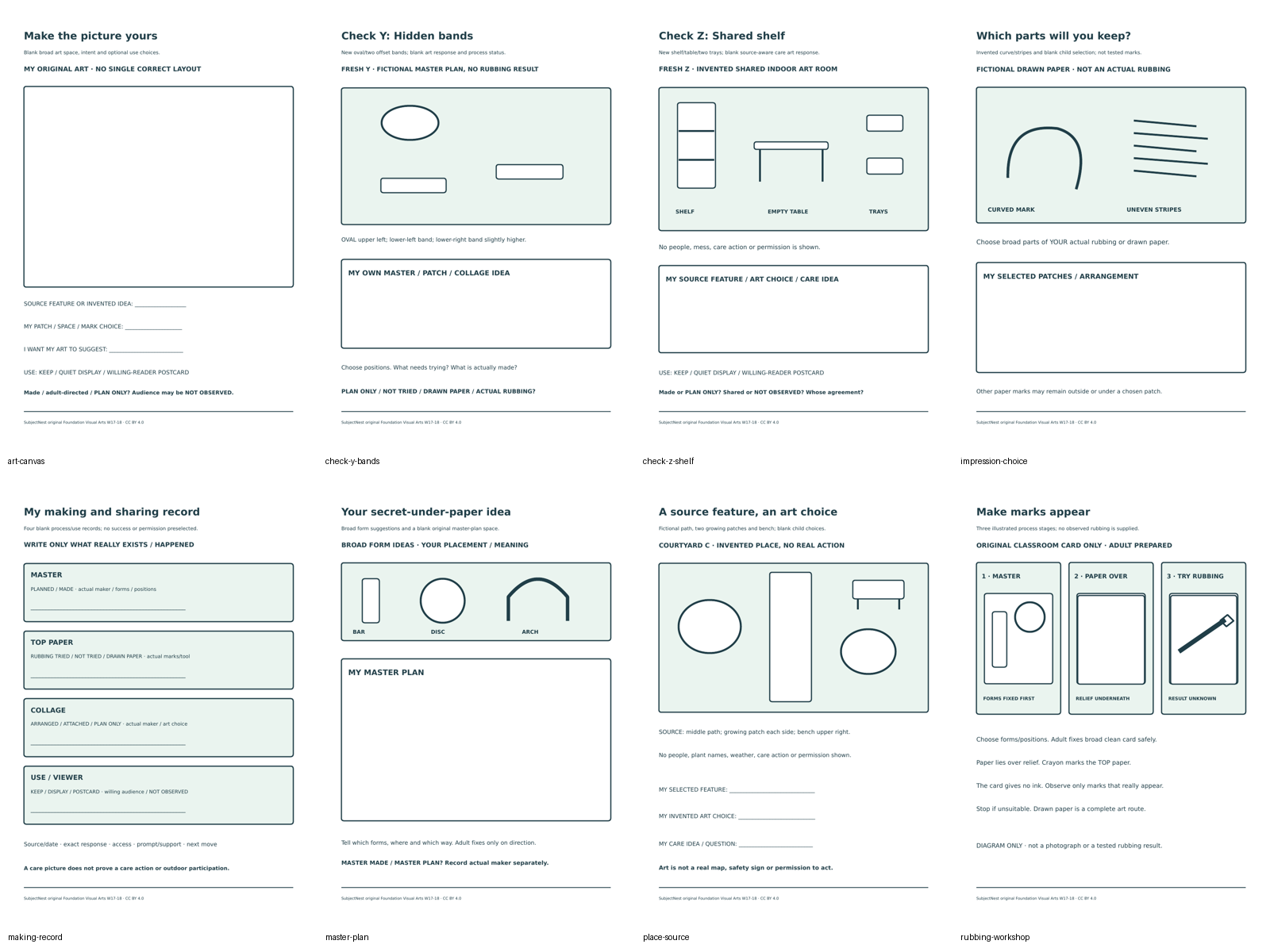
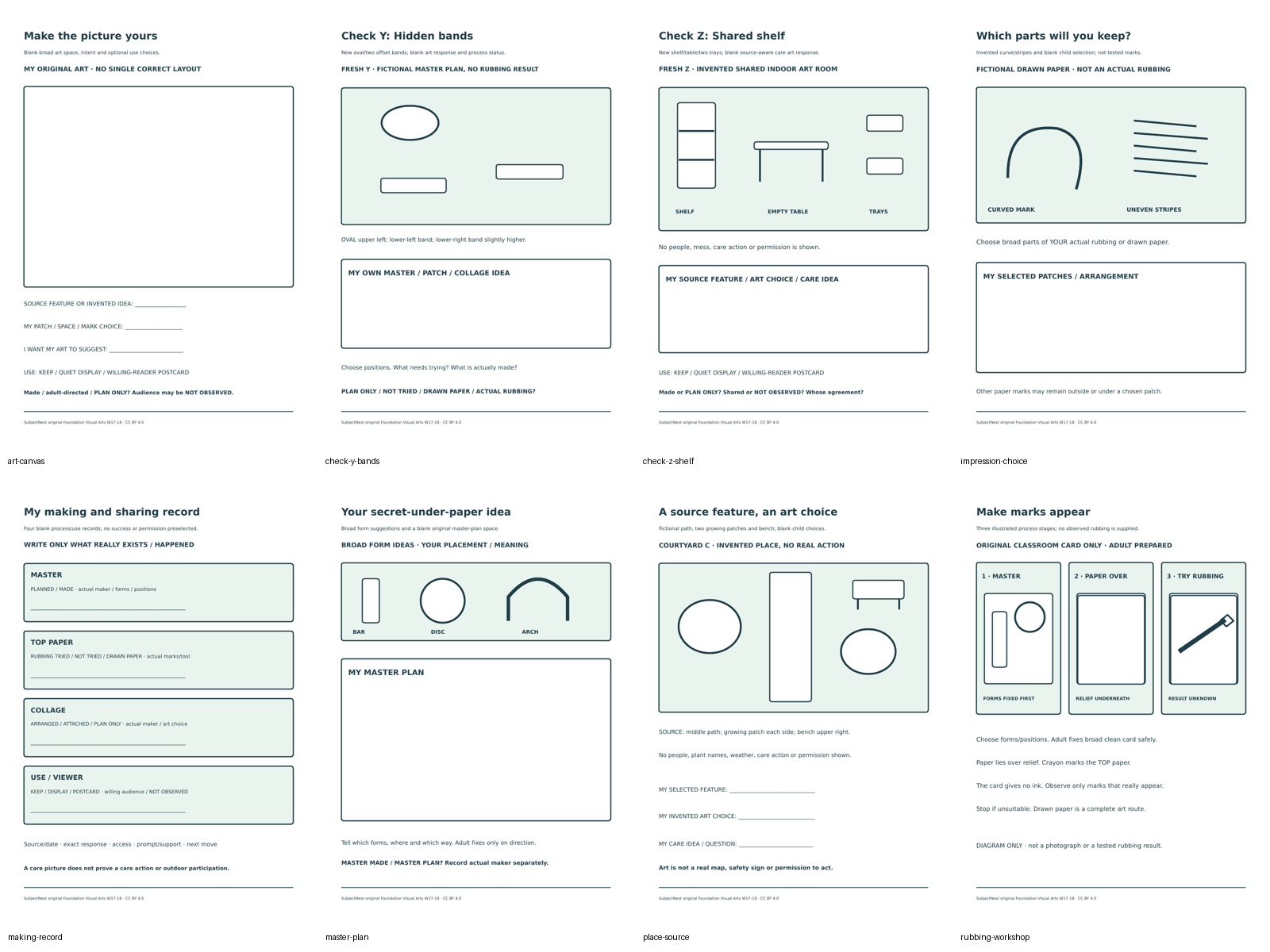
- Choose from eight A4 pairs and their complete alternatives, the print contact sheet · Download original PNG, or the offline collage planner and paper equivalent. A screen arrangement is a plan, not a rubbing or assembled paper work.
- Keep learner work and any actual place/audience record privately under school policy. Check local curriculum, materials, individual adjustments and consent before use.
The fortnight
| Week | Child makes/chooses | Integrated connection and boundary |
|---|---|---|
| 17 | Compose a master, try rubbing, choose actual marks, rearrange a small artwork. | What a picture shows: an impression can show some raised features; a missing mark does not establish that no feature exists. This VA process is distinct from the six-card Media Arts frame/data task. |
| 18 | Choose a feature and care idea, assemble care-themed art, choose keep/display/postcard, optionally invite a willing viewer. | Care for a shared place: use our fiction or a dated approved observation. Art is not proof of a care action, outdoor movement or local Country/Place learning. |
A child may invent a creature, landscape or pattern in Week 17; no adult assigns universal meaning to their marks. Week 18's care theme does not make the artwork a functional safety sign or permission to alter a place. A real recipient can decline; choosing a private work remains valid art making.
Evidence and rights
Exact crosswalk, source/rights, source snapshot, fresh fetch receipts, authentic encounter/local gate, desk critique and exact QA, read-only verifier, and version/SHA manifest describe the authored evidence. This is author desk checked development material, not independently educator reviewed, child tested or an accessibility pilot. Human review and actual use remain open.
© NeuroForgeIO Pty Ltd 2026. Original educational text, vector illustrations and educational browser artwork are CC BY 4.0: credit SubjectNest by NeuroForgeIO Pty Ltd, link this source and licence, and indicate changes. Curriculum text, fonts, community-held knowledge and authorised outside works retain their own rights. Generator/verifier/browser code: Apache 2.0. No third-party art or child data is included.