Use practice Texts P–U, the clean learner page, daily routes, optional extras and the worked key. Each script is 2 + 4 + 5 + 7 + 4 + 3 = 25 minutes. The seven-minute product is an initial sample, with additional composition time as locally needed. Days 25/30 use new public formative cards, not QCAA instruments. Source labels are part of the teaching: every named club, person and place is fictional.
Day 21 · One final point, one whole match
Target: analyse what Text P's headline foregrounds and what the 4–3 result cannot attribute. Prepare: P and the foreground strip.
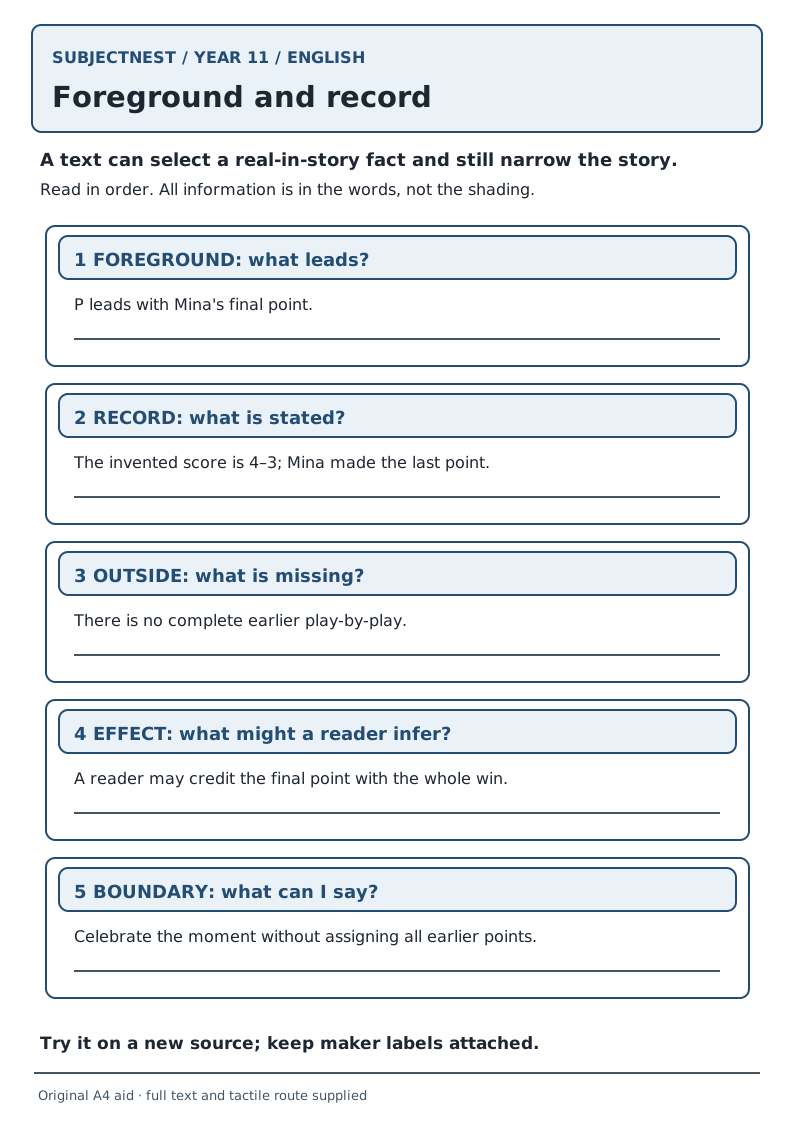
- Launch · 2 min. Show “Mina wins it” without the body. Ask what kind of story a reader expects.
- Model · 4 min. Read P with maker label. Mark the exact result and final-point fact, then underline the absence of a full play-by-play. Model “Mina scored the last point” as supported; “Mina scored all four” is not.
- Guided reading · 5 min. Test three claims: last point, all Comets points, biggest contribution. Ask which is stated and which needs absent evidence. Discuss how present-tense headline compresses the match.
- Practice route · 7 min. Choose Day 21 route. Produce a two-sentence editor note naming the selected hero frame, one exact fact and one unknown.
- Peer audit · 4 min. Partner finds the warrant for each verb; writer revises an attribution if unsupported.
- Exit · 3 min. “Does 4–3 tell us who made every earlier point?” Collect
no + source reason.
Day 22 · A score sheet cannot hold everything
Target: analyse Text Q's torn-paper image and close-third-person focus while distinguishing fictional Jo from a match witness. Prepare: Q and sequence windows.
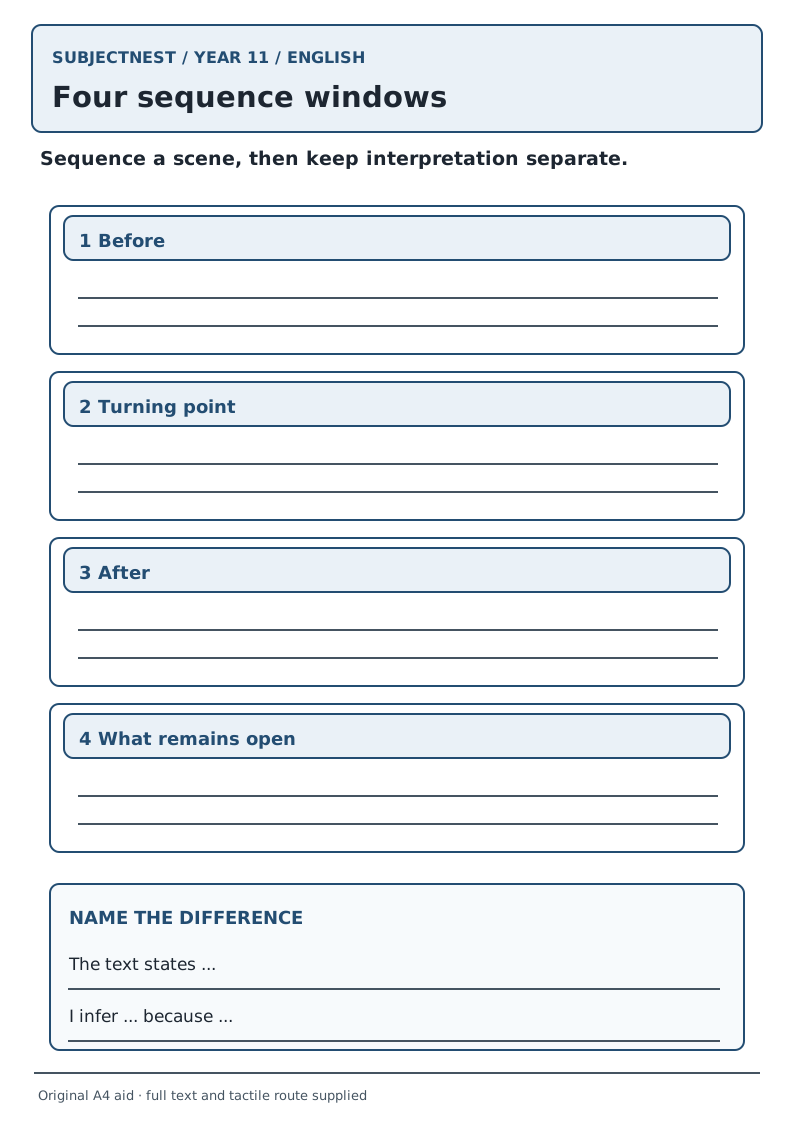
- Launch · 2 min. Ask what a score sheet can record well and what it may omit; invite source-based guesses only.
- Model · 4 min. Read Q. Point to “small moon” as an image of the torn sheet; it is not a real astronomical claim or a hidden statistic.
- Guided reading · 5 min. Sequence 3–3, Mina's last shot, 4–3 and Jo's reflection. Identify two actions the page “could not hold.” Name the fictional narrator's limited focus.
- Practice route · 7 min. Choose Day 22 route. Explain one image or structural shift, its possible effect and one claim the scene cannot prove about the real match.
- Peer audit · 4 min. Partner checks whether the sentence calls Jo an interviewee or treats the net-straightener as a documented player contribution.
- Exit · 3 min. “Why leave the hole in the last sentence?” Accept a bounded interpretation about incomplete recording; reject any claim it proves a real error in scoring.
Day 23 · Report, scene, editor note
Target: synthesise P/Q/R by provenance and purpose, not by treating one text as a correction to all facts. Prepare: three labelled strips and foreground strip.
- Launch · 2 min. Put P's headline, Q's final line and R's “no complete sequence” together. Ask who wrote each.
- Model · 4 min. Place P as fictional published brief, Q as SubjectNest fiction and R as fictional internal evidence note. Only P/R specify the stipulated result; Q imagines a perspective.
- Guided reading · 5 min. Trace a safe chain: known final point → chosen headline → reader's possible impression → R's warning. Do not use Q to fill an absent match log.
- Practice route · 7 min. Choose Day 23 route. Make a three-source note with one detail and purpose per source, plus a claim that remains unknowable.
- Peer audit · 4 min. Peer marks each source label and checks whether a fictional image has become a factual statistic.
- Exit · 3 min. “Which source explicitly says we lack earlier play-by-play?” Key: P and R, with R directing editorial caution.
Day 24 · Revise without erasing the celebration
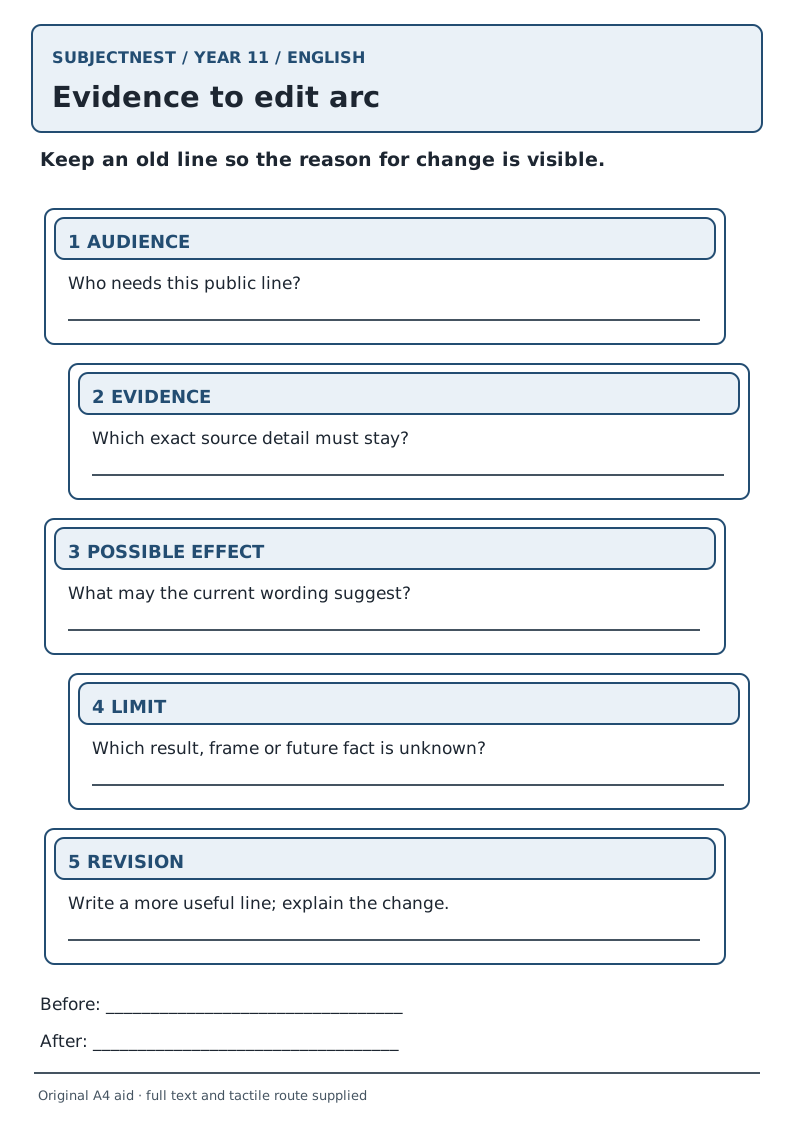
Target: write a public match line that preserves the result and final point without awarding unrecorded sole credit. Prepare: P/R and editor arc.
- Launch · 2 min. Compare “Mina scored the final point” with “Mina alone won every point.” Ask which could be printed from P.
- Model · 4 min. Draft a candidate headline: “Mina's final point closes a 4–3 Comets win.” Explain the possessive and why it celebrates a moment without claiming the whole match belonged to one person.
- Guided reading · 5 min. Test two subheads: “Seven points, many possible contributors” versus “Every player helped equally.” Only the first can be framed cautiously; the second invents distribution.
- Practice route · 7 min. Choose Day 24 route. Write a headline and 70–100-word public note with exact score, final point, a reason to avoid sole-credit language and one missing evidence question. Save an earlier line and revision.
- Peer audit · 4 min. Reader checks that a public supporter could understand the result without being told a fictional scene was an interview.
- Exit · 3 min. State one change and its warrant in P/R. Use the key to determine if attribution needs reteaching.
Day 25 · New-case check A: a game demo
Target: apply foregrounding and attribution to fresh Texts V–W. Both prompt and key are public. Prepare: card not previously used in this sequence.
- Launch · 2 min. State audience: a fictional game-demo newsletter editor. Avoid suggesting a preferred headline.
- Source access · 4 min. Release V/W with labels and log any reading support; do not give the answer key.
- Independent plan · 5 min. Learner selects one exact detail per text, the report's chosen focus, a stylistic effect and a source limit.
- Independent response · 7 min. Choose Day 25 route. Capture a first 90–130-word/equivalent editor note with a justified replacement line.
- Self-audit · 4 min. Learner checks attribution,
only/everyclaims and whether the literary scene is mistaken for an interview. - Submit · 3 min. Collect first response and mode/support log. Use the public worked key for a specific next move.
Day 26 · When a metaphor meets a count
Target: compare Text S's “green wall” with its ten-planter observation without treating the metaphor as a measured conclusion. Prepare: S and foreground strip.
- Launch · 2 min. Read S's title alone. Ask what the image suggests before showing the count.
- Model · 4 min. Read the complete bulletin and sort six with shoots, four without visible shoots at day seven, later outcome unknown. A 6/10 observation does not certify a literal wall.
- Guided reading · 5 min. Ask whether “green wall” can be an expressive headline even if not all planters show shoots. Discuss how including the four changes a reader's picture without proving why they differ.
- Practice route · 7 min. Choose Day 26 route. Explain the metaphor's likely effect, the exact observation and one future unknown in two to four sentences or equivalent.
- Peer audit · 4 min. Partner locates the day-seven qualifier and rejects “the four failed forever” or “the six will grow into food.”
- Exit · 3 min. “What did the group actually see at the seven-day check?” Key: six visible shoots, four not yet visible.
Day 27 · A poem can leave a question open
Target: interpret Text T's comma/full-stop imagery and line ending as a literary response, not garden data. Prepare: T and sequence windows.
- Launch · 2 min. Show “Six small green commas.” Ask what a comma usually does in a sentence.
- Model · 4 min. Read T twice with natural pauses. Contrast comma/open continuation with full stop/possible ending; note the poem's “I want” belongs to an invented speaker.
- Guided reading · 5 min. Pair T's six/four with S's observation but ask what the poem does differently: it creates a feeling of unfinishedness through punctuation images and line breaks.
- Practice route · 7 min. Choose Day 27 route. Make one interpretation supported by two exact poem details and say what the poem cannot predict.
- Peer audit · 4 min. Partner tests whether the interpretation permits another reading; avoid treating “dark full stops” as botanical proof.
- Exit · 3 min. “Why does morning leave the page open?” Accept a source-backed reading about uncertain later growth, not a scientific forecast.
Day 28 · The crop is a choice
Target: evaluate Text U's described close crop and two captions using S's full count. Prepare: S/U and foreground strip. No unprovided photograph is required.
- Launch · 2 min. Read U's complete image description before either caption. Ask what is inside versus outside the frame.
- Model · 4 min. Caption 1's “whole story” exceeds a crop showing six of ten planters. Caption 2 names the four outside and keeps the day-seven limit.
- Guided reading · 5 min. Ask whether a close crop is always dishonest (no); it becomes misleading when the caption claims completeness. Separate framing choice from certainty about intention.
- Practice route · 7 min. Choose Day 28 route. Write a 35–55-word accessible caption/transcript describing what is shown, what is outside frame and what remains unknown.
- Peer audit · 4 min. Reader with no image checks whether the text alone explains the ten-planter situation; revise any visual-only instruction.
- Exit · 3 min. “Which word in Caption 1 causes the clearest overclaim?” Key: “whole.”
Day 29 · A public review with both record and image
Target: write and visibly revise a short public reflection comparing S and T/U without flattening poem into data. Prepare: S/T/U and editor arc.
- Launch · 2 min. Set audience as an imagined garden newsletter reader who has not seen the sources.
- Model · 4 min. Offer a plan, not a full model: bounded count → selected metaphor/image → possible effect → missing future evidence → useful caption/question.
- Guided reading · 5 min. Test “The poem proves four planters will stay bare” against T's final line; model a narrower interpretation.
- Practice route · 7 min. Choose Day 29 route. Draft 120–160 words or an equivalent complete public transcript with one S fact, one T detail, one U framing point and a question. Keep before/after sentence.
- Peer audit · 4 min. Partner identifies a source-backed comparison and one line where the poem/data boundary could be clearer; learner revises and names the effect.
- Exit · 3 min. Submit draft, revision reason and support log. Offer more time for a finished version; speed is not the construct.
Day 30 · New-case check B: a travelling book cart
Target: transfer count, image and individual voice to fresh Texts X–Y. Prepare: new card and neutral paper/aids only; key public.
- Launch · 2 min. Set fictional local-news editor audience and 90–130-word/equivalent task; withhold preferred interpretation.
- Source access · 4 min. Release X/Y, including full text description; log read-aloud/access support.
- Independent plan · 5 min. Learner notes maker/purpose, exact count or route detail, one literary choice, an omitted/unknown fact and possible audience effect.
- Independent response · 7 min. Choose Day 30 route. Capture source-linked first response and a more careful public line.
- Self-audit · 4 min. Check that one fictional speaker is not a survey and a photograph does not prove unseen streets.
- Submit · 3 min. Collect response and support log; use the public key for feedback, not a QCAA grade.
SubjectNest original scripts © NeuroForgeIO Pty Ltd 2026, CC BY 4.0.