ERAIS / exact software execution
Doom, recompiled into neural computation.
This is not a controller playing Doom. The game's computational execution is the experiment. A qualified build runs through ERAIS-derived computation, restores from one portable capsule, and reproduces the reference frame byte-for-byte.
What is different here
The game itself is the neural workload.
The earlier Doom AI experiment asks how a controller plays the game. Neural Doom asks a different question: can the game's own computation be represented through qualified ERAIS circuits and still produce the same pixels and audio?
The build covers game logic, renderer, video conversion, sound, music and integer softfloat. The qualification compares its output with the native reference at named game tics, across maps, monsters, menus, save/load and audio.
Two different demonstrations
| Doom AI | Experimental controllers play the game. |
|---|---|
| Neural Doom | The game's computation runs through ERAIS-derived execution. |
| Shared evidence | Neither claim substitutes for the other. |
Exactness / the frame is the oracle
Same output, not a similar-looking result.
The tic-100 frame is compared as raw bytes. A single difference is a failure. This is the same frame used by the Windows and capsule receipts.
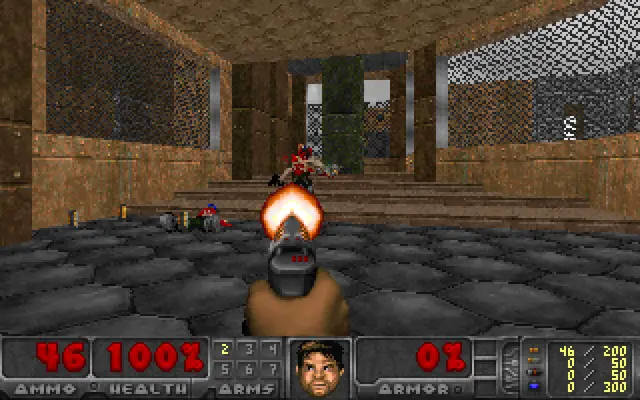
b145dd81258fc1a7c5f2ebd49b3a27ae063b2d63e0be5c8a0b1038ebdedbc9b4The frame is 1,024,000 bytes of 640×400 RGBA. The expected and actual SHA-256 values are identical.
Exactness receipt
| Frame tic | 100 |
|---|---|
| Framebuffer bytes | 1,024,000 |
| Frame match | exact |
| WAD reconstructed | yes |
| WAD SHA-256 verified | yes |
| Restored executable dependencies | none |
The framebuffer is not a screenshot comparison. The harness writes the game's own buffer and hashes it after the qualified tic.
Portable capsule / separate machine
One artifact carried the program and its data.
The capsule is not a folder of build outputs. It carries the verified object cache and the int8 asset bank. A standalone restorer checks every object, reconstructs the WAD, verifies CRC32 and SHA-256, links the program and runs the exact frame.
- 01Start with two files
Only the 11.09 MB capsule and the standalone restorer were present in the clean working directory.
- 02Verify before executing
Every program object is hashed. The manifest object set must match exactly; extras and missing objects fail.
- 03Reconstruct the data
The 7,031-page bank decodes to the 28,795,076-byte Freedoom WAD. CRC32 and SHA-256 must agree.
- 04Link, run and compare
The restorer links the object cache, executes the game and checks the tic-100 frame.
Restore record
| Capsule | 11,093,317 bytes |
|---|---|
| Objects | 93 |
| Restore time | 1.63 s |
| Restored executable | 653,432 bytes |
| Dynamic dependencies | none |
| Network used | no |
The restored executable was 653,432 bytes and reported no DT_NEEDED entries.
This is a verified object-cache capsule with a DoomGeneric create/tick ABI. It is a real restoration milestone, not a universal IR or bytecode capsule.
Win32 frontend / Wine-qualified
A visible window, keyboard input and audio.
The Windows build uses a native GDI window and a waveOut sink. Under Wine it opened a 640×400 window, accepted Escape, opened the audio device and produced the same exact frame.
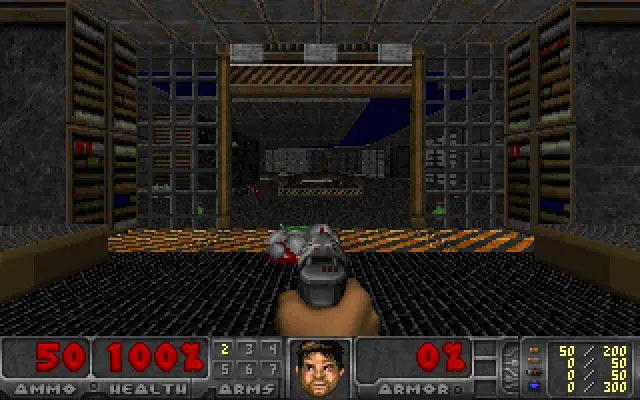
d0b5e699a38e1982cac07615c34e613fe0d3c48ed69ebbfe12d0002efe86230cCaptured from the paced 640×400 window. The game frame itself is the exact tic-100 reference.
Run record
| Host | AMD Ryzen 5 5500 |
|---|---|
| Runtime | wine-9.0 on Ubuntu 24.04.5 LTS |
| Window | 640x400 |
| Pacing | 70 tics / 2.011 s |
| Rate | 34.81 tics/s |
| Audio | open, 72 blocks |
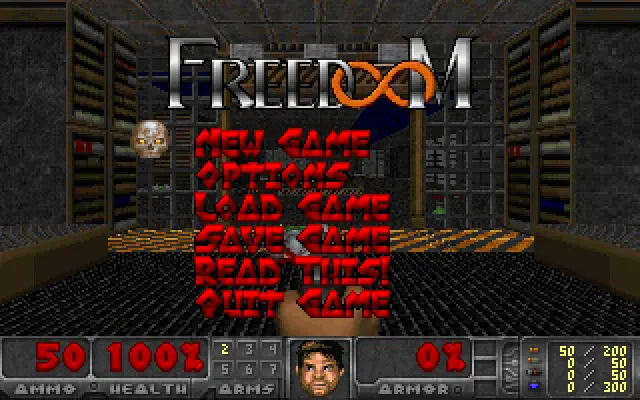
| Input | Escape opened the Freedoom menu |
Wine-qualified, not a native Windows kernel test. Native Windows hardware remains a separate qualification target.
Performance / same workload
Faster in the recorded Phase 1 comparison.
The qualified ERAIS build measured 0.224ms/tick against 0.251 ms/tick for the matched native C reference.
Interleaved Phase 1 qualification on the recorded host; not a universal performance claim.
| Implementation | Median |
|---|---|
| ERAIS Phase 1 AOT | 0.224 ms/tick |
| Matched native C | 0.251 ms/tick |
This is not a universal speed claim. The workload, host and qualification profile are part of the result.
Claims and limitations
What this establishes.
- verified
The qualified build reproduced the tic-100 framebuffer byte-for-byte.
ND-EXACT-FRAME - verified
One 11.09 MB object-cache capsule restored the program and asset bank on a separate machine in 1.63 s.
ND-CAPSULE - wine qualified
A visible Win32 GDI window and waveOut sink ran 70 tics in 2.011 s under Wine.
ND-WINDOWS - limitation
This is a verified object-cache capsule with a DoomGeneric ABI, not a universal IR or bytecode format.
ND-SCOPE
Known boundaries
- The capsule is a Doom-specific verified object cache, not a universal program format.
- The Windows frontend is Wine-qualified; native Windows hardware is not independently qualified.
- The capsule and executable derive from GPL-2.0 DoomGeneric; public binary distribution requires a compliance route.
- The phase-1 performance comparison is workload-specific and does not establish a universal speed advantage.