Each block is 25 minutes. Use the reproducible teacher sets, clean learner cards, and original picture-data or paper-route aid. Hold back Days 125/130 checks. Record first child-controlled sort, comparison, placement, relation and reason before correction, with exact source of data and support. Adult reading of labels is allowed; do not turn mathematics into a print test.
Week 25 · Day 121 — Ask a question before sorting
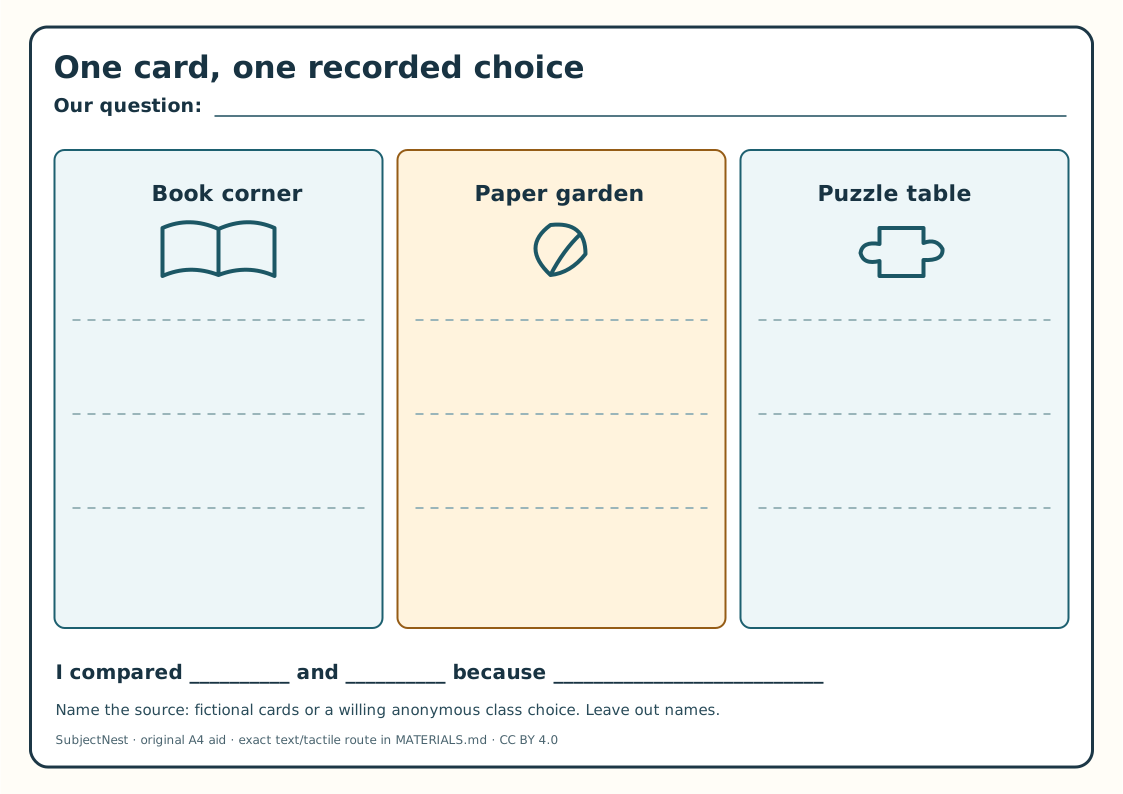
Goal: collect and sort image cards for a given familiar story-setting question. Proposed code: AC9MFST01. Prepare: Card 121, seven mixed fictional Set A cards, empty labelled mat.
- Question · 3 min. Say “Which picture setting did these imaginary storytellers choose?” Explain one card represents one fictional recorded choice.
- Model · 4 min. Place B1 under BOOK CORNER because of its open-book image, not because of card colour or suffix.
- Guide · 5 min. Children sort G1 and P1, naming each picture feature; adult reads setting labels if needed.
- Independent collect/sort · 7 min. Child takes remaining mixed cards and completes three groups. Record first placement, any extra/omitted card and their group rule.
- Check · 4 min. Ask if these seven cards show what our real classmates chose. Expect no; the set is invented and only answers the stated pretend question.
- Exit · 2 min. Child shows one card in each group and names why. If a card sits in two groups, retest one-to-one placement tomorrow.
Week 25 · Day 122 — Show and compare the responses
Goal: represent one fictional choice with one image/object token and compare groups by matching/counting. Proposed code: AC9MFST01. Prepare: Card 122, Set A already mixed again and data mat.
- Retrieve · 3 min. Repeat the question; child picks one card and says what it represents.
- Model · 4 min. Align book and garden tokens in rows; match pairs to see whether one group has an extra card.
- Guide · 5 min. Children rebuild all three groups, placing each image exactly once; compare garden with puzzle by matched pairs.
- Independent compare · 7 min. Child names a group with more, fewer or same and points to matched/unmatched tokens or counts, not just a tall stack's height.
- Check · 4 min. Spread book cards farther apart without changing their number; ask whether that makes more choices. Expect no; one card remains one choice.
- Exit · 2 min. Child explains one comparison. If spacing drives answer, pair tokens in a new arrangement tomorrow.
Week 25 · Day 123 — A changed set may change the answer
Goal: collect/sort a revised fictional dataset and compare it with the original without rewriting the source. Proposed code: AC9MFST01. Prepare: Card 123, original Set A and Set B change from Materials; two labelled mats.
- Retrieve · 3 min. Child states which group had most in yesterday's unchanged set, using cards for evidence.
- Model · 4 min. Announce a new trial: replace one book card with one garden card. Keep old display as the earlier record.
- Guide · 5 min. Children physically re-sort the new seven-card set and align matching pairs; no unseen card is silently added.
- Independent comparison · 7 min. Child says what count relation changed, which group now has most, and which two groups match, with one-card-per-choice reason.
- Source check · 4 min. Ask “Did the first seven imaginary choosers change their minds?” Expect the story does not say that; the displayed dataset changed for a new trial.
- Exit · 2 min. Child points to one old/new difference. If all differences are missed, use two-category three-card contrast tomorrow.
Week 25 · Day 124 — What can the display tell us?
Goal: state a question and source, build a one-image-per-response display, and make only supported comparisons. Proposed code: AC9MFST01. Prepare: Card 124; optional anonymous class choice with local consent, otherwise fictional motif Set C in Materials.
- Question · 3 min. Say the chosen question before any token is placed; name whether respondents are actual willing classmates or invented characters.
- Model · 4 min. Show one large icon token = one recorded choice; no name or private reason is attached.
- Guide · 5 min. Collect cards by the agreed private/fictional route and sort dot/stripe/star or local suitable categories.
- Independent display · 7 min. Child places each card once, compares any two groups by matching/counting and states exactly which displayed group has more or is equal.
- Boundary check · 4 min. Ask what the display cannot tell: why someone chose it, absent classmates' preferences or “everyone likes X.”
- Exit · 2 min. Child gives one bounded data sentence. If source is confused, label the dataset in large print and recheck a different set before fresh Day 125.
Week 25 · Day 125 — Fresh picture-data check
Goal: collect, sort, represent and compare a new image dataset for a stated story-place question. Proposed code: AC9MFST01. Prepare: unseen nine-card set, Card 125, empty group spaces and private record.
- Welcome · 3 min. Say the nine cards describe imaginary storytellers and help choose the next practice, not a ranking of real children.
- Question · 4 min. State the exact new question and read category labels if needed; do not reveal group sizes.
- Collect · 5 min. Child takes all mixed cards, with access adjustments logged, and begins grouping without a teacher placement cue.
- Independent sort/compare · 7 min. Child completes groups, identifies most/fewest and compares two named groups with visible card evidence. Save first response.
- Source check · 4 min. Ask one-card meaning and what the set cannot say about the actual class; show key only after first record.
- Close · 2 min. Choose a next step from Assessment: category feature, one-to-one, match/count, source boundary or smaller fresh diagnostic.
Week 26 · Day 126 — Where, relative to what?
Goal: describe a symbol's location with a named reference on an agreed paper orientation. Proposed code: AC9MFSP02. Prepare: Card 126, fixed map, large visitor token.
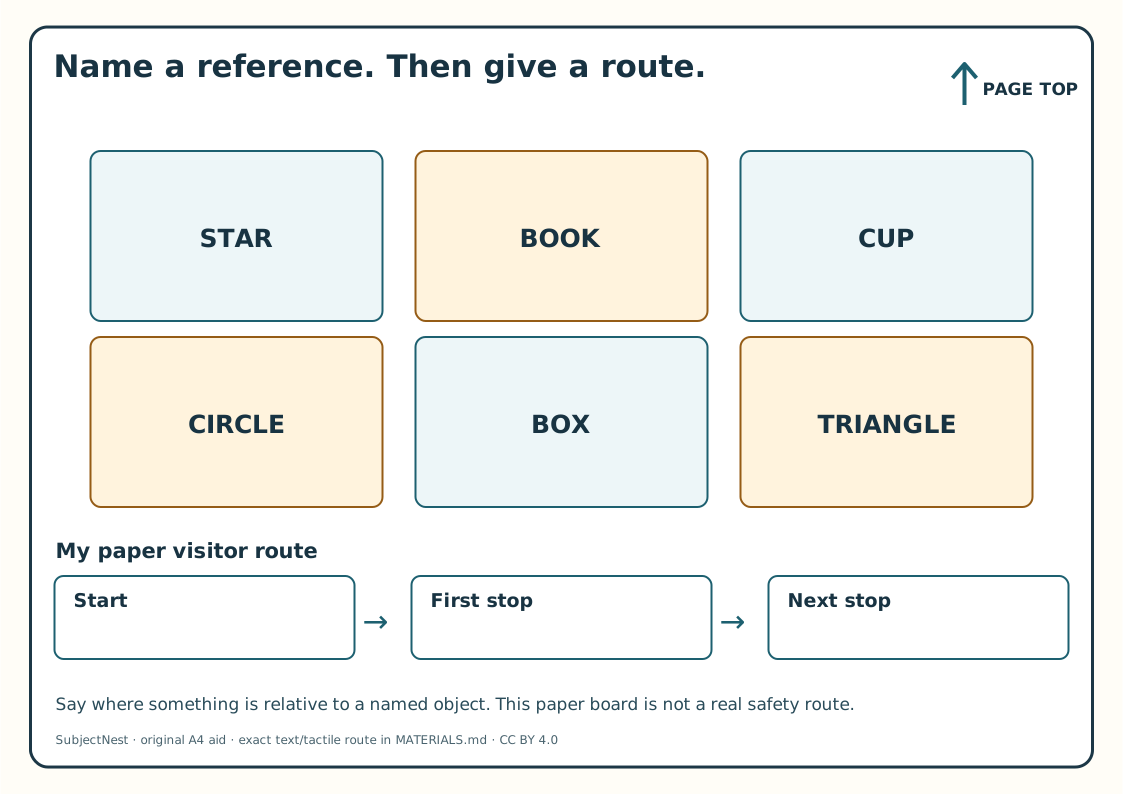
- Orient · 3 min. Name PAGE TOP and identify STAR, BOOK, CUP on this paper board; it is not a real travel route.
- Model · 4 min. Say “BOOK is right of STAR” and “BOOK is left of CUP,” tracing the reference pair each time.
- Guide · 5 min. Ask where BOX is relative to BOOK; children check the row/column path before saying “below BOOK.”
- Independent relation · 7 min. Give a new symbol/reference pair on the fixed map; child gives/places a true relation with both objects named and a reason tied to layout.
- Change viewpoint · 4 min. Turn a loose copy or rotate the learner's view by agreement. Ask whether “right” can be used without restating page top; reorient and retest.
- Exit · 2 min. Child finishes “relative to ___.” If a relation has no reference, practise one pair tomorrow.
Week 26 · Day 127 — A route has two connected legs
Goal: follow and communicate start → first stop → next stop on a labelled paper map. Proposed code: AC9MFSP02. Prepare: Card 127, fixed map, moveable visitor, Start/First/Next cards.
- Retrieve · 3 min. Child names BOOK relative to STAR with agreed page top.
- Model · 4 min. Move STAR → BOOK, pause, then BOOK → BOX. Say the first stop is also the second leg's start.
- Guide · 5 min. Children place a visitor at CUP and follow CUP → BOOK → STAR, naming each stop before moving.
- Independent route · 7 min. Child chooses a different start, first and next, directs a listener to move a visitor and names final location relative to a supplied symbol. Record first endpoint/words.
- Listener check · 4 min. Partner/adult follows only the given words. Child revises a missing reference or order, saving both versions.
- Exit · 2 min. Ask what object served as first stop. If both legs collapse into one jump, rehearse pause at a new middle object tomorrow.
Week 26 · Day 128 — When a symbol moves
Goal: update a position sentence after a named paper symbol changes place. Proposed code: AC9MFSP02. Prepare: Card 128, loose practice symbols, unchanged printed map for comparison.
- Retrieve · 3 min. Child states BOX's old location below BOOK on the original map.
- Model · 4 min. Move BOX to bottom-right and TRIANGLE to bottom-middle on a loose grid; announce both changes, not a silent map edit.
- Guide · 5 min. Children check which symbol is now below BOOK and whether “BOX below BOOK” is still true.
- Independent revision · 7 min. Child gives a corrected BOX relation with a named reference and a new two-leg paper route to BOX. Listener tests the route before help.
- Compare · 4 min. Place original and changed map side by side; child names which exact placement changed their sentence. Do not infer a real room moved.
- Exit · 2 min. Child says one new true relation. If old layout dominates, cover the original and use three large tactile positions tomorrow.
Week 26 · Day 129 — Let someone else follow
Goal: design and test a two-leg paper route with a stated viewpoint and reference; optionally transfer to a safe familiar-space relation. Proposed code: AC9MFSP02. Prepare: Card 129, blank/loose map and locally approved optional classroom setup.
- Orient · 3 min. Agree page top and name all loose symbols. A real-space option occurs only in a pre-approved bounded area.
- Model · 4 min. Adult gives an ambiguous “move it there,” lets listener ask “from where?”, then revises with named start and stop.
- Guide · 5 min. Children plan a start, first and next stop using three large symbols; they may point, sign or direct placement.
- Independent route · 7 min. Child gives route to chosen listener; listener follows literally. Save first wording and endpoint before any correction.
- Transfer/check · 4 min. Child revises the paper route or, if safe and freely chosen, describes their position relative to a named classroom object/person. Record paper and real-space evidence separately.
- Exit · 2 min. Child explains one named reference that helped. No real classroom map, address or safety route is published.
Week 26 · Day 130 — Fresh position check
Goal: follow an unseen two-leg paper route and describe a final relative position under a stated orientation. Proposed code: AC9MFSP02. Prepare: new map/key, Card 130, large/tactile symbols and private record.
- Welcome · 3 min. Say the new paper map helps the teacher choose a route activity; it is not a race or real navigation.
- Orient · 4 min. State PAGE TOP and read symbol labels without tracing the route or hinting endpoint.
- Listen · 5 min. Read two connected directions once, repeat if the access route requires and log the repeat.
- Independent route · 7 min. Child moves/directs first and next legs, names final object and gives two reference-rich relations. Save first endpoint/words.
- Check · 4 min. Ask how the child checked page top and whether silent rotation affects direction words; compare with key only after first record.
- Close · 2 min. Choose exact next move: one leg, named reference, page orientation, listener test or accessible real-space relation. Paper success alone does not establish the full code.
Use the Week 25 integrated guide and Week 26 integrated guide after the fresh subject checks on Days 125 and 130. Keep maths data and position evidence separate from English/arts/HPE outcomes.